
TL;DR
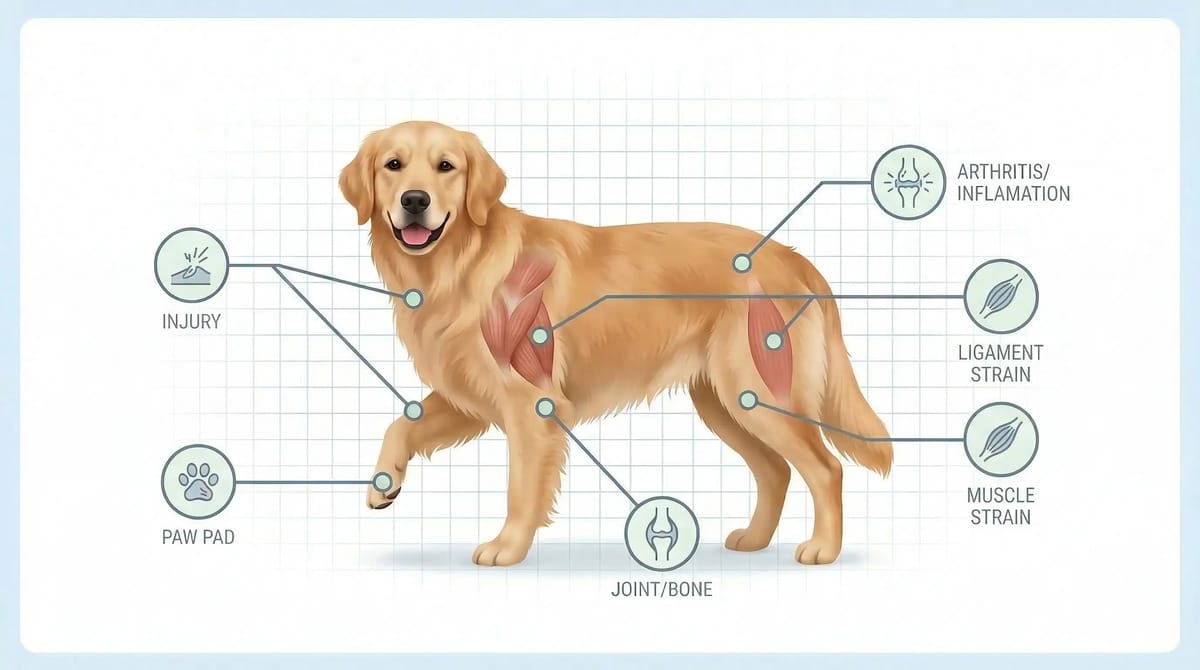
A common question many owners ask is why is my dog limping. A dog limping can happen for several reasons. It may come from a paw injury, muscle strain, joint problems, or other health issues. Sometimes lameness in dogs appears suddenly after running, rough play, or a small accident.
Some dogs limp but do not cry. This can make the problem hard to notice. A dog may still be limping but not in pain, or may hide discomfort. Dogs often try to protect the affected limb, even when the dog is limping but not crying.
Certain warning signs need fast veterinary attention. A dog that cannot bear weight, shows severe swelling, has an irregular angle, or a dangling limb may need urgent veterinary care. These signs can mean the dog may have a serious injury.
Veterinarians usually start with a physical exam. They may check the paw, joints, and the affected limb. In some cases, tests such as blood work or tick testing may help identify the underlying cause of the limp.
If you want a complete understanding of joint pain and mobility issues, read our full guide on dog joint pain.
Table of Contents
Quick Answer Box
Why is my dog limping?
A dog limping can happen because of a paw injury, muscle strain, torn ligament, joint problem, or another health issue. Sometimes lameness in dogs appears after running, rough play, or a small accident.
Is limp without crying still serious?
Yes. Some dogs hide pain well. A dog may be limping but not crying or limping but not in pain, while still protecting the affected limb.
When should a vet be called?
Veterinary care may be needed if the dog:
- cannot bear weight on a leg
- shows visible swelling or severe pain
- has an irregular angle or dangling limb
- keeps limping for more than a day
These signs may suggest a more serious injury.
Can back leg limping mean joint trouble?
Yes. A dog limping on the back leg can sometimes be linked to hip, knee, or ligament problems. Conditions such as hip dysplasia or luxating patella may affect the joints and lead to limping.
Why Dogs Limp?
Why is my dog limping?
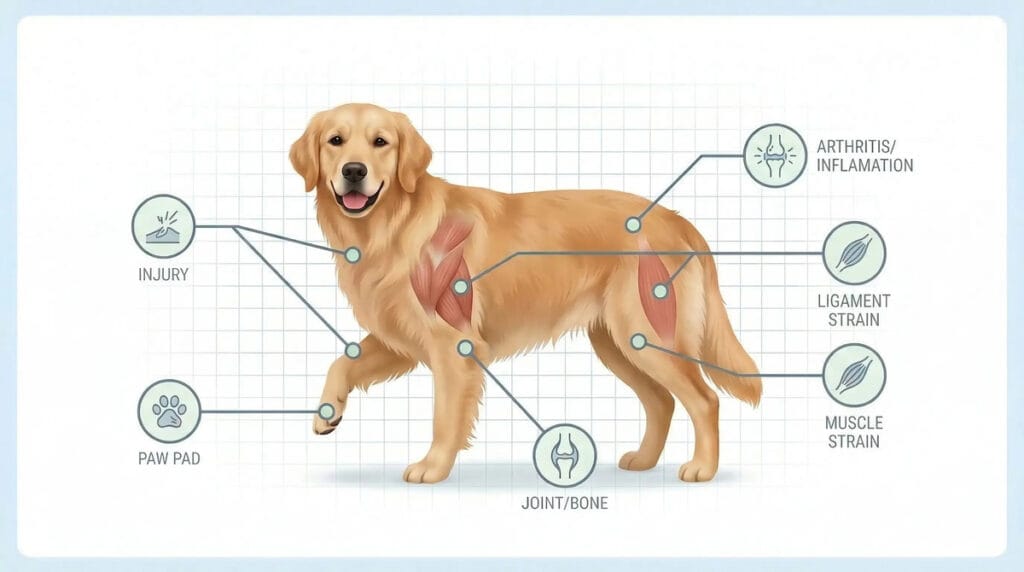
A dog may limp because of a paw injury, muscle strain, joint problem, ligament damage, arthritis, or infection. Limping in dogs is a sign that the dog is protecting a painful or irritated limb.
A limp is a sign, not a diagnosis
When a dog is limping, it usually means something is affecting the leg, paw, or joint. A limp is only a visible sign of a problem. The real reason can vary from a small paw issue to joint stress or injury.
In many cases, lameness in dogs starts when the body tries to protect an affected limb. The cause often follows a simple pattern:
minor injury → inflammation → pain → limping
If your dog started limping suddenly without warning, it may also happen after routine vaccinations—learn more about dog limping after a vaccine and what it means. This guide explains the possible causes and what to do next.
Finding the underlying cause is important. A veterinarian can examine the dog and decide what may be affecting the limb or joint.
Why some dogs limp but act normal
Some dogs continue normal behavior even when a limping dog has discomfort. Animals often hide weakness because it is part of natural survival behavior.
This is why a dog limping but acting normal can still have a problem. The dog may still run, play, or eat normally while protecting one leg.
Owners may notice small changes instead, such as:
- favoring one leg
- slower movement
- avoiding pressure on one paw
- a dog that limps when walking but not running
Watching these small signs helps detect problems earlier.
Why some dogs limp but do not cry
Many owners worry when my dog is limping but not crying. Lack of crying does not always mean the dog feels no pain.
Dogs experience discomfort differently. Some dogs stay quiet even when the dog’s pain is present. A dog may simply shift weight away from the sore limb.
Signs that discomfort may still exist include:
- dog not putting weight on back leg
- dog limping but not whining
- trembling or licking a paw
- holding one leg slightly off the ground
If a dog starts limping out of nowhere or the limp lasts more than a day, a vet should check the dog to identify the cause.
Common Causes of Dog Limping
| Possible Cause | Typical Signs |
| Paw injury | Dog licking paw, limping on one leg |
| Muscle strain | Limp after running or jumping |
| Torn ligament | Dog not putting weight on back leg |
| Hip dysplasia | Stiffness, back leg limping |
| Luxating patella | Sudden skipping step while walking |
| Arthritis | Limp after rest or when getting up |
| Tick-borne disease | Limping with fever or tiredness |
Paw and foot problems
Paw injuries are a common reason for dog limping. Small problems on the paw can make a dog avoid pressure on one leg. Even a minor injury can make the dog protect the affected limb.
Common paw problems include:
- foreign objects such as thorns or small stones
- torn nails that cause pain when walking
- cuts on the paw pads
- a sore paw after rough ground or long walks
- a swollen paw caused by irritation or injury
When a dog has a paw problem, the dog may favor one leg or lick the paw often.
Muscle strains and minor soft tissue injuries
Dogs can strain muscles during active play. This may happen after running, jumping, or sudden movement.
Common causes include:
- rough play with other dogs
- slipping on smooth floors
- jumping off furniture
- sudden turns while running
The cause chain often looks like this:
overstretching muscle → inflammation → discomfort → limping
A dog limping after running or playing may sometimes have this type of strain.
Torn ligaments and joint injuries
Ligament injuries can affect how the joint moves. These injuries can cause a dog suddenly limping back leg or avoiding weight on one leg.
Possible problems include:
- torn ligaments in the knee joint
- joint instability
- a sudden back leg limp
Dogs with ligament problems may not put weight on the back leg or may hold the leg slightly raised.
Hip dysplasia and luxating patella
Some dogs limp because of joint structure problems. Two known examples are hip dysplasia and luxating patella.
These conditions affect how joints move. They may lead to discomfort, especially during activity.
These issues are:
- more common in larger breeds
- sometimes seen in active or growing dogs
- linked to joint instability over time
Joint problems can lead to this chain:
joint instability → joint irritation → inflammation → limping
Arthritis and joint wear
Joint wear can also cause lameness in dogs. Arthritis affects the joint surface and may lead to stiffness.
Dogs with joint problems may show:
- joint pain
- stiffness after rest
- a dog that limps when getting up but runs fine
Over time, the pattern may appear as:
joint damage → inflammation → pain → limping
Older dogs may show these signs more often.
Infections and tick-borne disease
Some infections can also affect a dog’s ability to walk normally. Lyme disease and other tick borne illnesses may sometimes lead to limping.
In these cases, the limp may appear along with other signs such as:
- tiredness
- fever
- swelling around joints
- shifting leg discomfort
If limping in dogs appears with other unusual symptoms, a veterinarian should evaluate the dog.
Dog Limping by Leg and Pattern
Dog limping on back leg
A dog limping on back leg can happen when the dog tries to protect the hind limb. Many owners notice back leg dog limping when the dog walks slower or avoids pressure.
Signs may include:
- dog not putting weight on back leg
- holding the leg slightly raised
- stiffness when standing up
Back leg limping can involve the hip, knee, or surrounding muscles. A veterinarian can examine the joint and identify the underlying cause if the limp continues.
Dog limping on front leg
A dog limping on front leg may look different from hind leg limping. The dog may shift body weight to the other front leg to reduce pressure.
Owners may notice:
- a dog front leg limp when walking
- shorter steps on the affected side
- frequent licking of the paw or leg
Front leg problems sometimes start from paw injuries, joint irritation, or soft tissue strain.
Dog limping on one leg
Sometimes a dog suddenly begins limping on one leg. This often means the dog is protecting the affected limb.
Possible reasons include:
- paw irritation or injury
- minor joint stress
- muscle strain
Because dogs move quickly during play, a small problem can appear suddenly.
Dog limping after running, playing, or jumping
Some dogs may limp after running or active play. Sudden turns, jumps, or high-impact movement can place stress on muscles and joints. This often happens after activity, especially after impact from jumps—see dog limping after jumping.
This pattern may appear when:
- a dog runs hard during play
- the dog jumps off furniture
- the dog slips while moving fast
the typical chain can look like:
overuse → muscle irritation → inflammation → limping
Rest and observation are often helpful, but a vet should evaluate the dog if the limp lasts more than a day.
Dog limps when getting up but runs fine
Some dogs limp when getting up but run fine once they start moving. This pattern often appears after resting or sleeping.
Owners may notice:
- stiffness after lying down — see dog stiff after lying down
- slow first steps
- movement improving after walking
This pattern can sometimes relate to joint stiffness or joint stress.
Dog limping on and off
A dog limping on and off may have an intermittent problem. The limp may appear for a short time and then disappear.
Common patterns include:
- dog limps on and off during activity
- the limp returns after rest or exercise
- discomfort appears only on certain days
When limping continues to return, a veterinarian should examine the dog to check joint health and rule out injury.
Dog Limping but Not in Pain: What It Can Mean
Why dogs may hide pain
Many owners notice their dog is limping but not crying. Dogs often hide pain because showing weakness can attract danger in the wild. These subtle behavior changes can sometimes appear among the early signs of joint pain in dogs.
Even when a dog is limping but not in pain, the dog may still feel discomfort. Instead of crying, the dog may quietly protect the affected limb.
Because of this behavior, a limping dog may still walk, eat, or play normally while trying to avoid pressure on one leg.
Limping without crying does not always mean mild injury
Some people assume that if a dog does not cry, the problem is small. However, dog limping but not crying can still happen with joint irritation, muscle strain, or paw injury.
Dogs respond to pain differently. Some breeds stay calm even when the dog’s pain is present. This is why lameness in dogs should still be observed carefully.
If a dog started limping out of nowhere or the limp continues for more than a day, veterinary care is recommended to check the underlying cause.
What signs still suggest the dog is uncomfortable
A dog may show small changes instead of clear pain signals. Owners should watch for behavior that suggests the dog is protecting a sore area.
Possible signs include:
favoring one leg while walking
- not wanting to bear weight on a limb
- trembling when standing
- licking a paw repeatedly
- slower movement or hesitation during walks
These changes can appear even when a dog seems calm.
Warning Signs That Need Fast Veterinary Care
Call a Vet Immediately If Your Dog Shows These Signs
- The dog cannot bear weight on a leg
- The leg has an irregular angle
- There is severe swelling
- The dog shows severe pain
- The limp lasts longer than 24 hours
A dog that shows these signs may have a serious injury. Quick veterinary care helps protect the dog’s health and prevents further complications.
A dog will not put weight on the leg
A serious warning sign is when a dog will not put weight on back leg or another limb. The dog may hold the leg up or avoid touching the ground.
This can happen when the dog feels strong discomfort in the affected limb. It may follow an injury, joint problem, or other health issue. A vet should check the dog if weight bearing does not return quickly.
Severe swelling, severe pain, or visible deformity
Visible changes in the leg can signal a more urgent problem. Severe swelling, strong pain, or a leg that looks unusual should not be ignored.
Possible warning signs include:
- rapid swelling around a joint
- clear signs of severe pain
- a joint that looks out of place
These changes may suggest damage that needs prompt veterinary care.
Dangling limb or irregular angle
A leg hanging loosely or bending at an irregular angle may indicate a serious injury. A dangling limb can happen when bones or joints are affected.
In these cases, the dog may refuse to move the leg at all. This situation may require emergency care, and the dog should be seen by a veterinarian as soon as possible.
Limping with shaking, crying, vomiting, or not eating
A dog limping and whining, shaking, or refusing food may be showing signs of distress. When limping appears with other symptoms, the problem may be more complex.
Owners should watch for signs such as:
- trembling or shaking
- crying or whining
- vomiting
- loss of appetite
These symptoms together may indicate the dog is experiencing significant discomfort.
Limping that lasts more than a day
Sometimes a limp improves quickly after rest. However, if limping in dogs continues for more than a day, the dog should be evaluated.
Persistent limping may suggest an underlying cause such as joint stress, ligament injury, or infection. A veterinarian can perform a physical exam to look for the reason.
Puppy limping or sudden limp in a young dog
When a puppy is limping, it should be taken seriously. Young dogs are still growing, and injuries may affect developing bones and joints.
A sudden limp in a young dog may follow a fall, rough play, or an accident. A veterinarian can assess the pet’s condition and recommend the best next step.
What a Vet May Check for a Limp
Physical exam and history
When a dog arrives at the clinic with dog limping, the veterinarian usually begins with a physical exam. The vet may ask the dog owner questions about when the limp started and what the dog was doing before it appeared.
Important details may include:
- when the dog started limping
- whether the limp appeared suddenly
- if the dog had rough play, a fall, or a slip
- how long the limp has lasted
This history helps the vet understand the possible underlying cause.
Checking the paw, joints, and affected limb
Next, the vet carefully examines the affected limb. This check helps identify pain points or visible problems.
The vet may look for:
- foreign objects in the paw
- cuts, swelling, or a sore paw
- joint stiffness or reduced movement
- signs that the dog cannot bear weight
This step helps locate the part of the leg causing discomfort.
When blood work or tick testing may be needed
Sometimes limping is linked to infection or other health problems. In these cases, the vet may suggest blood work.
Tests may also include tick testing if the dog may have been exposed to tick borne diseases such as lyme disease.
These tests help rule out conditions that can affect the joints and cause limping in dogs.
When imaging may be recommended
If the cause is not clear from the physical exam, the vet may recommend imaging tests. These tests help examine bones and joints more closely.
Imaging may help detect:
- joint injury
- torn ligaments
- bone damage
- structural problems such as hip dysplasia
This step helps the vet understand what may be happening inside the limb.
How the treatment plan depends on the underlying cause
After the exam and tests, the veterinarian develops a treatment plan based on the findings. The plan focuses on the dog’s overall health, comfort, and recovery.
The approach may aim to:
- relieve pain
- reduce inflammation
- support joint health
- prevent further injury
The exact plan depends on the underlying cause of the limp.
What Dog Owners Can Do Before the Vet Visit
Rest and leash walks only
When dog limping is noticed, rest is one of the safest first steps. Limiting activity can help prevent further injury to the affected area.
Short leash walks for bathroom breaks are usually safer than free running. Rest allows the body time to settle inflammation while the pet’s condition is observed.
Limit rough play and jumping
Active play can place extra pressure on joints and muscles. If my dog is limping, owners should pause games that involve running, jumping, or wrestling. High movement can increase strain on the affected limb. Reducing activity helps protect joint health until the dog can be evaluated.
Check the paw for visible problems
A quick paw check can sometimes reveal simple causes of dog paw limping. Small injuries or objects stuck in the paw may cause discomfort.
Owners can gently look for:
- foreign objects such as small stones or thorns
- cuts or torn nails
- visible swelling in the paw
- signs the paw feels hot or tender
If anything unusual is found, a vet should examine the dog.
Use heat or ice packs only if a vet has advised it
Some veterinarians recommend heat and ice packs to help reduce swelling or ease discomfort in certain situations.
However, these methods should only be used if a veterinarian has already advised it. Incorrect use may irritate the area or worsen the problem.
Avoid human pain medicine
Owners should never give human pain medicine to a dog without veterinary guidance. Many medications that are safe for people can harm a pet’s health.
Even small amounts may affect the dog’s overall health or cause serious reactions. Always ask a vet before giving any medication.
Watch for changes in swelling, weight bearing, and behavior
Before the vet visit, owners can observe how the limp changes over time. Small details may help the veterinarian understand the situation.
Things to watch include:
- whether the dog can bear weight on the leg
- changes in swelling or tenderness
- signs the dog is experiencing pain
- changes in walking, appetite, or energy
These observations can help guide the veterinarian during the physical exam.
What Treatment May Involve
Pain relief and reducing inflammation
When a dog is limping, the veterinarian may focus first on comfort. The goal is to relieve pain and help reduce inflammation in the affected area.
Pain and swelling often follow a simple pattern:
tissue stress → inflammation → discomfort → limping
Managing inflammation can help the dog move more comfortably while the underlying cause is evaluated.
Joint support and physical therapy
If the limp is linked to joint stress or mobility problems, the vet may recommend ways to support joint health.
This may include:
- controlled activity
- joint-support strategies
- physical therapy guided by professionals
These steps help improve movement while protecting the affected limb.
Rehabilitation exercises
In some cases, veterinarians suggest rehabilitation exercises. These exercises help restore normal movement after injury or joint strain.
Slow, guided activity may help with:
- rebuilding muscle support
- improving joint flexibility
- helping the dog bear weight more evenly
Rehabilitation should always follow veterinary guidance.
Follow-up care based on the cause
Treatment plans vary because limping in dogs can have many causes. The veterinarian adjusts care based on the dog’s condition, age-related joint problems, breed, and health history.
Follow-up visits may help track progress and ensure the treatment plan continues to support the dog’s overall health.
Why appropriate treatment helps prevent further injury
Early care helps protect the leg from additional strain. Without proper support, a dog may shift weight and stress other joints.
This pattern can develop like this:
limping → uneven weight bearing → extra joint strain → further injury
Proper care helps protect mobility and supports the dog’s well being.
When Limping May Be Linked to Arthritis or Long-Term Joint Problems
Some cases of limping may be related to joint pain in dogs, which can develop slowly over time.
How arthritis can cause a limp
Sometimes dog limping is linked to long-term joint problems such as arthritis. Arthritis affects the joints and can make movement uncomfortable.
When joint surfaces wear down, the body may react with irritation inside the joint. This discomfort can make a dog shift weight away from the sore leg.
Over time, the dog may move differently to protect the joint, which can lead to limping in dogs or stiffness during walking.
Cause chain
joint damage → inflammation → pain → limping
Arthritis often develops through a simple process inside the joint.
As joint tissue becomes irritated, swelling can develop. This may reduce normal movement and cause the dog to favor one affected limb.
The limp may appear more clearly after rest or long activity.
Why larger breeds may face higher joint stress
Some larger breeds may experience more stress on their joints. Greater body weight can increase pressure on hips, knees, and other joints.
Over time, this pressure may contribute to joint wear or conditions such as hip dysplasia. These problems may affect the dog’s joint health and mobility.
However, joint issues can affect dogs of many sizes and breeds.
When repeated limping should not be ignored
A limp that appears again and again should be taken seriously. Dogs limping on and off may be showing signs of an underlying joint problem.
Repeated limping can appear after activity, when getting up, or during longer walks. These patterns may suggest the dog is protecting a painful joint.
If a dog keeps limping or the problem continues, a vet should evaluate the dog’s overall health and movement.
Limping in Specific Situations
Dogs may limp in different situations, and the cause often depends on when the limp starts.
- dog limping after running may happen due to muscle strain or overuse
- dog limping after playing may happen after sudden turns or rough movement
- dog limping after jumping may happen because of impact on joints or soft tissues
- dog limping after a vaccine may happen due to soreness at the injection site
Each situation may point to a different underlying cause.
Limping Patterns in Dogs
Limping does not always happen the same way. The pattern or timing of limping can give important clues about the cause. Looking at when limping appears can help narrow down possible reasons.
Sudden Limping
Sudden limping can appear without warning. It may happen after a small injury, a slip, or an awkward movement. If it does not improve quickly, it should be checked.
To understand possible reasons in detail, see dog suddenly limping.
Limping After Sleeping
Some dogs limp after resting or sleeping. This is often linked to stiffness in joints or muscles. The limp may improve as the dog starts moving.
To understand this pattern better, see dog limping after sleeping.
Limping On and Off
Limping that comes and goes can be harder to understand. It may suggest early joint problems or mild instability. Even if it disappears, it should not be ignored.
This pattern is explained in dog limping on and off.
Limping by Body Location
Front Leg Limping
Limping in the front leg may be linked to shoulder, elbow, or paw issues. Dogs may shift weight or avoid placing pressure on the affected leg.
To understand possible causes, see dog limping in the front leg.
Back Leg Limping
Back leg limping is often related to hip, knee, or ligament problems. It may affect how the dog walks, runs, or stands.
For more details, see dog limping on the back leg.
Not Putting Weight on a Leg
If a dog is not putting weight on one leg, it may indicate pain, injury, or instability. This should be monitored closely.
This situation is explained in dog not putting weight on the back leg.
Frequently Asked Questions
Why is my dog limping without any injury?
A dog may limp without a visible injury because of muscle strain, joint irritation, minor paw problems, or early joint disease. Sometimes the problem develops inside the joint where swelling or inflammation is not immediately visible. If the limp continues or worsens, a veterinarian should evaluate the dog to find the underlying cause.
Why is my dog limping but not crying?
A dog may limp without crying because many dogs naturally hide pain. Instead of vocalizing, a dog may protect the affected limb by shifting weight or walking differently. If limping continues or the dog avoids putting weight on the leg, veterinary care is recommended.
Why is my dog limping on the back leg?
A dog limping on the back leg may have a muscle strain, ligament injury, or joint problem affecting the hip or knee. Conditions such as hip dysplasia or luxating patella can also cause rear leg limping. A veterinarian can examine the dog to identify the exact cause.
What causes a dog to limp on the front leg?
Front leg limping often happens because of paw injuries, foreign objects, muscle strain, or joint irritation. The shoulder, elbow, or wrist joints may also be affected. A veterinary exam helps determine which part of the leg is causing the limp.
Can a dog limp from arthritis?
Yes. Arthritis can cause limping in dogs when joint inflammation leads to pain and stiffness. Dogs with arthritis may limp after resting or show stiffness when getting up. A veterinarian can evaluate the dog and confirm whether joint disease may be involved.
How long should a dog limp before a vet visit?
A dog that continues limping for more than 24 hours should be examined by a veterinarian. Immediate veterinary care is needed if the dog cannot bear weight, shows severe swelling, or appears to be in significant pain. Early evaluation helps identify the cause and prevent further injury.
When should a dog owner worry about limping?
A limp deserves attention if certain warning signs appear. A dog owner should seek veterinary help if the dog shows:
- inability to bear weight on a leg
- severe swelling or visible deformity
- signs of severe pain
- a dangling limb or abnormal angle
- limping that lasts more than a day
These signs may indicate a more serious injury.
What does lameness mean in dogs?
Lameness in dogs means abnormal movement or difficulty using one or more legs. It is a sign rather than a specific disease.
Lameness can appear as:
- dog limping
- reduced weight bearing
- stiffness when walking
Veterinarians use the term to describe changes in normal movement caused by pain or joint problems.
Why does a dog limp after getting up?
Some dogs limp briefly after resting. This pattern may happen when joints feel stiff after lying down.
Stiffness can follow this pattern:
rest → reduced joint movement → stiffness → limping when standing
If the limp improves with movement but returns often, a vet may check the dog’s joint health.
Can a dog’s limp go away on its own?
Some mild problems, such as small muscle strains or minor paw irritation, may improve with rest.
However, if dog limping continues, worsens, or returns repeatedly, the dog should be evaluated by a veterinarian. Persistent limping may indicate an underlying cause that needs professional attention.
Sources & References
The information in this article is based on veterinary educational resources and professional animal health references.
- Merck Veterinary Manual – Lameness in Dogs
https://www.merckvetmanual.com/dog-owners/bone-joint-and-muscle-disorders-of-dogs/lameness-in-dogs - Explains that lameness is a sign of illness affecting the musculoskeletal system, including joints, bones, muscles, and nerves.
- Merck Veterinary Manual – Overview of Musculoskeletal Disorders in Dogs
https://www.merckvetmanual.com/dog-owners/bone-joint-and-muscle-disorders-of-dogs/overview-of-musculoskeletal-disorders-and-diseases-in-dogs - Describes how injuries, inflammation, infections, or developmental problems can lead to joint disorders and limping.
- Merck Veterinary Manual – Osteoarthritis in Dogs and Cats
https://www.merckvetmanual.com/musculoskeletal-system/osteoarthritis-in-dogs-and-cats/osteoarthritis-in-dogs-and-cats - Explains that arthritis can cause lameness, stiffness, and difficulty rising, especially after rest.
- Merck Veterinary Manual – Hip Dysplasia in Dogs
https://www.merckvetmanual.com/dog-owners/bone-joint-and-muscle-disorders-of-dogs/hip-dysplasia - Discusses how hip dysplasia can lead to lameness, stiffness, and joint pain in dogs.
- Merck Veterinary Manual – Diagnosis of Musculoskeletal Disorders
https://www.merckvetmanual.com/musculoskeletal-system/musculoskeletal-system-introduction/diagnosis-and-treatment-of-musculoskeletal-disorders-in-animals
Describes how veterinarians evaluate limping through history, gait observation, and physical examination.
Soft CTA
Dog limping can have many causes. Some may be minor, while others may need medical attention.
Dog owners should watch their dog closely for changes in movement, swelling, or behavior. If the dog cannot bear weight, shows severe pain, or the limp lasts more than a day, it is best to seek veterinary care.
Careful observation helps protect the dog’s overall health. A veterinarian can evaluate the condition and guide the next steps if needed.
Readers who want to learn more can explore the Dog Joint Pain Relief Guide, as well as related topics like the stages of dog joint pain.
Update Note
This guide was last reviewed and updated on March 11, 2026, to reflect current veterinary knowledge about dog limping and lameness in dogs.
Pet health guidance can change as new veterinary research becomes available. For this reason, the information on this page may be reviewed and updated periodically to improve accuracy and clarity.
This article is intended for educational purposes and does not replace professional veterinary advice. If a dog shows ongoing limping, severe discomfort, or changes in movement, a veterinarian should evaluate the dog’s condition.