
TL;DR
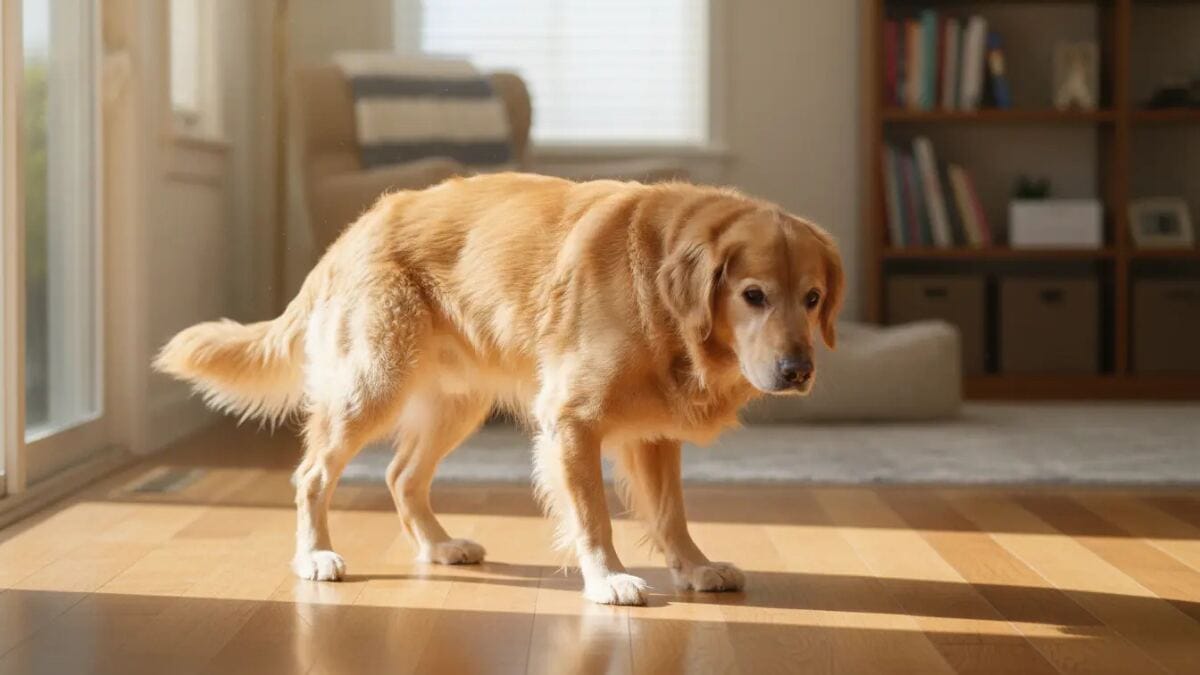
Dog limping after sleeping is often linked to stiffness, minor strain, or joint issues. It can happen when a dog rests for a long time and then starts moving again.
Rest → stiffness → discomfort → limping
- Limping may improve after movement in mild cases
- Common causes include muscle stiffness, joint problems, or soft tissue injury
- Sudden or severe limping needs attention
If limping lasts more than 24–48 hours, veterinary evaluation is important. A dog that completely avoids putting weight on a leg should be seen sooner rather than later, since this is a stronger signal than ordinary post-rest stiffness.
Quick Answer Box
Why is my dog limping after sleeping?
When a dog rests for a long time, the body can become stiff. This is why dog limping after sleeping is common, especially when muscles and joints tighten.
- resting → stiffness → discomfort → limping
- joint issues → inflammation → reduced movement → limp
- soft tissue strain → pain → weight shifting → limp
Many dogs show dog limping after waking up due to stiffness. The limp often improves after a few steps. If it does not improve, it may need closer attention. It also helps to rule out a simpler explanation first: a leg that has briefly fallen asleep from an odd sleeping position usually resolves within a minute or two and doesn’t return the next time the dog rests, while true limping from stiffness or joint issues tends to happen more consistently and take longer to fully ease.
This article focuses specifically on dogs that limp after sleeping or after a long period of rest. Unlike articles about sudden limping, limping after exercise, or general stiffness, this page focuses on limping that appears when the dog first gets up and may improve after movement. If a dog is mainly stiff rather than limping, see Dog Stiff After Lying Down. If the main change is slower movement after resting, see Why Is My Dog Walking Slow After Rest.
Table of Contents
Why Is My Dog Limping After Sleeping
Dog limping after sleeping often happens when movement starts after rest. The body may feel uncomfortable at first, especially if muscles or joints have tightened during inactivity.
sleeping/resting → reduced movement → muscle stiffness → discomfort → limping
When a dog gets up, it may limp for a few steps. This explains why a dog may limp when getting up after resting. The body needs time to loosen and move normally again.
Many dogs show dog limping after waking up because of this stiffness. In mild cases, the limp improves with movement. As the dog walks, blood flow increases and the stiffness reduces. This is why a dog limp improves with movement in many situations.
If the limping lasts longer or gets worse, it may need closer attention.
Why Rest Makes Some Dogs Limp More Than Others
Not every dog limps after sleeping. Some only show a limp after a particularly long rest or a hard day. Others limp almost every morning without any obvious trigger. The difference usually comes down to how much joint damage is already present, how well the muscles around those joints are supporting the body, and what the dog did the day before.
How Arthritis Severity and Cartilage Condition Affect Morning Stiffness
When cartilage wears down over time, the surfaces inside a joint lose their cushioning. Inflamed tissue and bone changes make those joints more sensitive to stillness. During sleep, blood flow to the joints slows and the synovial fluid that keeps joints moving smoothly becomes less effective. When the dog wakes and tries to rise, those damaged joints resist movement. VCA Animal Hospitals notes that lameness which is worse after rest and improves with gentle movement is a classic sign of arthritis in dogs.
joint inflammation → reduced joint lubrication during rest → pain on rising → limping for first few steps
A dog with mild early joint changes may only show this on mornings after a long or deep sleep. A dog with more advanced damage will limp after almost any rest because the joint tissues are more consistently inflamed. This is why two dogs of the same age can look completely different after waking — one walks off a brief limp in seconds, the other struggles for several minutes before moving comfortably.
The limp that improves after a few minutes of gentle walking is a well-known arthritis pattern.
It does not mean the problem is minor. It means the joints have warmed up enough to move more easily, which gives the impression of recovery while the underlying condition continues.
Why Muscle Condition and Body Weight Change How Hard Rising Feels
Muscles around the joints act as shock absorbers. A dog with strong, well-conditioned muscles around the hips, knees, and shoulders can often compensate for moderate joint damage. The muscles take on some of the load and help stabilize each step.
When those muscles weaken — through inactivity, age, or disuse after a period of pain — the joint takes more of the impact on every step. Rising from rest becomes harder because there is less muscular support to help push the body upright smoothly.
weak muscles around the joint → less support on rising → more weight on the affected joint → more pronounced limp
Body weight works the same way. Extra weight increases the mechanical load on every joint, particularly the hips, stifles, and elbows. A heavier dog with moderate arthritis may limp noticeably on rising, while a leaner dog with similar joint changes may only show a brief hesitation. This is why weight management is one of the most direct ways to reduce morning limping in dogs already showing joint problems.
Why the Previous Day’s Activity Can Make the Next Morning Worse
Many owners notice that their dog’s morning limp is worse after a big day — a long walk, a run, or rough play. This is not coincidence. Overexertion the day before can temporarily increase inflammation inside affected joints. That heightened inflammation is still present the following morning, making the joint stiffer and more painful on rising.
overexertion → micro-injury and increased joint inflammation → overnight stiffness builds → more severe morning limp
The reverse is also true. A dog that had gentle, controlled activity the previous day often shows a milder limp on waking. Moderate movement helps maintain circulation to the joints and keeps muscles warm. Complete inactivity, especially over a full day of rest, can allow stiffness to build more than usual, leading to a rougher start the next morning.
Owners who track this pattern — noticing that big activity days consistently produce worse limping the next morning — are usually seeing early arthritis behavior. That connection between activity and next-morning stiffness is worth noting and sharing with a veterinarian, as it helps build a clearer picture of how the joint disease is progressing. This kind of progression is often one of the earliest signs of arthritis in dogs, and it’s worth sharing with a veterinarian.
Signs to Watch in a Dog Limping After Sleeping
After rest, some signs can show whether the limp is mild or needs attention. Watching these early changes helps dog owners understand what is happening.
- dog not putting weight on one leg
- dog limps after lying down for a while
- stiffness or slow movement when getting up
- dog holding one leg up while standing or walking
- sudden limping after rest or sleep
These signs may appear right after the dog wakes up. In some cases, movement improves the limp. If the signs stay or get worse, it is best to monitor closely and consider veterinary evaluation.
Common Causes of Dog Limping After Sleeping
The image below shows why dog limping after sleeping happens step by step.
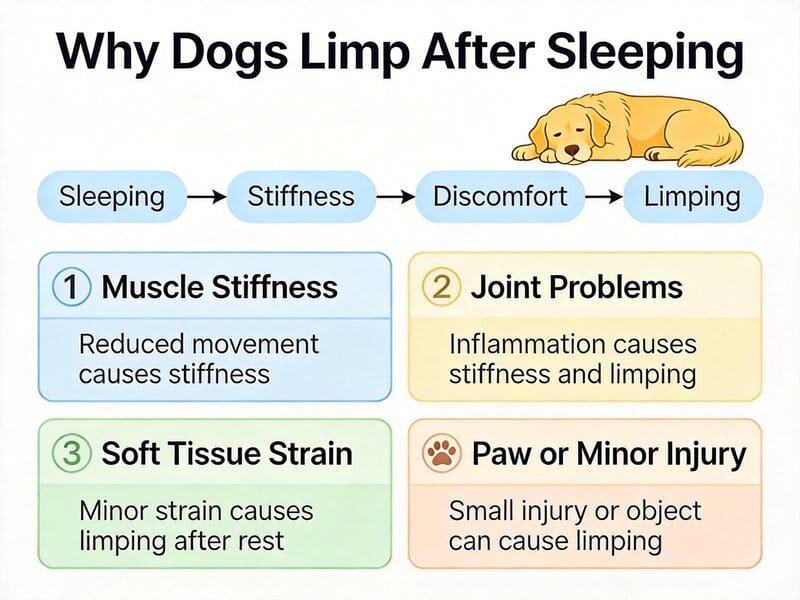
| Cause | What Happens | Key Sign |
| Muscle stiffness | Tight muscles after rest | Improves with movement |
| Joint problems | Inflammation in joints | Worse in older dogs |
| Soft tissue injury | Strain or minor tear | Limp after activity/rest |
| Growing pains | Bone development stress | Seen in young dogs |
| Paw injury | Irritation or small wound | Paw sensitivity |
Muscle Stiffness After Rest
When a dog rests for a long time, muscles can tighten. Blood flow slows down, which leads to stiffness.
rest → reduced circulation → stiffness → limping
This is why a dog limps in the morning or shows dog limping after resting. The limp often improves as the dog starts moving and loosens up.
Joint Problems (Arthritis or Early Joint Issues)
Joint problems can make movement harder after rest. This is more common in older dogs but can also start early.
joint wear → inflammation → stiffness → limping
A senior dog limping after sleeping may show this pattern. Early joint issues can also cause stiffness that appears after rest and improves slightly with movement.
Soft Tissue Injury or Strain
A small strain from activity can cause discomfort that shows after resting. The dog may seem fine during activity but limp later.
activity → strain → inflammation → limping after rest
This explains dog limping after a nap or rest period. Soft tissue injuries may not always show visible signs but still affect movement.
Growing Pains (Young Dogs)
Young dogs may limp due to rapid growth. Bones and joints adjust, which can cause temporary discomfort.
growth → bone stress → discomfort → limping
This can appear as puppy limping after sleeping or a young dog stiff leg after lying down. It often comes and goes as the dog grows.
Can a Dog’s Leg Fall Asleep Like a Human’s?
Yes — a dog’s leg can fall asleep, though it tends to be less pronounced than in humans due to differences in how dogs distribute weight during sleep. When a dog lies in one position for a long time, pressure on a nerve or blood vessel can temporarily interrupt normal signaling to the limb. The leg feels numb or tingly, and when the dog stands up, it may take a few wobbly steps before the sensation returns and the leg responds normally again.
odd sleeping position → nerve or blood vessel compression → temporary numbness in the limb → brief awkward steps → resolves almost immediately
This is different from the kind of twitching or paddling a dog does during deep sleep. That movement happens during active sleep and comes from the brain, not from pressure on a limb. A leg that has fallen asleep only becomes noticeable when the dog actually tries to stand and use it.
What Happens When a Dog’s Leg Falls Asleep — and How It Looks
The pattern is usually easy to spot. The dog wakes up, tries to stand, and one leg seems uncooperative — it may buckle slightly, land at an odd angle, or cause the dog to limp for a few steps. The dog might shake the leg or shift its weight instinctively. Within seconds to a couple of minutes, circulation and nerve signaling normalize, and the dog walks away completely normally.
This type of limp is position-dependent. It tends to happen after the dog has been lying very still, curled tightly, or sleeping with a leg tucked under its body for a long period. Heavier dogs may experience it more often simply because they put more pressure on a limb when resting.
The limp it causes is short-lived. If the dog is walking normally within a minute or two, and if the leg looks and moves normally after that, a positional limb falling asleep is a reasonable explanation.
How to Tell If the Limp Is From a Leg That Fell Asleep or Something More Serious
The key difference is how quickly the limp resolves — and whether it keeps happening.
A true positional limp from temporary nerve compression should be occasional and gone almost immediately. It should not happen after every rest. It should not get worse. The dog should return to full normal movement within minutes and show no hesitation, guarding, or reluctance to use the leg afterward.
If the limp lasts longer than a couple of minutes, comes back regularly, or happens even when the dog was not lying in an unusual position, it is not simply a leg falling asleep. Persistent or recurring limping after rest is more commonly linked to joint problems, soft tissue injury, or early arthritis — not positional numbness.
positional limp → resolves within seconds to two minutes → rare, not consistent → not a concern recurring limp after rest → lasts several minutes or longer → happens most mornings or after any lying down → needs veterinary attention
Some owners notice the difference gradually. The first few times, the limp fades quickly and seems harmless. Over weeks or months, it starts lasting a little longer, or it appears even after a short nap, or the dog hesitates to put weight on the leg before moving. That shift in pattern is the signal that something more than sleeping position is involved. Other warning signs of joint pain can help owners make that distinction more confidently.
Growing Pains in Young Dogs — What the Limp Actually Looks Like
Panosteitis, the condition commonly called growing pains in dogs, causes inflammation deep inside the long bones of the legs. It is not a joint problem and it is not a soft tissue strain. The pain comes from the bone itself, specifically from the bone marrow cavity — the soft inner core of the long leg bones — where rapid growth triggers an inflammatory response.
The Shifting-Leg Pattern — Why the Limp Moves Between Legs
rapid growth in a large-breed young dog → bone marrow inflammation inside a long bone → acute painful lameness in that limb → pain settles, then flares in a different leg
The most distinctive thing owners notice is that the limp moves. A puppy may limp on the left front leg for a few weeks, then seem to recover, then begin limping on the right rear leg. This shifting-leg lameness is the hallmark sign of panosteitis and the most useful pattern for distinguishing it from a single injury, which stays on one limb.
The leg itself may look completely normal. The joints often feel fine when moved. But pressing firmly along the bone shaft — the long sections of the leg between the joints — can cause pain. A veterinarian will check for this during an exam and may confirm the diagnosis with X-rays, which can show characteristic changes in the bone marrow cavity.
Episodes typically last two to five weeks each. They recur across different legs over several months, usually with symptom-free intervals between them. The puppy may also show mild lethargy or a reduced appetite during active flare-ups, which is not a typical sign of a simple soft tissue sprain.
VCA Animal Hospitals’ guide to panosteitis describes this same shifting-leg pattern as one of the clearest signs distinguishing growing pains from a single injury.
Which Dogs Are Most Affected and When Growing Pains Usually Resolve
Panosteitis most commonly affects large and giant breed dogs between five and eighteen months of age. German Shepherds, Golden Retrievers, Labrador Retrievers, Great Danes, Basset Hounds, and Dobermans are among the breeds seen most often. Male dogs are more frequently affected than females, though any large-breed dog in the growth phase can develop it.
The good news is that panosteitis is self-limiting. It does not cause permanent damage, and it does not require long-term management. Most dogs stop having episodes by eighteen to twenty-four months of age, once skeletal maturity is reached. Some German Shepherds may experience episodes into their mid-adult years, but this is less common.
During flare-ups, rest and activity restriction help reduce discomfort. A veterinarian may recommend pain relief to keep the puppy comfortable while the episode runs its course. Owners should avoid pushing through the limp with strenuous exercise during active periods, as this can worsen temporary discomfort without speeding recovery.
If an older dog is showing signs — or if the breed and age do not fit the typical profile — veterinary evaluation is important to rule out other causes. The pattern alone is not enough to confirm panosteitis without a proper examination.
Paw or Minor Injury
Small injuries can cause pain when the dog puts weight on the paw. These may not always be easy to see.
small injury → irritation → pain → limping
Paw pad injuries or foreign objects like small debris can lead to limping after rest, especially when the dog first steps down.
Dog Limping but Improves After Walking
Some dogs limp at first but move better after a few steps. This often points to stiffness after rest rather than a deeper injury.
stiffness → movement → improved circulation → reduced discomfort
When the dog starts walking, blood flow increases and muscles loosen. This is why a dog limp improves with movement in many mild cases.
Owners may notice that a dog limps when he gets up but runs fine after moving. This pattern can happen after sleep or long rest.
However, improvement with movement does not always mean the problem is minor. If the limp keeps returning, gets worse, or affects daily activity, it may need closer attention.
Morning Limping vs Limping After Any Rest — Is There a Difference?
Many owners search for “morning limping” or “dog limping after nap” or “dog limping after lying down” as if these are separate problems. They are not. The underlying mechanism is the same in all three situations — inactivity allows joints to stiffen, and rising from rest triggers the limp. What changes is how much stiffness builds, and that depends on how long the dog was still, not what time of day it was.
Why Longer Rest Means More Stiffness — The Inactivity Connection
When a dog lies still, synovial fluid — the lubricating fluid inside the joints — moves less. Muscles cool and tighten. Inflamed tissues stiffen without the gentle pressure of movement to keep them mobile. The longer the dog stays in one position, the more pronounced these changes become.
inactivity → reduced synovial fluid movement → joint stiffness builds → muscles tighten → limping on rising
A full night of sleep means several hours of reduced movement — far longer than any daytime rest — which gives joints more time to stiffen. A twenty-minute daytime nap gives far less time for stiffness to accumulate. This is why a dog may limp noticeably after waking in the morning but rise from a short afternoon rest with only a minor hesitation, or no obvious limp at all.
Limping after any period of rest is tied to this stiffness. But the severity of that limp often reflects how long the dog was resting — which gives owners a practical clue about what they are dealing with.
If a dog only limps after overnight sleep, stiffness from inactivity is likely the main driver, and the pattern fits with earlier-stage joint disease. If the main concern is whole-body stiffness rather than a noticeable limp, that is a related but separate pattern..
What It Means When the Limp Only Happens After Overnight Sleep
A limp that appears exclusively in the morning — never after short rests during the day — is often an early signal. It means the joints are affected enough to show symptoms after a long, still night, but not enough that shorter daytime rests trigger the same response.
limp only after overnight sleep → joints tolerate short inactivity → early or mild joint disease more likely
Over time, owners sometimes notice the pattern shift. The dog that once only limped in the morning starts to limp after afternoon naps too. Then after any lying down. That progression — limping after shorter and shorter rests — reflects worsening joint inflammation or further cartilage loss. It is one of the clearer signs that the underlying condition is advancing, even when the dog appears fine once it has warmed up.
This is useful for owners who wonder whether their dog’s morning limp is something to watch or something to act on. A dog that limps every morning, every day, without exception, is showing a more consistent pattern than one that only limps after unusually long rest on cold mornings. Both deserve veterinary attention if the pattern is new or worsening, but the daily-every-morning pattern typically reflects more established joint disease.
Does Cold Weather Make Limping After Sleeping Worse?
Yes — cold weather makes post-rest limping noticeably worse in many dogs, particularly those with early joint disease or arthritis. This is one of the most commonly observed seasonal patterns in dogs with mobility issues.
Why Cold Temperatures and Damp Conditions Increase Morning Stiffness
Cold temperatures affect the fluid inside joints. Synovial fluid — which cushions and lubricates joint surfaces — becomes more viscous in cold conditions. When it thickens, it moves less freely, which means the joint does not glide as smoothly when the dog first rises. At the same time, muscles tighten in the cold, reducing the support around the joint and making the first few steps harder and more painful.
cold temperature → synovial fluid thickens → joint surfaces move with more resistance → muscles tighten → greater stiffness and pain on rising → more pronounced limping after sleep
Damp weather adds a second layer. Drops in barometric pressure that typically accompany rain and storms are associated with increased joint swelling and sensitivity. Some owners notice their dog is more reluctant to rise, slower to get moving, or limping for longer on stormy days — and many owners observe this pattern consistently, though the degree varies between individual dogs.
Cold floors are a separate but related factor. A dog sleeping on tile, concrete, or a cold garage floor loses body heat through contact with the surface throughout the night. By morning, both the joints and the surrounding muscles are colder and tighter than they would be after sleeping on a padded, insulated surface. The limp on rising reflects this.
cold floor → heat loss through contact → colder joints and muscles overnight → stiffer, more painful rising → longer-lasting morning limp
It is important to note that cold weather does not cause joint disease. It amplifies and reveals what is already there. A dog that limps noticeably more in winter and barely at all in summer likely has underlying joint inflammation that the cold is making worse — not a new problem that appeared with the season.
Simple Ways to Reduce Cold-Weather Limping After Rest
The environmental contribution to morning limping is reversible, which makes it one of the more actionable pieces of information for owners. Two changes tend to make the biggest practical difference.
The first is where the dog sleeps. Moving the dog off hard cold floors and onto a thick padded or orthopedic bed in a warmer area of the home directly reduces the joint and muscle cooling that worsens morning stiffness. Dogs that sleep in unheated garages, on tiled floors near exterior walls, or outdoors in cold weather are at particular risk of worse morning limping.
The second is temperature of the sleeping environment. A draft-free, consistently warm sleeping area helps the joints maintain a more comfortable temperature through the night. This is not a cure for the underlying condition, but it reduces the environmental load on already-sensitive joints.
If morning limping continues to worsen through cold months despite these adjustments, or if it is severe, a veterinarian can assess whether additional management is needed. Environmental adjustments like these are part of broader supportive care for dogs with stiff joints.
What Normal Recovery Looks Like After Getting Up — and When It Is Not Normal
What the Warm-Up Pattern Should Look Like in Mild Cases
In mild post-rest limping, the pattern has a clear shape. The dog rises, favors a leg or moves stiffly for the first few steps, then gradually settles into a more even gait as the body warms up. By the time the dog has walked for two to five minutes on a flat surface, the limp has eased noticeably or disappeared entirely.
mild stiffness on rising → first few steps are uneven or hesitant → gait smooths out as blood flow increases → limp fades or disappears → dog moves normally for the rest of the walk
The key word in that pattern is consistently. A mild post-rest limp that resolves quickly and behaves the same way each time — resolving in roughly the same number of steps, at roughly the same pace — is a different situation from one that is taking a little longer each week.
Short gentle walking on a stable, non-slippery surface is generally acceptable when the limp is mild and improving. The movement itself helps, since it warms the joint and increases circulation. Strenuous activity, running, or jumping right after rising is a different matter — that puts load on a joint before it has had a chance to loosen up. If the main issue is slower overall movement rather than a clear limp, that is a related but separate pattern.
Signs the Recovery Pattern Is Getting Worse Over Time
The warm-up effect is a well-recognized feature of early arthritis in dogs. In itself, it is not a reason for panic. But it is a signal — and the trajectory of that signal matters more than any single morning.
Owners who watch carefully over weeks often notice the change before it becomes obvious. The limp that used to fade in two minutes now takes five. The dog that used to be walking normally by the end of the driveway is still favoring the leg halfway down the street. The limp that used to disappear entirely now leaves a slight unevenness even after a full walk.
progressive joint disease → increasing inflammation and joint damage → warm-up takes longer → limp no longer fully resolves → limping begins appearing at other times of day
Running fine after a few steps is not always reassuring. Dogs mask pain well. A dog that appears to recover fully after warming up may still have significant joint inflammation — it is simply moving well enough in the moment that the limp is no longer visible. What matters is the trend over time. If recovery is slower month over month, or if the limp stops fully resolving, that change deserves veterinary attention.
An early arthritis guide can help owners understand what these warming-up patterns typically signal in terms of joint health. A veterinarian can assess whether the pattern reflects normal early disease or something that needs closer management.
Dog Limping but Not Crying or Showing Pain
Dogs often hide pain as a natural survival instinct. In the wild, showing weakness can make an animal vulnerable, so many dogs stay quiet even when something feels wrong.
dogs hide pain → survival instinct → no visible reaction → limping
This is why a dog may be limping with no pain when touched. The dog may not cry, whine, or react strongly, even though discomfort is present.
Owners may notice that my dog is limping but shows no sign of pain. The limp itself is an important signal that something is not normal, even without clear signs of distress.
It is important to watch behavior closely. If the limp continues, worsens, or affects daily movement, it is best to consider veterinary evaluation.
Sudden Limping After Sleeping
Sudden Limping
Sudden limping often appears without warning. A dog may wake up and limp right away.
injury → pain → weight avoidance → limping
This can happen due to a minor injury, awkward movement during sleep, or strain. In these cases, dog suddenly limping after sleeping may show more discomfort and less willingness to move.
Gradual Limping
Gradual limping develops over time as joint changes and chronic conditions build, rather than starting from a single incident. Since this article focuses specifically on post-rest and sleep-related limping, the broader range of gradual causes is covered more fully on why is my dog limping.
Why There Is No Swelling or Visible Injury
Sometimes a dog may limp, but there is no swelling or clear injury. This can happen when the problem is inside the body and not visible from the outside.
internal issues → no external signs → discomfort → limping
An unseen injury, such as a mild strain or soft tissue issue, can cause discomfort without any visible marks. The dog may still limp even though the leg looks normal.
Early joint issues can also show this pattern. In these cases, stiffness and inflammation begin inside the joint, but swelling may not appear right away.
This is why a limp should not be ignored, even if nothing looks wrong. If the limping continues or changes over time, it is best to monitor closely and consider veterinary evaluation.
When to Worry About Dog Limping After Sleeping
Some limping after rest can be mild. However, certain signs may mean the problem needs attention.
Schedule a vet visit if:
- limping lasts more than 48 hours
- swelling appears in the leg or paw
- sudden limping without a clear reason
See a vet sooner rather than later if:
- the dog is not putting any weight on the affected leg
- the limping is severe or the dog is having real difficulty walking
These signs may point to a deeper issue rather than simple stiffness. If any of these appear, it is best to monitor closely and consider veterinary evaluation.
Signs the Limping Pattern Is Becoming More Serious
When Occasional Morning Limping Becomes Chronic
A limp that appears occasionally after sleeping is different from one that appears most mornings. A limp that resolves in two minutes is different from one that takes ten. These distinctions matter clinically, and they matter practically for owners trying to decide whether to wait and watch or book an appointment.
Veterinary guidance defines chronic lameness as limping that occurs consistently for two weeks or more. That threshold is not arbitrary — it reflects the difference between a temporary flare-up that the body may resolve on its own and an ongoing pattern that signals an underlying condition requiring assessment. A limp that has been present every morning for two weeks, even a mild one, crosses that line.
The Merck Veterinary Manual defines chronic lameness in similar terms, noting that persistent lameness lasting two weeks or more typically warrants a full veterinary work-up.
occasional morning limp → appears some days, not others → pattern is variable and not yet consistent → watch and record
daily morning limp for two or more weeks → pattern is consistent and persistent → chronic by clinical definition → veterinary evaluation warranted
Beyond frequency, the direction of change matters. A limp that was mild six weeks ago and is noticeably worse today is a different situation from one that has stayed the same. Progression — not just presence — is the signal owners should track. A limp that is stable and mild is less urgent than one that is mild but clearly getting worse week by week, even if neither one looks severe on any given morning.
The other timing marker owners often miss is when the limp stops fully resolving. A post-rest limp that used to disappear completely after a few minutes of walking but now leaves a slight unevenness for the rest of the morning is showing incomplete resolution. That shift — from full resolution to partial resolution — is often the first sign that the underlying joint condition has progressed beyond the early stage.
limp fully resolves after warm-up → early pattern, monitor closely
limp partially resolves — slight favor remains after warm-up → condition has progressed → veterinary evaluation recommended
limp does not resolve — dog limps throughout the day → more advanced disease or secondary issue → veterinary evaluation needed
A limp that does not resolve at all is covered in the When to Worry section above — this section focuses specifically on the gradual changes that happen over days and weeks rather than sudden severe episodes.
Subtle Signs Owners Often Miss — Even When the Dog Is Not Crying
Dogs do not communicate pain the way humans do. They rarely cry out from chronic joint discomfort. They adjust. They compensate. They find ways to move that reduce the load on a painful limb, and they continue functioning at a level that can look almost normal until the condition is quite advanced.
This means owners who are waiting for obvious distress before acting may be waiting too long. The signs that a limping pattern is becoming more serious are often behavioral and positional — changes in what the dog chooses to do rather than visible expressions of pain.
Signs worth noting even when the dog appears otherwise fine:
- The dog that used to jump onto the sofa now waits to be lifted or avoids it entirely
- The dog that used to bound up stairs now hesitates at the bottom or takes them one step at a time
- The dog is slower to get up when called, even when fully rested — not just first thing in the morning
- The dog walks a shorter distance before wanting to turn back, even on routes it used to manage easily
- The dog lies down more during walks or play sessions than it used to
- The dog shifts weight when standing — leaning away from one leg, standing with a leg slightly raised
None of these behaviors announce themselves as limping. But each one reflects a dog that is managing pain by reducing what it asks of the affected limb or body. When these changes appear alongside a morning limp that is becoming more frequent or lasting longer, the combination is a clear signal that the underlying condition needs veterinary attention.
Pain masking does not mean the condition is mild. It means the dog has adapted. This kind of adaptation typically reflects a specific stage of arthritis progression. Matching what they are seeing to the right level of urgency is the key decision for owners at this point.
What to Do If Dog Is Limping After Sleeping
Simple steps can help when a dog shows limping after rest. These steps focus on safety and observation.
- limit activity to reduce strain on the affected leg
- avoid jumping, running, or rough play
- monitor behavior and movement throughout the day
- check the paw gently for cuts, swelling, or debris
- allow proper rest so the body can recover
These steps can help in mild cases where stiffness or minor strain is involved. If the limping continues, gets worse, or does not improve with rest, it is best to seek veterinary attention.
How to Monitor Limping That Appears Only After Sleeping
Telling an owner to monitor a limp is easy. Giving them a framework for how to do it is more useful. Most owners who notice a morning limp keep a rough mental note — it happened again today, it seemed worse this week — but without a consistent way of recording what they are seeing, those observations are hard to act on and even harder to share with a veterinarian.
What to Record Each Time the Limp Appears
A simple written or phone-note record made at the time of each episode is far more useful than memory. The goal is not to create a medical document — it is to build a picture of whether the pattern is stable, improving, or worsening over days and weeks.
The most useful things to record each time:
- Which leg is affected — front left, rear right, or more than one
- How long the limp lasted before the dog moved normally
- Whether the limp fully resolved or left a slight unevenness afterward
- What the dog did the day before — active day, rest day, short walk, long walk
- Weather conditions — cold, damp, warm, dry
- Time of the episode — after overnight sleep, after a daytime nap, after lying down briefly
These details are simple to note in a few seconds. Over two or three weeks, they reveal patterns that a single vet visit cannot capture — which leg is consistently involved, whether big activity days reliably produce worse mornings, whether cold weather is a consistent trigger, and whether recovery is taking longer than it used to.
If the leg affected is shifting between different limbs over time, that is a specific pattern worth flagging separately — it points toward a different underlying cause than a consistent single-leg limp and is something a veterinarian will want to know about.
When to Capture Video — and What to Film
Dogs frequently hide their limp once they arrive at the veterinary clinic. The combination of new smells, surfaces, and stimulation can mask a gait abnormality that is obvious at home every morning. A short video removes that problem entirely.
What to film:
- The first seconds after the dog rises from sleep — before the dog has taken more than a few steps
- The dog walking away from the camera on a flat surface — this angle shows gait asymmetry most clearly
- A second clip after the dog has been walking for two to three minutes — to show how much the limp improves or whether it persists
Clips of fifteen to thirty seconds each are sufficient. Multiple clips from different episodes are more useful than one long video, because they show variability — whether the limp is the same every morning or worse on some days than others. Most phones make this straightforward. A consistent filming spot at home — same hallway, same lighting — makes the clips easier to
compare over time.
Changes That Mean It Is Time to Call the Vet Sooner
Monitoring is not a substitute for veterinary care — it is a way to make that care more timely and more informed. Certain changes in the pattern should prompt an earlier call rather than continued watching.
Some of these changes signal gradual progression. Others — particularly sudden new reluctance to bear weight or visible swelling — may indicate a more acute problem that warrants same-day attention rather than monitoring.
Call the vet sooner if:
- The limp is lasting noticeably longer before resolving than it did a week or two ago
- The limp stops fully resolving — there is still a slight favor or unevenness after the dog has warmed up
- The limp begins appearing after short daytime naps as well as overnight sleep
- The affected leg changes or shifts between episodes
- The dog starts avoiding stairs, jumping onto furniture, or getting into the car when it did not hesitate before
- The dog seems slower, quieter, or less interested in walking even when the limp itself appears mild
None of these changes require waiting for a scheduled check-up. They are signals that the pattern has moved and that a veterinarian needs to see the dog sooner rather than later. Taking the diary notes and videos to that appointment gives the vet a far clearer picture than a description from memory alone.
A veterinarian can then correlate what the owner has recorded with a physical examination and decide whether diagnostic imaging or other assessment is warranted. A veterinarian typically looks for these same patterns when diagnosing joint problems in dogs.
FAQ Section
Why is my dog limping after laying down then fine?
A dog may limp after laying down due to stiffness in the muscles or joints. In mild cases, the limp improves after a few steps as the body loosens up.
Why does my dog limp when he gets up from sleeping?
A dog may limp when getting up from sleep because rest can make muscles and joints stiff. Movement often helps reduce the stiffness.
Is it normal for dogs to limp after waking up?
Mild limping after waking up can happen after long rest. If it happens often, gets worse, or does not improve, it needs closer attention.
How long does a limp last in dogs?
A mild limp may improve within a few hours or by the next day. If it lasts more than 24 to 48 hours, veterinary evaluation is important.
Why is my dog suddenly limping after waking up?
Sudden limping after waking up may happen due to a minor strain, awkward sleeping position, or paw discomfort. Severe or persistent limping needs attention.
What is the most common cause of limping in dogs?
Common causes of limping in dogs include muscle strain, joint problems, soft tissue injury, and paw problems. The most likely cause depends on the dog’s age, activity, and symptoms.
Should you massage a limping dog?
Gentle massage around the muscle may provide some comfort in mild cases of muscle stiffness. But it should not replace veterinary evaluation, especially if the limp does not improve with movement or keeps returning. A veterinarian can advise whether massage is appropriate for the specific cause of the limping.
Should I let my dog walk if the limp improves after a few steps?
Short, controlled walks on a stable, non-slippery surface are usually fine when a dog limp improves with movement. This is a common pattern in mild post-rest stiffness. Strenuous activity, running, or jumping should still be avoided until the limp has fully resolved, since dogs hide pain well and may look more comfortable than they actually are.
Should I record a video of my dog limping before the vet visit?
Yes. Dogs often hide pain and may walk normally once they reach the clinic, which can make an intermittent limp hard for a veterinarian to see in person. A short video filmed at home — especially of the dog walking away from the camera — shows the limp clearly and helps with monitoring a dog’s behavior over time, giving the vet a more accurate picture than a description alone.
Why does my dog limp after resting?
A dog may limp after resting because muscles and joints can become stiff during inactivity. The limp may improve after walking.
Can dog nails cause limping?
Yes, damaged or overgrown nails can cause limping. They can make walking painful and change how the dog puts weight on the foot.
Sources & References
- VCA Animal Hospitals — Lameness in Dogs
- Merck Veterinary Manual — Lameness in Dogs (Pet Owner Version)
- VCA Animal Hospitals — Arthritis in Dogs
- American Kennel Club — Why Is My Dog Limping?
- PDSA — Limping and stiffness in dogs
- PDSA — Arthritis in dogs
- ToeGrips — 12 Signs of Arthritis in Dogs
- ToeGrips — Why is My Dog Limping? 18 Causes From a Veterinarian
- PetMD — Why Is My Dog Limping?
- VCA Animal Hospitals — Panosteitis in Dogs
- Small Door Veterinary — Panosteitis (Growing Pains) in Dogs
What to Do Next
If a dog is limping after sleeping, it is important to observe how the limp changes with movement. Mild cases may improve as the body loosens, but repeated or worsening limping should not be ignored.
To understand the full picture, see why is my dog limping. If the limp isn’t tied to rest specifically but keeps coming and going more generally,
see why is my dog limping on and off.
For broader joint support, explore the dog joint pain relief guide.
If the limp continues, worsens, or affects normal walking, a veterinarian should evaluate the dog.
Update Note
Last reviewed and updated: July 16, 2026
This update added a clearer way to tell a leg that’s briefly fallen asleep apart from true limping right in the opening summary, and connected several key claims — including the arthritis pattern, the panosteitis shifting-leg sign, and the chronic lameness threshold — to their supporting veterinary sources.
Educational content only. This article is not a substitute for professional veterinary advice, diagnosis, or treatment. Any dog showing severe limping, non-weight-bearing lameness, or a limp lasting more than 48 hours should be evaluated by a veterinarian.