
TL;DR
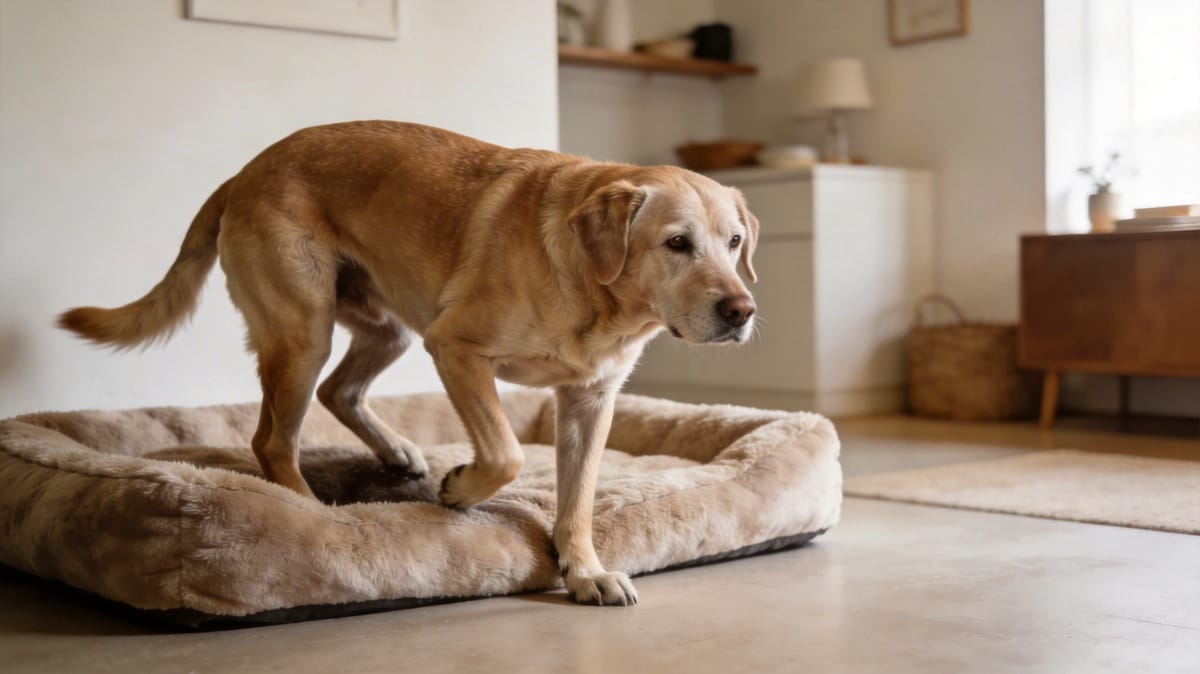
A dog stiff after lying down is often an early sign of joint problems. This stiffness can happen when joints stay still for too long and become tight.
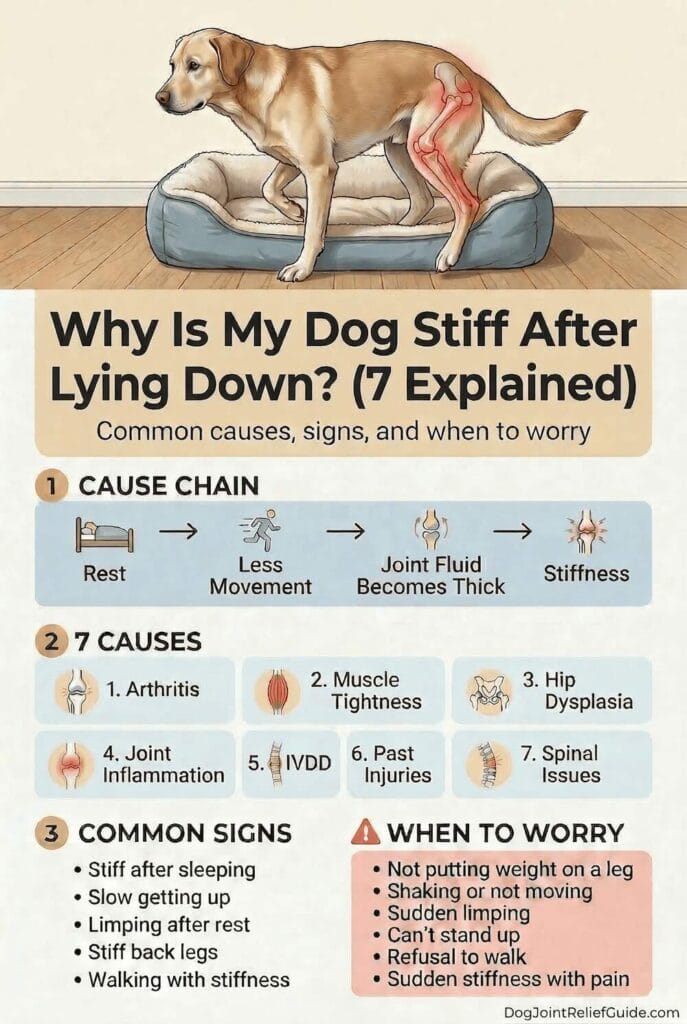
Common causes include joint inflammation, arthritis, muscle strain, hip dysplasia, and spinal or nerve issues. These can affect how easily a dog moves after rest.
In many older dogs, stiffness improves after walking. Movement helps joints loosen and improves blood flow.
It helps to tell stiffness apart from limping: stiffness usually looks even across all four legs and eases within a few minutes, while a limp favors one specific leg and tends to stay that way even after the dog has warmed up.
Watch for warning signs like limping, shaking, or a dog not putting weight on a leg. These may point to a more serious issue.
If stiffness gets worse, appears suddenly, or happens during a temporary dog arthritis flare up, a veterinary check is important to find the underlying cause.
Quick Answer Box
A dog stiff after lying down usually means the joints have become tight during rest. This often links to joint inflammation, arthritis, or mild muscle strain. In many dogs, post-rest stiffness can be one of the early signs of arthritis in dogs.
If the dog moves better after walking, it may be early stiffness. This is common in older dogs and those with joint issues.
If stiffness becomes worse, does not improve with movement, or affects normal walking, it may need veterinary attention.
Common signs:
- dog stiff after sleeping
- dog slow getting up
- dog stiff back legs after rest
- dog walking stiffly
- reduced movement after lying down
This article focuses specifically on dogs that become stiff after lying down or resting and then gradually loosen up once they start moving. If the main concern is that a dog moves more slowly after resting rather than stiffness itself, see why is my dog walking slow after rest. While some dogs may also limp or have difficulty standing, the main focus here is post-rest stiffness, why it happens, and when it may indicate an underlying joint or mobility problem.
Table of Contents
Why Is My Dog Stiff After Lying Down?
A dog stiff after lying down often shows a change inside the joints and muscles during rest. When a dog stays still, the body can become tight, especially in the hind legs.
This stiffness is more noticeable in older dogs, especially as joint problems develop with age, but it can also appear in younger dogs after strain or overuse.
What Happens Inside the Joints (Cause Chain)
Joint stiffness after lying down happens because joints stay inactive during rest, which can reduce lubrication, increase inflammation, and make movement feel tight at first.
A simple process explains this:
Rest → less movement → joint fluid thickens → increased stiffness → difficulty moving after lying down
Aging or injury → cartilage wear → joint inflammation → stiffness during rest → difficulty moving after lying down
These internal changes often build up gradually, especially in older dogs, leading to stiffness that is most noticeable after rest. When arthritis contributes to stiffness after lying down, some owners find it helpful to explore ways to help a dog with arthritis at home, including environmental changes, daily routines, and mobility support.
Cartilage acts like a cushion between bones. When it wears down, joints do not move smoothly. This can lead to stiffness in the back legs, along with slow or careful movement after rest. This process is well documented in veterinary research — a review published via PubMed Central describes how cartilage breakdown drives the joint changes seen in canine osteoarthritis.
Why Stiffness Improves After Movement
Many dogs move better after a few steps. This happens because the body starts working again.
- joints warm up
- blood flow increases
- muscles loosen
- mobility improves
That is why a dog may seem stiff at first but then walk more normally. If stiffness starts to affect normal walking, see why is my dog limping. If the problem shows up after sleep, see why is my dog limping after sleeping.
Several underlying causes can explain why a dog feels stiff after rest. Understanding these causes helps pet owners know when stiffness is normal and when it may need attention.
Is It Stiffness or Is It a Limp? How to Tell the Difference
Some dogs seem tight and slow all over after resting. Others clearly favor one leg. These are not the same thing, and telling them apart helps an owner know what to watch for.
Whole-body stiffness usually looks even. The dog moves slowly and carefully on all four legs, but no single leg looks worse than the others. A limp looks different. One leg is held differently, gets less weight, or moves out of step with the rest of the body.
Signs It’s Whole-Body Stiffness
A stiff dog often looks slow to get going, almost like an older dog taking its first few steps of the day. The movement is careful, but it is spread evenly across all four legs. Nothing is clearly favored. After a few steps, the dog usually loosens up and starts moving more normally.
joint or back pain → dog rises slowly and moves stiffly all over → no single leg is favored
This pattern is common after rest, and in mild cases, it settles down on its own once the dog starts walking.
Signs It’s a Limp Instead
A limp points to one specific leg. The dog may hold that leg up, put less weight on it, or take a shorter step with it compared to the others. This uneven pattern usually stays with the same leg, even after the dog has been moving for a while.
one painful limb → dog shifts weight away from that leg → the limp stays even after the whole body has loosened up
A dog can show both patterns at once. It might rise stiffly at first, the way any dog with sore joints does, but then continue to favor one leg once it starts walking. When that happens, the limp is usually the bigger clue, since it points to a specific spot that needs attention. If one leg is clearly favored rather than the whole body seeming tight, that is a distinct pattern with its own set of causes.
Mild stiffness that improves evenly across all four legs within a few minutes is usually nothing urgent. A limp that keeps returning, or stiffness that starts happening more often or lasting longer, is worth watching more closely and may need a veterinary evaluation.
Why Some Dogs Become Stiffer After Longer Periods of Rest
Not every dog gets stiff the same way after resting. Some dogs barely notice a short nap, but a long sleep leaves them slow and tight. Others feel it every time they lie down, no matter how long. The difference usually comes down to how much joint wear is already there, how strong the muscles around those joints are, and what the dog did the day before.
Joint Condition Severity and Rest Duration
Joints that already have some wear or inflammation take longer to move smoothly again after rest. The longer a dog stays still, the more time those joints have to tighten up.
more advanced joint disease → reduced comfort after inactivity → stronger stiffness after naps or overnight rest
A dog with mild, early joint changes might only feel stiff after a long sleep. A dog with more wear in the joints can feel stiff after almost any rest, even a short one. This is why two dogs the same age can look very different after getting up. One shakes off the stiffness in seconds.
The other needs several minutes before moving normally.
Muscle Conditioning and Body Weight
Strong muscles around a joint help carry some of the load. When those muscles are well conditioned, they support the joint and make rising easier, even if there is some wear inside the joint itself.
weak muscles around the joint → less support on rising → more effort needed to stand up
Body weight works the same way. A heavier dog puts more strain on the hips, knees, and elbows with every step. That means two dogs with similar joint wear can look different after resting.
The heavier or less conditioned dog often looks stiffer, even though the joint problem underneath may be about the same. Keeping a dog at a healthy weight is one of the more direct ways to ease this kind of stiffness.
How the Previous Day’s Activity Affects Stiffness
Many owners notice their dog is stiffer after a busy day. This is not a coincidence. A long walk, a run, or a lot of rough play can leave a little extra inflammation in the joints. That inflammation is often still there the next time the dog rests, which makes the stiffness worse on rising.
more activity the day before → temporary soreness on top of existing joint wear → more noticeable stiffness afterward
A quieter day with gentle movement tends to have the opposite effect. Regular, easy movement keeps blood flowing to the joints and helps keep muscles from tightening up too much. A day with no movement at all can sometimes make things worse, since the joints get no chance to stay loose. If a dog seems stiffer after big activity days and looser after calm ones, that pattern is worth noting, since it often reflects how much wear is already present in the joints.
If the main issue is a leg favoring or an uneven gait rather than general body stiffness, that is a related but separate pattern with its own distinct causes.
Morning Stiffness vs Stiffness After Any Period of Rest
Many owners notice their dog is stiffest first thing in the morning. Others start to see it after a short afternoon nap, or even after sitting still for a while. These are not different problems. They come from the same process, just at different points in how far it has developed.
Why Overnight Rest Produces More Stiffness
A full night of sleep is the longest stretch of stillness a dog goes through in a normal day. Joints have more time to tighten, and muscles cool down more than they would during a short daytime rest. Tails Chiro Care’s guidance on morning stiffness in dogs notes this same overnight cooling effect as a common reason stiffness is most noticeable first thing in the day.
overnight rest → more time without movement → more stiffness on first rise
This is why morning stiffness is often the most noticeable. It does not necessarily mean the joint problem is worse than a dog that only seems mildly stiff after naps. It usually just reflects how much time the body had to settle into stillness before being asked to move again.
When Stiffness Starts Appearing After Shorter Rests
A dog that is only stiff first thing in the morning, and moves normally after a short nap, is usually showing an earlier stage of the same pattern. The joints have enough reserve to handle brief rest without much trouble. Longer rest is what pushes them past that point.
stiffness limited to overnight rest → joints tolerate short breaks → early or mild pattern
Over time, some dogs start showing stiffness after shorter and shorter rests. A twenty-minute nap that never used to cause a problem starts leaving the dog stiff too. This shift is worth paying attention to. It usually means the joints have less reserve than they used to, and the same underlying issue is becoming more persistent.
shorter rests triggering stiffness → reduced joint reserve → pattern is progressing
This progression is one of the more useful things an owner can track. A dog that is stiff only in the morning is behaving differently than a dog that is stiff after any rest, even a brief one, and that difference can help a veterinarian understand how the condition is developing.
What Normal Recovery From Stiffness Looks Like
Knowing that stiffness improves with movement is only part of the picture. Owners still need a way to tell whether their dog’s recovery pattern looks normal or is starting to change.
What a Predictable Recovery Pattern Looks Like
In mild cases, stiffness follows a fairly steady pattern. The dog rises slowly, moves carefully for a few minutes, and then settles into a more normal pace. This tends to happen the same way each time, at roughly the same speed.
mild stiffness after rest → dog moves a bit → body loosens → normal activity looks close to baseline
That consistency is a good sign. A dog whose stiffness eases within a similar amount of time on most days, and who still wants to walk, sniff around, or interact once loosened up, usually has a stable pattern rather than a worsening one.
When Recovery Time Signals a Bigger Problem
The trend over time matters more than any single morning. If recovery is taking longer than it used to, that shift is worth paying attention to.
stiffness that takes longer to ease day by day → reduced recovery reserve → concern that the problem is progressing
A dog that used to loosen up quickly but now needs several more minutes to move comfortably may be showing early signs of arthritis in dogs. The same is true if the dog seems less willing to move even after warming up, or if the once-predictable pattern starts to vary a lot from day to day. Persistent or lengthening recovery time is a signal worth mentioning at a veterinary visit, since it often reflects how the underlying joint condition is changing.
7 Possible Causes of a Dog Stiff After Lying Down
Arthritis (Degenerative Joint Disease)
Arthritis is one of the most common causes of stiffness after rest in dogs. It develops slowly over time as joints undergo wear and inflammation, affecting how smoothly they move.
VCA Animal Hospitals lists slowness to rise after rest as one of the earliest observable signs of osteoarthritis in dogs.
Cartilage wear
- joint inflammation
- pain
- stiffness after lying down
Dogs may show stiffness in dogs back legs and move slowly at first.
Muscle Tightness and Poor Circulation
Muscles can tighten during long rest. Blood flow also slows down when the body stays still. Joint fluid may also thicken during inactivity, which can make movement harder at first.
Rest
- reduced blood flow
- muscle tightness
- stiffness after movement
This may explain why a dog stiff after lying down improves after walking.
Hip Dysplasia
Hip dysplasia affects how the hip joint fits together. It is common in large and giant breed dogs.
Poor joint fit → joint stress → inflammation → stiffness after rest
Dogs may show back leg stiffness or uneven movement or struggle to stand up.
Joint Inflammation
Inflammation can build up inside the joints during rest. This affects joint function and movement.
Inflammation
- swelling
- reduced joint movement
- stiffness
This often leads to stiffness in dogs back legs after rest.
Intervertebral Disc Disease (IVDD)
IVDD affects the spine and nearby nerves. It can change how a dog moves after lying down.
Spinal pressure
- nerve irritation
- weakness or stiffness
- difficulty walking
Some dogs may also show hesitation or shaking.
Previous Injuries and Scar Tissue
Old injuries can affect movement even after healing. Scar tissue may become tight during rest.
Past injury
- scar tissue
- reduced flexibility
- stiffness after lying down
This may cause the dog to move unevenly at times or feel stiff after sleep.
Spinal or Nerve Issues
Problems in the spine or nerves can affect the whole body. These issues may not always show clear pain at first.
Nerve compression → reduced signals → poor movement control → stiffness or weakness
Dogs may avoid placing weight on one leg or move unevenly.
| Causes | Common Signs |
| Arthritis | stiffness after rest, slow movement, difficulty getting up |
| Muscle strain | stiffness after activity, soreness, slower movement |
| Hip dysplasia | hind leg stiffness, uneven walking, reduced movement |
| Joint inflammation | stiffness in dogs back legs, reduced joint movement |
| IVDD (spinal issue) | stiffness, difficulty walking, hesitation to move |
| Injury or trauma | reduced movement, guarding one leg, discomfort after rest |
| Spinal or nerve issues | weakness, poor coordination, stiffness |
Why Young Dogs Can Become Stiff After Rest
The causes above mostly explain stiffness in older dogs. Young dogs can show a similar pattern too, and it does not always mean something is wrong.
Overactivity, Muscle Fatigue, and Developing Joints
A puppy that plays hard and then looks stiff afterward is a common sight. The muscles get tired from all that activity, and once the dog settles down, that fatigue can show up as general soreness on rising.
overactivity or rough play → muscle fatigue → stiffness after rest → puppy seems sore or slow to rise
Growing joints can also play a part. As bones and joints develop, they may feel a bit uncomfortable after a period of inactivity, which can leave a young dog rising slowly from a nap or looking stiff without any clear favoring of one leg. This kind of stiffness usually shows up as general soreness across the body rather than a specific limb problem, and it often eases once the dog gets moving again.
How This Differs From Panosteitis
Growing pains that shift between legs are a different pattern, known as panosteitis. That condition causes pain inside the bone itself, and it moves from one leg to another over the course of weeks or months. The stiffness described here is not that. It is a general, whole-body soreness tied to overactivity or developing joints, not a shifting single-leg lameness.
A young dog with brief stiffness after strenuous play that resolves quickly, and who is otherwise energetic and eating well, is usually not showing anything concerning. Repeated stiffness after rest, reduced activity, or signs that do not fit a simple “overdid it” pattern are worth a veterinary check, since a young dog’s stiffness should not automatically be dismissed as just growing.
When Stiffness Gets Worse
Key Progression Signs
Sometimes stiffness does not stay mild. It can slowly become more noticeable as discomfort increases.
Common signs to watch:
- may begin to move more slowly after rest
- may show uneven movement when first getting up
- may show slight imbalance while walking
These signs show that the dog may feel more discomfort when first moving. The stiffness may come and go, especially after rest.
What This Change Means
There is often a simple progression behind this change:
stiffness → discomfort → slower movement → reduced mobility
At first, the dog may only seem stiff. Over time, movement may become slower, more careful, or more limited after rest. Some dogs may also begin having difficulty rising from the floor or need extra effort to get up. If standing up becomes difficult, see why is my dog struggling to stand up.
If stiffness becomes more frequent, more severe, or starts affecting normal walking, it is important to seek veterinary care to check the underlying cause.
Signs the Stiffness Pattern Is Getting Worse
The existing progression signs cover things like slower movement and uneven imbalance while walking. But there is another kind of change that shows up before a dog walks anywhere. It happens while the dog is still trying to lie down or get comfortable, and it is easy to miss if an owner is only watching for limping or hesitation to move.
Difficulty Settling Into a Lying Position
A dog with worsening stiffness often takes longer to settle down for rest, not just longer to get up from it. The dog may circle a few times, shift position repeatedly, or seem unable to find a comfortable spot right away.
more discomfort in the joints or back → dog takes longer to settle into a lying position → visible restlessness or repeated repositioning
Some dogs also make a small sound, like a groan or sigh, when they finally lie down or when they rise again. This is usually a sign of strain rather than simple slowness, and it is worth noting if it starts happening more often.
When Getting Comfortable Takes Longer Than It Used To
Surface preference is another clue. A dog that used to lie anywhere may start avoiding hard floors and heading straight for a soft bed or padded area instead.
hard surfaces become uncomfortable → dog avoids them → preference for soft beds or padded areas
The pattern to watch is change over time, not any single evening. A dog that occasionally takes a moment to get comfortable is not necessarily showing a problem. A dog that used to settle almost instantly but now needs much longer, or groans more often when lying down, may be dealing with a joint condition that is advancing. This kind of shift is one of the useful early markers owners can share with a vet, since it often reflects how the stages of arthritis are progressing before more obvious mobility problems appear.
Warning Signs That Need Veterinary Attention
Serious Symptoms to Watch
Some signs go beyond normal stiffness. These may show that the problem is more serious.
Watch for:
- dog won’t put weight on back leg
- dog shaking and won’t move
- dog not walking
- dog suddenly stiff and shaking
- dog can’t stand up
These signs can point to strong pain, nerve issues, or injury. If they appear, the dog should be checked by a veterinarian as soon as possible. This stiffness may also appear when the dog tries to use stairs, especially during climbing or going up steps.
Emergency Situations
Some symptoms need urgent attention. These may affect the dog’s safety and movement.
Seek immediate help if:
- the dog is unresponsive
- there are clear signs of severe pain
- there is sudden loss of movement
These signs may be linked to a serious underlying condition. Quick veterinary care helps protect the dog’s mobility and overall health. If the back legs suddenly give out or buckle, see Why Are My Old Dog’s Back Legs Collapsing? Common Causes and What to Do.
What Dog Owners Can Do at Home (Supportive Care Only)
Safe Support Steps
Simple changes at home can help reduce stiffness after rest. These steps support joint health and improve comfort. Preventive care helps reduce long-term joint problems and supports better mobility.
- provide soft bedding to reduce pressure on joints
- avoid slippery floors to prevent stress on the hind leg
- maintain a healthy weight to reduce joint load
- allow gentle movement to keep joints active
These steps can help dogs with stiffness in dogs back legs or those slow to get up after lying down.
When to Monitor vs Act
It is important to know when to watch and when to take action.
mild stiffness
- monitor at home
- check if movement improves
worsening symptoms
- more difficulty getting up
- reduced movement
- refuses to bear weight on a leg
- seek veterinary care
If the dog shows ongoing stiffness or has trouble moving normally after rest, a vet check helps find the underlying cause safely.
How to Monitor Stiffness at Home
Watching for stiffness is one thing. Keeping track of it in a useful way is another. A quick note each time it happens gives a much clearer picture than trying to remember details later, and it makes any future vet visit far more productive.
What to Note Each Time Stiffness Appears
A simple written note or phone reminder taken right after the stiffness shows up is more reliable than memory. It does not need to be detailed. A few quick details are enough to build a useful picture over time.
The most helpful things to track:
- How long it took the dog to get up
- How long it took to loosen up once moving
- Whether it happened after overnight sleep, a short nap, or both
- What the dog did the day before
- Any weather changes, especially colder days
stiffness log kept over weeks → pattern becomes visible → easier for a vet to assess
These small notes add up. After a couple of weeks, they can show things a single vet visit might miss, like whether busy days reliably lead to stiffer mornings, or whether the stiffness is starting to take longer to ease than it used to.
What Patterns Are Worth Mentioning to a Vet
Not every pattern needs immediate action, but some are worth flagging sooner rather than later. Stiffness that used to happen only after long rest but is now showing up after short naps too is one example. So is stiffness that keeps lasting a little longer each week, even if it still eventually eases.
recording rest length and activity level → clearer triggers → better understanding of why symptoms vary
Bringing these notes to a veterinary visit gives a far more accurate picture than trying to describe the pattern from memory. It helps separate a single off day from a mobility change that has been building for a while.
How Veterinarians Identify the Cause
Diagnostic Approach
Veterinarians use a step-by-step process to understand why a dog feels stiff after rest. This helps find the exact cause without guessing.
Common steps include:
- physical examination to check pain, swelling, and posture
- joint movement checks to see how the limbs move
- blood tests to look for underlying conditions
- imaging if needed, such as X-rays, to view bones and joints
These checks help assess the musculoskeletal system and find where the problem may be.
Why Professional Evaluation Matters
A proper evaluation helps identify the underlying cause of stiffness or reduced mobility. This is important when the dog keeps moving slowly after rest or shows worsening movement problems.
Early evaluation
- better understanding
- timely care
- improved mobility
Veterinary attention also helps prevent worsening symptoms and protects long-term joint health and quality of life.
Frequently Asked Questions
Why is my dog stiff after lying down?
A dog may feel stiff after lying down because joints become tight during rest. Common causes include arthritis, joint inflammation, and muscle strain.
Why is my dog stiff and not moving?
A dog that is stiff and not moving may be experiencing discomfort, weakness, or reduced mobility. This can affect joints, muscles, or nerves and needs attention if it continues.
Why does my dog move slowly after getting up?
A dog may move slowly after getting up because joints and muscles can feel tight during rest. This is common with arthritis, inflammation, or age-related stiffness.
Why is my dog not putting weight on his back leg?
A dog may avoid putting weight on a back leg due to pain, injury, or weakness. This often happens when the affected limb is uncomfortable to use.
Is stiffness after rest a sign of arthritis?
Yes, stiffness after rest can be an early sign of arthritis in dogs. It often appears when joints become inflamed and less flexible.
When should I worry about my dog stiffness?
Dog stiffness should be a concern if it gets worse, happens often, or includes limping or refusal to move. These signs may need veterinary evaluation.
How can I tell if my dog is stiff or limping?
Stiffness usually looks even across all four legs, with the dog moving slowly but not favoring one side. A limp is different — one leg is held, off-loaded, or moved differently than the others, even after the dog has warmed up.
Can a dog be stiff without limping?
Yes. A dog can move slowly and carefully after rest without ever favoring one specific leg. This is a common sign of general joint or muscle stiffness rather than a limb-specific injury.
Why is my dog only stiff first thing in the morning?
Overnight sleep is usually the longest period of stillness in a dog’s day, giving joints more time to tighten than a short daytime rest would. This is often an earlier-stage version of the same pattern seen with longer rest.
Does stiffness after any rest mean something different than morning-only stiffness?
It can suggest the joints have less reserve than before. A dog that used to be stiff only in the morning but is now stiff after any rest, even short ones, may be showing a more advanced stage of the same underlying issue.
Why does my dog loosen up after a few minutes?
Movement increases blood flow and helps the body settle back into its normal range of motion. This warm-up effect is a well-recognized part of mild post-rest stiffness.
How do I know if my dog’s stiffness is getting worse?
Look for changes like taking longer to settle into a lying position, groaning when lying down or rising, or a growing preference for soft surfaces over hard floors. These shifts often appear before stiffness becomes more obvious during walking.
Why is my puppy stiff after resting?
Overactivity, muscle fatigue from play, or developing joints can all cause temporary stiffness in young dogs. It is usually general soreness rather than a sign of a specific leg problem.
Should you massage a stiff dog?
Gentle massage may offer some comfort for mild, temporary stiffness, but it should not replace a vet visit if the stiffness is persistent, painful, or getting worse.
Why is my dog stiffer some days than others after resting?
Stiffness severity often depends on how advanced any joint wear already is, how strong the muscles around the joints are, and how active the dog was the day before. All three can shift day to day.
Does a long nap make stiffness worse than a short one?
Often, yes. Longer rest gives joints and muscles more time to tighten, so a dog may look noticeably stiffer after a long nap than after a brief rest.
Why does my dog seem more affected by rest than other dogs the same age?
Body weight and muscle conditioning play a role. A heavier or less-conditioned dog puts more load on the joints, which can make rest-related stiffness more noticeable even if the underlying joint wear is similar to another dog’s.
Why is my dog stiffer after a long nap than a short rest?
The longer the body stays still, the more time joints have to lose their normal ease of movement. A short rest simply does not allow as much stiffness to build up.
How long should stiffness take to go away?
In mild cases, stiffness typically eases within a few minutes of gentle movement and follows a similar pattern each time. Recovery that keeps taking longer than it used to is worth watching.
Is it normal for stiffness to take longer some days?
A little day-to-day variation is common. What matters more is the overall trend — recovery that is consistently getting slower over weeks is more significant than one slightly stiffer morning.
What are early signs stiffness is becoming serious?
Repeated repositioning before lying down, more frequent groaning, and stiffness that starts appearing after shorter rests than before are all early signs worth mentioning to a vet.
Is it normal to take longer to get comfortable as dogs age?
Some slowing is common with age, but a noticeable and ongoing increase in the time it takes to settle or rise is more often linked to a joint condition than aging alone.
What should I track if my dog seems stiff after resting?
Useful details include how long it takes the dog to get up, how long it takes to loosen up afterward, what kind of rest preceded it, and what the dog did the day before.
How long should I monitor before seeing a vet?
A couple of weeks of simple notes is usually enough to reveal whether the pattern is stable or changing. If stiffness is worsening or appearing more often during that time, it is reasonable to schedule a vet visit sooner.
What details actually help a vet understand the pattern?
Timing, duration, and any noticeable triggers — such as a busy day beforehand or cold weather — give a vet a much clearer picture than a general description of “seeming stiff.”
Is stiffness in young dogs normal, or a sign of a problem?
Brief stiffness after strenuous play that resolves quickly is usually not a concern, especially if the dog is otherwise active and eating normally. Stiffness that keeps repeating or does not fit an “overdid it” pattern is worth a veterinary check.
How is this different from growing pains that shift between legs?
Growing pains that move from one leg to another are a distinct pattern called panosteitis, caused by inflammation inside the bone itself. The general stiffness described here affects the whole body rather than shifting between individual legs.
Is it okay to stretch my dog when they’re stiff?
It is best to let a stiff dog move and stretch on its own rather than forcing a stretch, since sore joints or back muscles can be aggravated by manipulation.
Can joint supplements help with stiffness after lying down?
Joint supplements may support long-term joint health, but they are not a quick fix for stiffness and should be discussed with a vet as part of a broader care plan.
Why is my dog walking slow and stiff?
A dog may walk slow and stiff due to reduced joint flexibility or muscle tightness. This is common in older dogs or those with joint problems.
Why is my dog stiff after sleeping?
A dog may be stiff after sleeping because the body stays still for a long time. This can cause joints and muscles to tighten until movement improves flexibility.
Sources & References
- PDSA — Arthritis in Dogs
https://www.pdsa.org.uk/pet-help-and-advice/pet-health-hub/conditions/arthritis-in-dogs - VCA Animal Hospitals — Arthritis in Dogs
https://vcahospitals.com/know-your-pet/arthritis-in-dogs - VCA Animal Hospitals — Five Signs Your Pet Has Osteoarthritis
https://vcahospitals.com/resources/conditions/five-signs-your-pet-has-osteoarthritis - Tails Chiro Care — Dog Stiff in the Morning
https://tailschirocare.com/dog-stiff-in-the-morning/ - PubMed Central — Osteoarthritis in Dogs (Research)
https://pmc.ncbi.nlm.nih.gov/articles/PMC8355611/ - PDSA — Limping and stiffness in dogs
https://www.pdsa.org.uk/pet-help-and-advice/pet-health-hub/symptoms/limping-and-stiffness-in-dogs - AAHA — What’s Wrong? Common Pet Pain Signs
https://www.aaha.org/resources/whats-wrong-common-pet-pain-signs/ - AAHA — How to Tell If Your Dog Is in Pain
http://www.aaha.org/wp-content/uploads/globalassets/02-guidelines/pain-management/painmgmt_dogpain.pdf - VCA Animal Hospitals — Pain Management for Dogs
https://vcahospitals.com/know-your-pet/pain-management-for-dogs - AAHA — The Why and the “Ow”: 7 Conditions That Cause Pain in Pets
https://www.aaha.org/resources/the-why-and-the-ow-7-conditions-that-cause-pain-in-pets/
Soft CTA
If a dog shows stiffness after lying down often, it may be an early sign of joint issues. To understand the bigger picture, see why is my dog limping. For broader support, explore the dog joint pain relief guide.
Simple steps like noticing how the dog moves, checking for stiffness, and keeping a safe space at home can make a difference over time.
If stiffness becomes frequent or worse, it is best to seek veterinary advice. Early attention can help manage joint changes and support long-term mobility.
Update Note
Last reviewed and updated: July 16, 2026
This update added a clearer way to tell stiffness apart from limping right in the opening summary, expanded the list of common causes to include hip dysplasia and spinal or nerve issues, and connected several key claims to their supporting veterinary and research sources.
Educational content only. This article is not a substitute for professional veterinary advice, diagnosis, or treatment. Any dog showing sudden stiffness, severe pain, or an inability to move should be evaluated by a veterinarian promptly.