
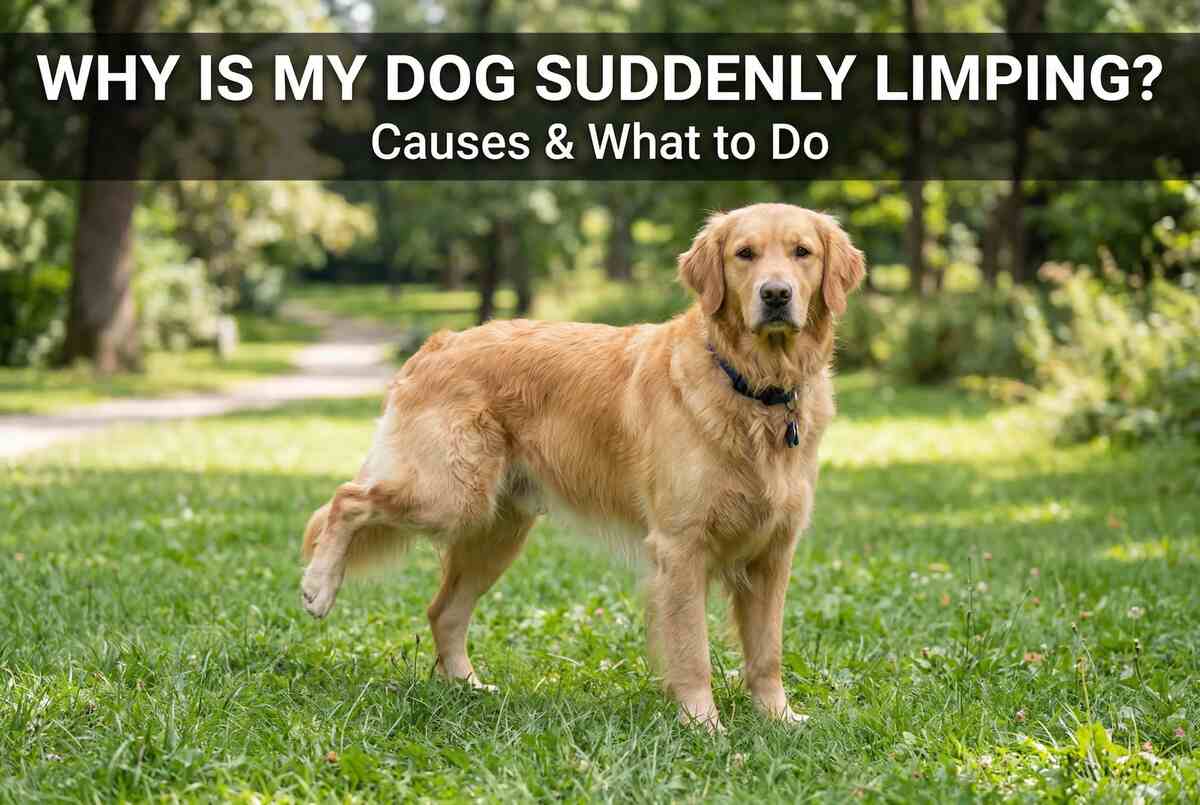
TL;DR
Sudden limping in dogs often means injury, strain, or a joint problem. It usually links to a recent trauma or overuse rather than a long-term condition. How much weight the dog puts on the leg is one of the clearest clues to how serious it is, and a dog that suddenly seems to “go limp” rather than simply favor the leg needs faster attention. Dogs may not show clear signs of pain even when something is wrong, and mild limping can improve on its own with rest. If a dog refuses to put weight on a leg, that needs attention right away. A sudden limp is a signal worth watching — if it continues or worsens, a vet check is important.
Quick Answer Box
Why is my dog suddenly limping? A dog may suddenly start limping because of an injury, a joint issue, or a paw problem. An injury typically leads to inflammation and pain that shows up as limping right away. A joint issue tends to cause stiffness and reduced movement instead. A paw injury usually causes irritation that makes the dog shift its weight off that leg. Many cases of sudden limping in dogs are linked to minor injuries like these, though in some cases it can point to deeper joint or nerve problems.
Table of Contents
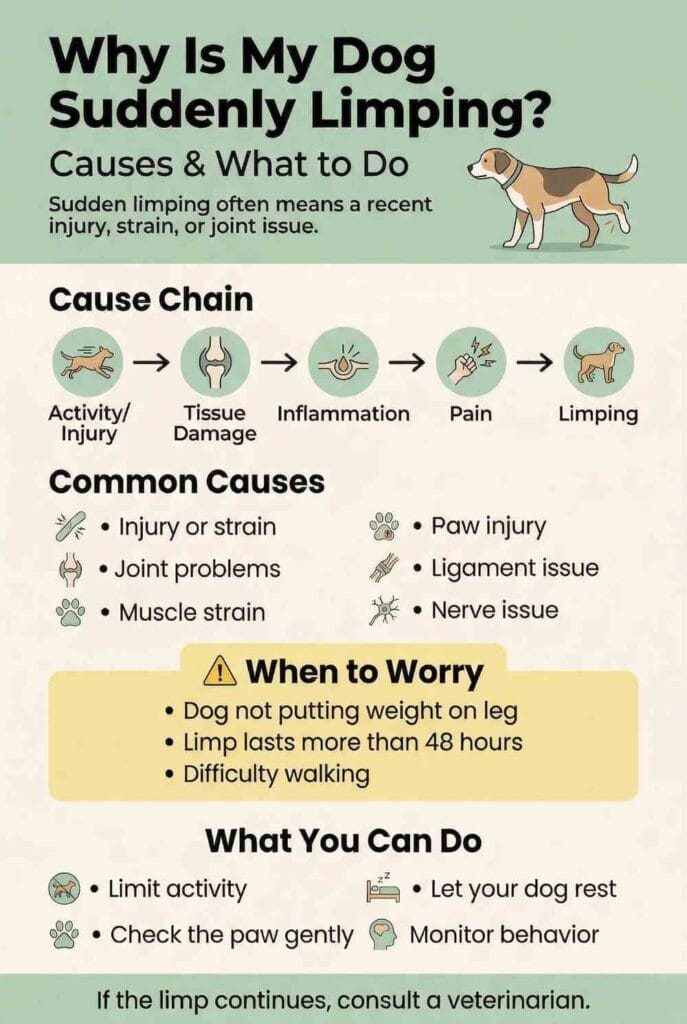
Here’s a simple visual to help you understand why a dog suddenly starts limping:
Why Is My Dog Suddenly Limping
Dog suddenly limping usually means something changed quickly in the body. When a dog starts limping out of nowhere, it often points to a recent trigger. This may include a small injury, muscle strain, or a hidden issue that was not obvious before.
In many cases, the cause follows a simple pattern:
activity or trauma → tissue damage → inflammation → pain → limping
A dog may get hurt while running, jumping, or playing. Even a minor strain can lead to limping. Sometimes, the problem is not easy to see, such as early joint stress or a small internal issue.
Knowing why this happens helps pet owners decide what to do next. For a complete overview of all possible causes, it helps to understand why is my dog limping. This sudden-onset pattern is also commonly described by the Veterinary Emergency Group as one of the most frequent reasons dogs are brought in for urgent evaluation. If the limp does not improve or gets worse, it is best to monitor closely and consider a veterinary check.
What Happened Before the Limp Started?
Sudden limping often traces back to a specific movement or moment, even when it feels completely random at first. A jump off the couch, a sharp turn while playing, a slip on a wet floor, or a hard landing can all be enough to trigger a limp right away. Looking back at what the dog was doing just before the limp appeared can offer real clues about what may be going on.
Activity and Movement Triggers
Most sudden limps follow a simple pattern: activity or trauma leads to tissue damage, which leads to inflammation, pain, and then limping. A sharp turn, a jump, or a hard landing can strain soft tissue or stress a ligament, causing the dog to suddenly favor one leg. A slip or a fall can jar a joint or bone, making the dog hesitate to put weight down right after. Rough play or a fast sprint can lead to overexertion, with pain showing up during the activity or shortly after it ends.
A limp that starts during or right after activity usually points to something new, like a strain, a sprain, or a paw injury. This is different from a limp that shows up after a period of rest, which tends to follow its own separate pattern and is covered elsewhere in this article.
Environmental and Contextual Clues
The ground a dog is walking on matters too. Hot pavement, ice, or debris-covered ground can irritate a paw pad enough to cause short steps or paw lifting, often without the owner ever seeing the exact moment it happened.
A recent vaccine is not a typical cause of sudden leg limping, but it is still worth mentioning to a vet if the dog seems sore, reactive, or generally unwell rather than just limping on one leg — see dog limping after vaccine for what that pattern usually looks like and when it needs attention. If the dog has recently spent time in a tick-prone or wooded area, that is also useful context to share, since it can point toward causes that go beyond a simple strain.
Why the Trigger Moment Is Often Missed
Many dogs seem completely fine one moment and then limping the next, with no clear accident in between. This is especially common when a dog was running, playing, or moving quickly, since fast movement makes it easy to miss the exact second something went wrong. The goal of thinking back through recent activity is not to diagnose which part of the body is affected, but to build a clearer timeline. This is most useful when the dog was active shortly before the limp started, or when the limp feels like it may be a repeat problem rather than something brand new.
Has This Leg Had Trouble Before?
It also helps to think about whether the same leg has caused problems in the past. A limp that keeps showing up in the same leg, even after periods of looking normal, can point toward an underlying issue that flares up rather than a single, one-time accident. This kind of pattern is worth mentioning during a vet visit, since it can shape which causes are more or less likely.
How to Safely Assess a Sudden Limp at Home
Watch Before You Touch
The safest first step is watching the dog’s stance and gait from a distance, before touching anything. A dog with a sudden limp often stands with one leg held differently even before it starts walking.
Comparing the affected paw to the opposite paw can reveal useful clues without any hands-on contact. One paw may look puffier, hotter, or more tender than the other. This side-by-side comparison can point to swelling, heat, a cut, or nail damage the owner might otherwise miss.
When to Stop the Check Immediately
Some signs mean it is time to stop checking the leg right away. If the dog cries, pulls away, guards the leg, growls, or becomes tense when touched, that is a clear signal to stop. A painful limb naturally leads to a guarding or pulled-back reaction, and pushing past that response only adds more stress for the dog.
It is not safe to bend, rotate, or squeeze a painful joint at home. This kind of handling can make the pain worse without giving the owner any useful information. A gentle look and a careful comparison are usually enough to gather what is needed before a vet visit.
Is “Went Limp” the Same as Limping?
Not always. Ordinary limping is pain-based. The dog is still trying to walk, just avoiding pressure on the sore leg. A dog that suddenly seems to “go limp,” on the other hand, may be showing signs of weakness or a floppy-type collapse instead of a typical gait limp. This is a different and more urgent situation than a standard limp.
Dragging the leg or knuckling the paw is another pattern worth recognizing on its own. Rather than favoring a sore leg, the dog may be showing poor limb control, which can point toward a nerve or spinal issue rather than ordinary pain-based limping. If a dog is dragging a leg or knuckling a paw, see why is my dog dragging his back legs for a closer look at that pattern.
Common Causes of Dog Suddenly Limping
| Cause | Signs | Severity |
| Injury | sudden limp, avoids putting weight | High |
| Joint issue | stiffness after rest, reduced movement | Medium |
| Paw injury | licking paw, sensitivity when touched | Low–Medium |
| Muscle strain | limping after activity, soreness | Low–Medium |
| Ligament injury (sudden limp) | cannot bear weight | High |
| Nerve issue | dragging leg, poor coordination | High |
Injury or Trauma (Most Common Cause)
A dog may suddenly limp after running, jumping, or playing. Even a small incident can lead to injury. This is the most common reason behind sudden lameness in dogs. A leg injury may not always show visible signs, but limping can start quickly after activity.
Soft Tissue Injuries (Muscle or Ligament)
Soft tissue injuries affect muscles, tendons, or ligaments. These injuries often happen from overuse or sudden movement. A mild muscle strain in the back leg may cause limping that worsens after activity. These injuries are common in active dogs.
Joint Problems (Arthritis or Joint Disease)
Joint issues can also cause sudden limping, especially in older dogs. In some cases, early joint issues may not be noticed until the dog starts limping. Conditions like arthritis or hip dysplasia can affect joint health. The dog may show stiffness before or after movement.
Paw or Foot Injury
Problems in the dog’s paw are easy to miss but often cause limping. A small object or cut can lead to discomfort. Paw pad injuries or a foreign object stuck in the paw can make the dog shift weight to other legs.
What Might Be Hidden in the Paw
Not every paw problem shows up as an obvious wound. A small object like a thorn or a piece of debris can lodge between the toes, causing pressure and irritation with every step. A nail that has cracked, split, or partly torn can hurt at the base with each step down, even when the nail itself still looks mostly normal from a distance.
Some signs point to a hidden paw problem before any wound is visible. A dog may lick or chew at one paw over and over. The nail might look broken or snagged. The skin between the toes may look red, swollen, or tender to the touch. In some cases, the dog clearly acts sore, but there is no obvious wound to explain it. This happens because the irritation is often under the fur, between the toes, or under the nail itself, not on the surface where it would be easy to spot.
A foreign object between the toes tends to follow a simple pattern: it causes local irritation, that irritation builds into pressure with each step, and the dog shifts weight away from the sore spot. A damaged nail follows its own pattern too. Pain builds at the nail bed, and the dog responds with short steps or a reluctance to put full weight down.
Environmental Irritation
The ground itself can be the problem. Hot pavement, ice, salt, or rough terrain can irritate the pads enough to cause a sudden limp. A dog that seems fine one moment and limping the next after a walk on a hot sidewalk or a salted path may simply be dealing with pad irritation from the surface underneath.
Insect Stings and Rarer Causes
An insect sting or bite can also cause sudden limping. The area swells, becomes uncomfortable, and the dog responds by licking, pawing at the spot, or favoring that leg.
Tick exposure is a much less common possibility, but it is still worth keeping in mind, especially if the limp comes with other signs of feeling unwell.
If something does seem to be stuck in the paw, it is best to look gently rather than try to dig it out. Removal attempts without the right tools or a clear view can push the object in deeper or cause more pain than leaving it for a vet or a careful, gentle check.
Neurological or Nerve Issues (Advanced Insight)
In some cases, limping is not caused by pain but by nerve problems. These affect how the leg moves. A dog dragging back legs or a dog losing use of back legs temporarily may show signs of nerve involvement. This is less common but important to notice.
Puppies: Why Sudden Limping Should Not Be Dismissed as Growing Pains
Growth Is One Possible Cause, Not an Automatic Explanation
Puppies are still developing, and one condition called panosteitis can cause limping that shifts between legs during a growth phase. But growth is just one possible explanation, not an automatic one. A limping puppy could also be dealing with a paw injury, a strain, a fracture, or another developmental bone or joint problem. Sudden limping in a puppy should never be waved off as simply “part of growing” without a closer look.
Puppies Can Still Play Through a Real Injury
The same masking instinct seen in adult dogs shows up in puppies too. A puppy may keep running, chasing, or roughhousing even while dealing with real pain. Continued play adds more stress to the injured area, which can make the limp worse later. This means a puppy can look severe with its limp while still seeming energetic and eager to play, which can easily mislead an owner into thinking nothing serious is wrong.
When a Puppy’s Limp Needs Veterinary Assessment
Persistent, severe, or non-weight-bearing limping in a puppy calls for veterinary assessment, even if a growth-related cause seems likely. A growing puppy still deserves the same careful attention as an adult dog when a limp doesn’t resolve on its own.
Dog Limping Front Leg vs Back Leg
Front Leg Limping
A limp in the front leg is often linked to issues in the paw, shoulder, or soft tissues. These areas carry most of the dog’s body weight, so even a small problem can affect movement.
Cause chain:
paw issue or strain → irritation → pain → limping
A limp may also be caused by cuts, objects stuck in the paw, or minor muscle strain. For a deeper look at front-leg-specific causes and signs, see why is my dog limping front leg.
Back Leg Limping
A limp in the back leg is often linked to the hip, knee, or ligaments. These joints play a key role in movement and support.
Cause chain:
joint stress or ligament strain → inflammation → pain → limping
A dog with a back leg limp may avoid putting weight on it. In some cases, not putting weight on a leg can indicate a more serious issue. If your dog won’t put any weight on the back leg at all, that’s a distinct and more urgent pattern — see dog not putting weight on back leg for what that specific symptom can mean.
Why This Difference Matters
This simple difference can guide the next steps and help identify possible causes early.
Understanding which leg is affected helps narrow down possible causes. It gives a clearer idea of what might be happening inside the body.
It also helps pet owners decide how urgent the situation may be. If the limp looks severe or unusual, closer monitoring and veterinary guidance are important.
Signs to Watch in a Suddenly Limping Dog
These signs can help pet owners understand how serious the limp may be. Watching closely can reveal important clues.
- dog not putting weight on one leg
- dog avoiding weight on the leg
- dog favoring one leg while walking
- dog holding leg up instead of using it
- dog limping randomly without a clear pattern
- dog limping but not in pain or not showing discomfort
If these signs continue or get worse, it is important to keep observing changes and contact a veterinarian if the limp does not improve.
Weight-Bearing vs. Non-Weight-Bearing: Why It’s the Key Severity Clue
How much weight a dog puts on the leg is one of the clearest at-home clues to how serious a limp may be. A mild weight-bearing limp still uses the leg, just carefully, often with a shorter stride. Partial weight-bearing looks different. The dog touches the paw down only briefly before lifting it again. Complete non-weight-bearing means the leg stays lifted or barely touches the ground, with the dog shifting its weight onto the other three legs instead. These are three separate patterns, not one sliding scale.
Weight-bearing is an observation, not a diagnosis. It shows how urgent the situation may be, but it does not reveal whether the cause is a sore paw, a ligament problem, or something else entirely. Dragging the leg or the paw flipping under is a different mechanism altogether, since it points to poor limb control rather than pain avoidance.
If your dog is refusing to bear any weight at all, see dog suddenly limping: when to take your dog to the vet for a full breakdown of urgency levels.
Dog Limping But Not Showing Pain
Dogs often hide pain as part of their natural instinct. In the wild, showing weakness can make them vulnerable. Because of this, a dog may limp even when it does not cry or react.
A dog limping with no pain when touched does not always mean there is no problem. The issue may still be present, but the dog is not showing clear signs.
Many pet owners notice that my dog is limping but shows no sign of pain. This can happen with minor injuries, early joint stress, or internal discomfort that is not easy to see.
If limping continues or behavior changes, it is best to monitor the dog closely and seek veterinary advice if needed.
For a deeper understanding, see why a dog may limp without showing pain.
Why a Dog May Limp With No Visible Injury
Pain Doesn’t Always Show on the Skin
A dog can limp without any sign of injury on the skin, because the real problem is often underneath. Muscle, tendon, or ligament injuries don’t always change how the skin looks. Joint pain can develop without any visible swelling. Even a paw injury can hide between the toes or under a nail where it stays out of sight.
A soft tissue injury causes pain without changing the skin, so the dog limps but looks completely normal from the outside. Joint pain without swelling leads to a subtle shift in the way the dog walks, and that persistent limp shows up with no obvious wound to explain it. A hidden paw injury follows the same pattern. There is no visible wound, but the dog keeps licking the area or hesitates to put weight on it.
Normal Behavior Doesn’t Rule Out Injury
An absence of a visible wound is not the same as an absence of injury. A dog that still eats, plays, or seems otherwise normal can still be dealing with something real — even activity level isn’t a reliable clue.
Does normal behavior mean the leg is fine?
Not on its own. Owners often watch for crying or limping as the main signs of a problem, but a dog can hide both while still eating, playing, and wagging normally — so the absence of those signs isn’t proof the leg is okay.
Sudden Limping vs Gradual Limping
Sudden Limping
Sudden limping happens quickly and often without warning. A dog suddenly limping is usually linked to a recent event, such as a jump, run, or minor injury.
Cause chain:
activity or trauma → tissue damage → inflammation → pain → limping
This type of limp appears fast and may seem like it came out of nowhere.
Gradual Limping
Gradual limping develops slowly over time, often linked to joint disease or long-term conditions rather than a single incident. This sudden-limping-focused article only touches on the gradual pattern briefly — why is my dog limping covers the full range of causes behind it.
New Injury vs. an Older Problem Becoming Suddenly Noticeable
How an Old Problem Can Suddenly “Appear”
A sudden limp doesn’t always mean a brand-new injury. Sometimes a structure that’s been quietly weakening, like a partially torn ligament, finally gives out during an ordinary movement. The dog wasn’t doing anything unusual. There was no fall, no yelp, no obvious moment where something went wrong. From the outside, this can look exactly like a fresh injury, but the mechanism underneath is different. A new injury usually follows a specific movement or impact. A previously hidden problem tends to show up during everyday activity, with no clear incident behind it.
If a limp keeps returning rather than resolving, that’s a different pattern worth understanding on its own — see why is my dog limping on and off.
When to Worry About Dog Suddenly Limping
Some signs suggest the limp may be more serious and needs attention.
- dog not putting weight on a leg
- swelling or visible deformity
- severe limping or inability to walk normally
- dog dragging leg or showing poor control
- limp lasts more than 48 hours
- sudden limping without a clear reason
If a sudden limp keeps returning instead of resolving, it may be shifting into a recurring pattern rather than a one-time injury.
If your dog shows any of these signs, especially difficulty bearing weight or severe pain, see dog suddenly limping: when to take your dog to the vet for a full breakdown of urgency levels.
If any of these signs appear, it is important to monitor closely and seek veterinary care for proper evaluation.
What to Do in the First 24 Hours
Limit Movement the Right Way
Stop running, jumping, rough play, and stairs where possible. For bathroom needs, use short, controlled leash trips instead of letting the dog move freely in the yard. A quick leash trip is not the same as a normal walk, and keeping movement this controlled gives the injured area a real chance to settle.
A stable, non-slip surface also helps during this first stretch, since a dog favoring a sore leg has less margin for a slip or a sudden shift in weight.
What to Track
A few details are worth writing down or keeping in mind over the next several hours. Note which leg seems affected, how much weight the dog puts on it, any swelling, and whether the dog’s behavior or appetite changes. A short walking video can help too — more on that below.
Rest and reduced movement tend to ease strain on the injured area, so a mild limp often improves with this kind of restriction. Continued jumping or running does the opposite. It adds more stress to the injury, and pain or swelling can worsen as a result.
Never Give Human Pain Medicine
Human pain relievers should never be given to a dog unless a veterinarian specifically says to. Even a dose that seems small can be dangerous or fatal, since dogs process these medications very differently than people do. Reaching for something from the medicine cabinet might feel like the responsible move in the moment, but it can end up masking symptoms unsafely or causing real harm on its own.
Can I give my dog Tylenol or ibuprofen for the pain?
No. Dogs metabolize these drugs very differently than people, and even common over-the-counter pain relievers can cause stomach ulcers, kidney damage, or liver failure at doses that would be harmless for a person.
How Long Is Too Long to Wait?
There isn’t one fixed number of hours that applies to every situation. What matters more is whether the limp is staying the same, improving, or getting worse. A truly mild limp that’s improving can often be watched for around 24 to 48 hours. If it isn’t improving in that window, or if new signs show up, it’s time to move toward a veterinary evaluation rather than continuing to wait it out.
How long should I wait before calling the vet if the limp doesn’t improve?
Watch the trend, not the clock. Two dogs both limping mildly at hour 12 can be in very different situations — one improving toward normal, one plateauing — and it’s that trajectory, more than the exact hour count, that should guide when to call.
Can a Dog Still Play or Act Normal With a Real Leg Problem?
Yes, a dog can still run, play, or act completely cheerful with a real injury. Excitement and adrenaline can temporarily override the instinct to guard a sore leg, so the dog keeps moving even though something is genuinely wrong underneath.
Continued activity can make an existing injury worse. Running, jumping, or rough play adds more stress to tissue that’s already hurt, and the limp may look worse once the activity stops and the adrenaline fades.
Activity level alone isn’t a reliable way to judge how serious a limp is. A happy, energetic dog isn’t the same as an uninjured one. If the limp keeps showing up after play or exercise, that pattern matters more than how normal the dog seems while playing.
Information to Record Before Calling the Vet
What to Note
A few clear details can make a real difference during that first call. Note the time the limp started, along with anything that might have triggered it. Write down which leg looks affected, and whether it’s the front or back, left or right. Pay attention to how much weight the dog puts on the leg, and whether the limp stays the same or seems to be changing.
Other useful details include any visible swelling or paw problem, and whether the dog is crying, panting, trembling, or guarding the leg. Appetite and general behavior are worth noting too, since a change there can add context to the physical signs.
A clear timeline paired with trigger notes gives the vet a stronger starting point, which often helps narrow down the likely causes faster. Cornell University’s Riney Canine Health Center offers similar guidance on what to expect and prepare for when bringing a limping dog in for evaluation.
What information should I write down before calling the vet?
Beyond the basics, mention anything that changed right before the limp — a walk, a jump, new terrain — since vets often ask about recent activity first, and having it ready saves time on the call.
Why a Walking Video Helps
A short walking video is often more useful than trying to describe the limp out loud. This matters most when the limp comes and goes, since it might not show up during the actual appointment. A video captures the real gait change, which can be the difference between a vet seeing exactly what’s happening at home and a vet examining a dog that suddenly looks perfectly normal in the exam room.
Why does a walking video help more than a description?
Vets are trained to read subtle gait patterns that are hard to put into words — a slightly shortened stride or a barely-there head bob — so footage often reveals more than an owner’s best verbal description ever could.
How Vets Diagnose Limping in Dogs
Veterinarians use a step-by-step approach to understand why a dog is limping. The goal is to find the underlying cause and guide the next steps in care.
First, a physical exam is done. The vet observes how the dog walks and checks the affected leg. This helps assess pain, movement, and balance. This step-by-step approach mirrors the orthopedic exam process described by the University of Illinois College of Veterinary Medicine, which also starts with observing gait before any hands-on evaluation.
Next, the vet checks joints and muscles. This helps identify stiffness, swelling, or weakness that may not be visible.
If needed, x-rays may be used. These help detect bone issues, joint problems, or hidden injuries.
The process focuses on proper diagnosis so the right treatment plan can be considered. Good veterinary care helps ensure the problem is understood clearly.
FAQ Section
Why is my dog suddenly limping on the back leg?
A dog may suddenly limp on the back leg due to injury, strain, or joint stress. Common causes include muscle strain, ligament issues, or paw problems. The limp can appear quickly after activity.
What would cause a dog to suddenly limp?
Sudden limping often comes from a recent trigger. This may include injury, overuse, or a minor trauma.
Cause chain:
activity → tissue damage → inflammation → pain → limping
What should I do if my dog is limping?
Stop running, jumping, rough play, and stairs where possible, and use short, controlled leash trips for bathroom needs instead of free yard time. Keep track of which leg is affected, how much weight the dog puts on it, and any changes in behavior or appetite. If the limp continues or the cause is unclear, a veterinary check is recommended.
How can I tell if my dog’s limp is serious?
A limp may be serious if the dog does not put weight on the leg, shows swelling, or has severe difficulty walking. Sudden changes that do not improve need attention.
Will a dog limping heal by itself?
Some mild cases improve with rest. However, not all limping resolves on its own. If it lasts more than a couple of days, it is best to seek veterinary advice.
Why is my dog limping with no sign of injury?
A dog can still limp even when the skin looks completely normal, since the real problem is often underneath. Muscle, tendon, and ligament injuries, along with joint pain, don’t always change how the skin looks, so a limp with no visible sign is not the same as no injury at all. Dogs may also hide pain, so it’s worth monitoring closely rather than assuming nothing is wrong.
What does it mean if my dog “just went limp”?
A dog that suddenly seems to “go limp” may be showing weakness or a floppy-type collapse rather than a typical gait limp. This is different from ordinary limping, which is pain-based and still involves the dog trying to walk, and it is considered a more urgent situation.
Does how much weight my dog puts on the leg tell me how serious the limp is?
Yes, this is one of the clearest at-home clues to how serious a limp may be. A mild limp still uses the leg carefully, a partial weight-bearing limp touches down only briefly, and a non-weight-bearing limp means the leg barely touches the ground at all — but weight-bearing is an observation, not a diagnosis, so it shows urgency without revealing whether the cause is a sore paw, a ligament problem, or something else.
Is sudden puppy limping just part of growing?
No, growth is only one possible explanation, not an automatic one. A limping puppy could also be dealing with a paw injury, a strain, a fracture, or another developmental bone or joint problem, so sudden puppy limping should never be waved off as simply “part of growing” without a closer look.
Should I walk my dog if he has a slight limp?
Light movement may be fine in mild cases, but activity should stay limited. Avoid running or jumping. Rest is important to prevent further strain.
What is the most common cause of limping in dogs?
Injury or strain is the most common cause. Sudden limping often happens after activity that leads to minor tissue damage or inflammation.
What kind of activity commonly precedes a dog suddenly limping out of nowhere?
A sudden limp often follows a specific movement, like a sharp turn, a jump, a slip, or rough play. These activities can strain soft tissue, stress a ligament, or jar a joint, which is why the limp shows up right after.
Why might my dog have started limping for no reason?
Fast movement makes it easy to miss the exact second something went wrong. A dog that suddenly started limping out of nowhere may have been running, playing, or moving quickly just before, with no clear accident in between.
Does it matter whether the limp appeared during or after activity?
Yes, timing offers a real clue. A limp that starts during or right after activity usually points to something new, like a strain, sprain, or paw injury. A limp that shows up after rest instead tends to follow a different pattern.
Can limping return in the same leg?
Yes, a limp that keeps showing up in the same leg, even after periods of looking normal, can point toward an underlying issue that flares up rather than a one-time accident. This pattern is worth mentioning at a vet visit.
What should be checked first if my dog is holding a leg up but not limping normally?
The safest first step is watching the dog’s stance and gait from a distance before touching anything — a dog holding a paw up or favoring a leg without walking normally often stands with it held differently even before moving. Comparing the affected paw to the opposite paw can also reveal useful clues, like swelling, heat, or nail damage, without any hands-on contact.
Is it safe to touch or move a limping dog’s leg at home?
It is not safe to bend, rotate, or squeeze a painful joint at home, since this kind of handling can make the pain worse without giving any useful information. A gentle look and a side-by-side comparison between paws is generally safe, but if the dog cries, pulls away, guards the leg, growls, or becomes tense when touched, that’s a signal to stop right away.
Is non-weight-bearing limping automatically more serious?
Non-weight-bearing generally signals a more urgent situation than a mild, weight-bearing limp, since it means the dog isn’t using the leg at all rather than just favoring it carefully.
What hidden paw problems commonly cause a dog to favor a paw or limp with paw pain?
A small object like a thorn or piece of debris can lodge between the toes, and a cracked, split, or partly torn nail can hurt at the base with every step. Both can cause sudden paw pain and limping, sometimes with a visibly swollen paw, without leaving an obvious wound behind.
Why might there be no visible cut or wound even with a real paw injury?
The irritation is often under the fur, between the toes, or under the nail itself, not on the surface where it would be easy to spot. A dog may still lick or chew at the paw repeatedly, or hesitate to put weight down, even without a visible wound.
Should an owner try to remove something stuck in the paw themselves?
It is best to look gently rather than try to dig it out. Removal attempts without the right tools or a clear view can push the object in deeper or cause more pain, so a vet or a careful, gentle check is the safer route.
Can a dog still run or play with an injured leg?
Yes, a dog can still run, play, or act completely cheerful with a real injury. Excitement and adrenaline can temporarily override the instinct to guard a sore leg, so the dog keeps moving even though something is genuinely wrong underneath.
Does my dog acting normal mean the limp isn’t serious?
Not necessarily. Activity level alone isn’t a reliable way to judge how serious a limp is, since a happy, energetic dog isn’t the same as an uninjured one. If the limp keeps showing up after play or exercise, that pattern matters more than how normal the dog seems while playing.
My dog was limping then stopped, or the limp seems to be getting worse — what does that mean?
A sudden limp doesn’t always mean a brand-new injury. Sometimes a structure that has been quietly weakening, like a partially torn ligament, finally gives out during an ordinary movement, with no fall, yelp, or obvious moment where something went wrong. Whether a limp comes and goes or seems to be getting worse over time, a previously hidden problem tends to show up during everyday activity rather than following a specific incident.
Does no visible injury mean it’s probably minor?
Not necessarily. A sudden-looking limp can come from a problem that was already developing, even without a visible injury, so the absence of a visible cause doesn’t confirm the limp is mild.
Can a puppy still be limping but not crying, and still want to play?
Yes, a puppy may keep running, chasing, or roughhousing even while dealing with real pain, since the same masking instinct seen in adult dogs shows up in puppies too — many puppies don’t cry even with a genuine injury. This means a puppy can look severe with its limp while still seeming energetic and eager to play, so persistent, severe, or non-weight-bearing limping still calls for veterinary assessment.
Sources & References
- American Kennel Club (AKC) — Why Is My Dog Limping?
https://www.akc.org/expert-advice/health/why-is-my-dog-limping/ - VCA Animal Hospitals — Lameness in Dogs
https://vcahospitals.com/know-your-pet/lameness-in-dogs - Merck Veterinary Manual — Lameness in Dogs
https://www.msdvetmanual.com/dog-owners/bone-joint-and-muscle-disorders-of-dogs/lameness-in-dogs - PetMD — Why Is My Dog Limping?
https://www.petmd.com/dog/symptoms/why-is-my-dog-limping - Cornell University Riney Canine Health Center — What to Expect When Taking Your Limping Dog to the Veterinarian
https://www.vet.cornell.edu/departments-centers-and-institutes/riney-canine-health-center/canine-health-information/what-to-expect-when-taking-your-limping-dog-to-the-veterinarian - University of Illinois College of Veterinary Medicine — Orthopedic Exam
https://vetmed.illinois.edu/demo-sa-orthopedics/orthopedic-exam-general/ - Veterinary Emergency Group (VEG) — Why is My Dog Limping Suddenly?
https://www.veg.com/post/dog-limping-suddenly
What to Do Next If Your Dog Keeps Limping
If a dog suddenly starts limping, it is important to watch for changes. Mild limping may improve, but it should not be ignored.
If the limp continues, gets worse, or new signs appear, seeking veterinary advice is the safest step. Early attention helps ensure proper care and better outcomes for the dog’s health.
Update Note
This article was reviewed and updated on July 29, 2026 with new sections covering how to safely check a limp at home, what typically triggers a sudden limp, how to tell how serious a limp is by weight-bearing level, hidden paw injuries that aren’t always visible, what to do in the first 24 hours, and why sudden puppy limping shouldn’t be dismissed as growing pains. This article is for educational purposes only and is not a substitute for professional veterinary care. If your dog’s limping continues, worsens, or is accompanied by other symptoms, a veterinarian can help confirm the cause and recommend next steps.