
TL;DR
A dog limping after running can happen for several reasons. Common causes include muscle strain, joint stress, paw injury, or ligament problems. This usually happens after running hard or long-distance activity. If the limp started during rough play, see why dogs limp after playing. If it happened after a jump or landing, see why dogs limp after jumping.
Some dogs improve after rest. This often means mild strain or overuse.
running → muscle fatigue → soreness → temporary limping
Limping without clear pain can still matter. Early joint issues or instability may not show obvious discomfort at first.
Sudden or worsening limping needs attention. If the dog avoids putting weight on the leg or the limp does not improve, the issue may be more serious.
Duration alone isn’t the most useful signal — whether the limp is improving, whether the dog is still bearing weight, and whether any swelling appears say more about severity than how many hours have passed. A veterinary check is recommended if the limp is worsening, recurring, or the dog is reluctant to bear weight.
Quick Answer Box
If a dog is limping after running, it is often linked to mild strain, paw injury, or joint stress. In some cases, it may also relate to ligament strain or early joint changes.
Common pattern:
running → repeated stress → inflammation → limping
What this means for owners:
- Mild limping may improve with rest
- Limping that comes and goes may signal early joint issues
- Sudden or severe limping needs attention
Even if the dog seems active, the body may be protecting an affected leg. Watching small changes early can help prevent further strain.
Table of Contents
What Kind of Run Happened Before the Limp?
Working out what the run actually looked like is one of the most useful first steps an owner can take. The moment a limp began, and how that run compared to the dog’s usual routine, often points toward whether the problem is a sudden strain, a paw issue, or something that built up over time.
What Happened During the Run
A sharp turn or sudden stop puts a lot of load on one leg at once. The limb twists under that load, soft tissue gets strained, and a limp shows up either right away or shortly after the run ends.
A slip or stumble mid-run works the same way. The joint or muscle is overstressed in a split second, and the owner usually notices an abrupt limp rather than one that creeps in gradually. This is often the story behind a dog that hurt a leg running with no other obvious warning.
An audible yelp is worth close attention. A yelp during a run points to an acute pain event at that exact moment, and the limping that follows is often localized to one specific spot.
Two details matter most here. The first is whether the limp started mid-run or only after the dog stopped. The second is whether anything obvious happened first, such as a slip, a stumble, or a sound.
Some dogs give a clear signal. Others show nothing at all until the run is over. Either way, the goal at this stage is simply reconstructing the moment, not working out which tissue is involved.
Was This Run Different From Usual?
The shape of the run matters as much as any single moment in it. A short, hard sprint loads the body very differently than a long, steady distance run, and each can cause trouble in its own way.
It also helps to think about whether the run pushed past the dog’s normal routine. A sudden jump in distance, a faster pace, or an unfamiliar uphill or downhill stretch all place demands the body may not be ready for. Uphill and downhill running each create their own kind of load, which is covered in more detail further down.
Time off matters too. When a dog returns to running after a break, conditioning has usually dropped.
Cause chain:
reduced conditioning → tissue overload → post-run soreness → limping
This is a common reason a dog is limping after running hard when the same effort caused no problem a few weeks earlier. The simplest question to ask is whether the run felt harder than usual, whether that means longer, faster, hillier, or just more than the dog has done lately.
Has This Happened After Earlier Runs?
A single limp after one run is a different situation from the same leg giving trouble again and again. When the same limb keeps showing a limp after multiple runs, that repeating pattern suggests a strain that never fully settled or an underlying issue that keeps getting triggered at a certain activity level.
A pattern like that is worth a veterinary evaluation rather than another round of rest and hope.
It helps to note which leg is affected and how much weight the dog puts on it each time. That is worth recording as an observation, not as a way to work out the cause. Which leg is involved does not identify what is wrong with it.
If the limp keeps coming and going across many activities rather than only after runs, that recurring pattern has its own considerations — see why is my dog limping on and off for a closer look.
Monitor, Vet Soon, or Emergency
One point is worth stating clearly. A limp that starts at a specific moment during a run is a different mechanism from one that builds slowly over weeks. Sudden-onset limping usually traces back to an injury or trauma during the activity itself — see why is my dog suddenly limping for a closer look at these acute causes — while gradual-onset limping points more toward a chronic or overuse-related process. These two are easy to blur together, but they are not the same thing.
A single awkward moment that leads to a mild limp, with the dog still bearing weight and improving after rest, is usually reasonable to watch at home.
A limp that followed a clear slip, yelp, or collision and has not improved after rest is worth checking with a vet soon. The same applies when the same leg has been affected repeatedly across recent runs.
A dog that will not put weight on the leg at all, has a visibly abnormal limb shape, seems to be in severe pain, or gave a loud yelp at the moment of injury needs same-day veterinary care.
Why Is My Dog Limping After Running?
A common reason why is my dog limping after running is that activity puts stress on muscles, joints, and paws. After running, the body may react with soreness, mild inflammation, or instability. This can change how the dog walks, even if the dog still seems active.
Limping After Exercise Is Common
Dogs that run for long distances or at high intensity can develop temporary strain. This is more likely in active dogs or after long or repetitive running activity.
Cause chain:
exercise → muscle fatigue → minor strain → limping
In many cases, this type of limping improves with rest. The body recovers once the stress reduces. Some dogs also struggle after activity, especially when using stairs, which can highlight underlying joint or movement issues.
Dogs May Not Show Pain Clearly
Some dogs limp without crying or showing clear pain. They may still run, eat, or play as usual.
Dogs often hide discomfort. A small limp may be the only visible sign that something feels wrong.
Sudden vs Gradual Limping
The timing of limping can give useful clues.
- Sudden limping → may appear after a run if the leg was overloaded or strained
- Gradual limping → may relate to joint changes or long-term stress
Sudden lameness in dogs should be watched closely. If it does not improve, it may be a sign of a more serious issue — see when to take your dog to the vet for sudden limping
While running is a common trigger, limping can also happen due to other possible causes of limping in dogs.
Common Causes of Dog Limping After Running
Several conditions can explain dog limping after running. Some are mild and improve with rest. Others may need closer attention if they persist or worsen.
Muscle Strain or Overuse
This is the most common cause. It often happens after long runs or repeated activity without enough rest.
Cause chain:
overuse → muscle strain → soreness → limping
The dog may limp after running hard but still stay active. This usually improves with rest.
Paw or Foot Injury
Small injuries in the paw can change how a dog walks. A thorn, cut, or debris may cause discomfort.
Signs may include:
- dog licking foot and limping
- dog sore paw limping
Even minor paw issues can lead to noticeable limping.
Ligament Stress or Partial Tear
Ligaments help stabilize joints, especially in the back leg. When stressed, the joint becomes less stable.
Cause chain:
joint instability → uneven weight → limping
A dog may avoid putting weight on the affected leg. This can appear as dog limping on back leg after running.
Joint Problems (Early Arthritis or Instability)
Joint issues can develop slowly, especially in older dogs. After running, stress on joints may trigger limping.
Cause chain:
joint wear → inflammation → stiffness → limping. The dog may limp at first but improve after moving.
Luxating Patella (Knee Cap Issue)
This condition causes the kneecap to move out of place briefly. It leads to sudden, short-term limping.
Cause chain:
kneecap shift → temporary instability → limping
The dog may return to normal quickly, then limp again later.
Minor Trauma (Slip, Jump, Fall)
A dog may move unevenly or overextend a limb during a run. This can cause sudden limping. In some cases, this type of movement can lead to issues similar to limping after jumping.
Cause chain:
sudden movement → soft tissue stress → limping
This is often seen when a dog was running and now limping.
How Running Style and Surface Change Limb Stress
Not every run loads a dog’s body the same way. Pace, direction changes, hills, and the ground underfoot each create a different kind of demand. A mismatch between those conditions and what the dog is conditioned for is a common trigger behind post-run limping.
Sprinting, Distance, and Sharp Turns
Fast sprinting loads joints and tendons quickly. That rapid force can strain tissue in a single burst, which is why a dog limping after running fast may show a limp that appears suddenly rather than building up.
Long-distance running works differently. The load is lighter in each stride but repeats thousands of times, so stress accumulates over the course of the run. This is often behind a dog limping after running a lot when nothing dramatic happened at any single moment.
Sharp turns add a twisting element that straight-line running does not.
Cause chain:
direction change → uneven limb loading → ligament and muscle stress → limping
The knee’s cruciate ligament is one commonly affected example. Owners often notice that limping follows runs with a lot of cutting and direction changes more than it follows steady, straight running.
Uphill vs. Downhill Running
Running uphill and running downhill are recognized as different kinds of work. Uphill running increases the pushing demand on the hind end, since the dog drives the body upward with every stride.
Downhill running shifts the demand toward braking and control. The legs work to slow the body rather than propel it, which is a different job for the same muscles and joints.
Both are worth noting when thinking back on a run, though the effect of grade alone is less clearly documented than the effect of surface type.
Hard, Rough, and Slippery Surfaces
The ground a dog runs on matters as much as how fast the dog runs on it. Hard pavement and concrete create repeated impact on the paw pads with every stride. On hot days, thermal stress adds to that, and pad burns or blistering can follow.
Pavement can cause trouble even when it is not hot. Dogs that are not used to running on concrete have pads that have not toughened for it.
Sand and soft ground create the opposite problem. The footing gives way underfoot, so muscles work harder to stabilize each stride and fatigue arrives sooner than it would on firm ground. This is one reason a dog limping after running on beach sand may struggle after a distance that would be easy elsewhere.
Rough or rocky trails introduce irregular foot placement. Each stride lands slightly differently, which raises the chance of a stumble or of abrasion across the pads. The limp often shows up once the run ends rather than during it.
Ice and slippery ground reduce traction. When footing gives way unexpectedly, the leg can stretch or twist as the dog tries to stay upright. A dog limping after running in snow may be reacting to a slip rather than to the cold itself.
A practical point runs through all of this. Dogs do best when exercised on reasonably consistent surfaces. When a new type of ground is introduced, doing it gradually gives the paws and muscles time to build tolerance.
Two owner observations are worth watching for here:
- limping that shows up specifically after runs on a new or unfamiliar surface
- redness, blistering, or raw-looking pads after pavement runs
Why a Small Paw Problem Gets Worse With Distance
A minor paw issue can stay quiet at the start of a run and become a real problem by the end. A small stone lodged between the toes, a torn or broken nail, or a patch of mild pad irritation all get pressed against the ground with every stride, a pattern Brinker Veterinary Hospital identifies as a common trigger behind post-activity limping.
The pressure repeats. Discomfort that was barely noticeable in the first few minutes builds as distance adds up, and the limp appears only later in the run or once the dog stops. This is why a dog limping after running around the yard or a trail may seem fine at the start and clearly uncomfortable by the end.
Excessive licking at one paw afterward is a useful signal. A dog that keeps returning to the same foot is often pointing to where the discomfort is.
Monitor, Vet Soon, or Emergency
One distinction is worth keeping clear. Pad-focused problems such as burns, abrasions, and cracked nails come from contact with the ground itself. Joint and ligament strain comes from turning, impact, and force loading. Different surfaces point toward different problems, so noting the ground the dog ran on narrows things down.
A mild limp after a short run on a familiar surface, with no swelling and the dog still bearing weight, is usually reasonable to monitor at home.
Limping that repeats after runs on the same surface is worth checking with a vet soon. The same applies to a visible paw wound that cannot be safely addressed at home.
Visible swelling, refusal to put weight on the leg, or clear signs of severe pain after a slip or fall call for same-day veterinary care.
Limping During the Run vs. After the Run vs. After Rest
When a limp shows up matters as much as what the run looked like. A limp that appears mid-run, one that surfaces the moment the dog stops, and one that only becomes obvious hours later each point toward something different happening in the body.
During the Run
A limp that starts in the middle of a run usually means something happened at that moment. An acute paw injury or a slip localizes pain right away, and the dog reacts immediately rather than gradually.
The signs tend to be obvious. The dog may yelp, stop short, or hesitate before continuing, and the limp is visible from that point onward. There is rarely any guesswork about when it started.
Right After the Run Ends
Some limps only appear once the run is over. Repetitive loading or paw irritation builds slowly across the run, and the discomfort becomes noticeable as the dog slows down and the strain finally registers.
Excitement plays a part here too. Adrenaline during activity can mask discomfort, so a dog limping after running but still running enthusiastically at the time is a common pattern rather than a contradiction. The limp surfaces once the dog calms down, not while the excitement is still high.
Owners often describe exactly this. The dog seemed completely fine during the run, then started favoring a leg a few minutes after stopping.
Later, After Resting
A different pattern shows up after a longer stretch of rest. Joint or soft tissue irritation can stiffen while the dog is lying still, so the limp or stiffness becomes most noticeable once the dog stands back up.
This one is worth recognizing but not over-interpreting. A limp that fades and then reappears after rest overlaps with post-rest stiffness patterns, which have their own separate considerations.
After Every Run
Some limps arrive on schedule. When an unresolved problem is triggered at a predictable activity level, the limp follows every run regardless of how long or short it was.
That consistency is the signal. A dog that limps after each run, rather than only after unusually hard ones, is showing a pattern rather than a one-off event. Recurring limping across activities has its own set of considerations covered separately.
Monitor, Vet Soon, or Emergency
One distinction is worth stating plainly. Mid-run onset points toward a specific injury moment. Delayed-onset limping is more often tied to cumulative strain or joint irritation becoming noticeable later. These are different mechanisms, not different levels of seriousness, and a delayed limp is not automatically milder than an immediate one.
A brief limp that improves with rest and does not happen often is usually reasonable to watch at home.
A limp that shows up after every run, or one that persists without improving, is worth checking with a vet soon.
A limp that begins mid-run alongside a yelp, an inability to bear weight, or visible swelling calls for same-day veterinary care.
What Happens Inside the Body (Simple Explanation)
After running, the body may respond to stress in muscles, joints, or soft tissues. This stress can affect how the dog moves, even if there is no clear pain at first.
Cause chain:
running → joint or muscle stress → inflammation or instability → uneven weight distribution → limping
When one area feels weak or irritated, the body shifts weight to protect it. This changes balance and movement.
In some cases, the dog may still walk or run. The discomfort may be mild or not obvious. But the movement pattern shows that something is not working normally.
Over time, uneven weight can place extra strain on other legs and joints. This is why even a mild limp after running should be watched closely.
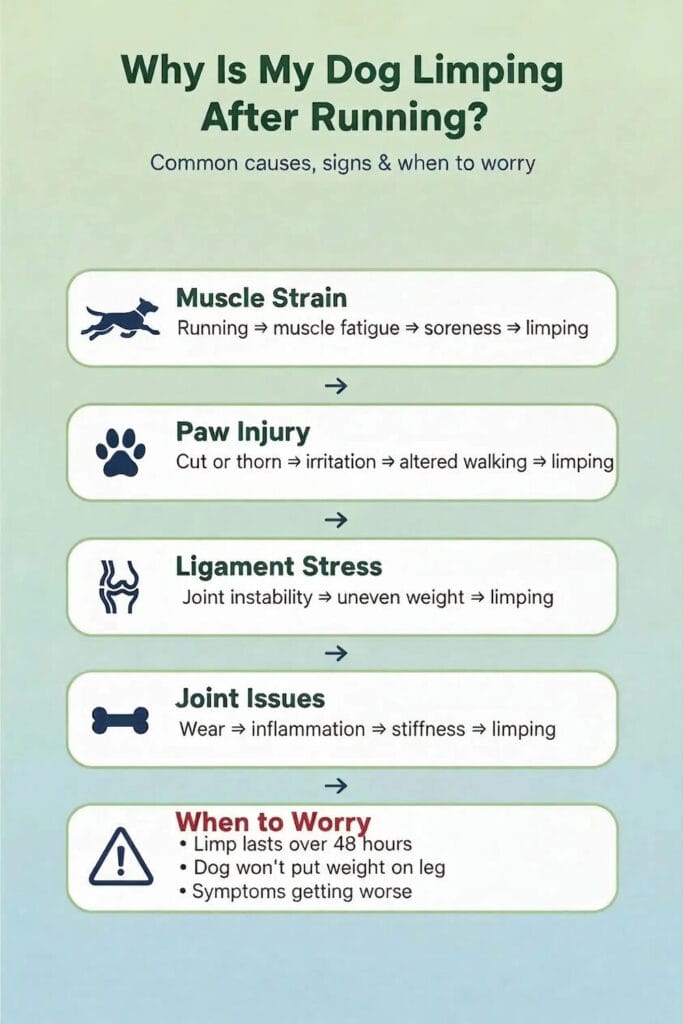
This visual explains why a dog may limp after running, including muscle strain, paw injury, ligament stress, or joint issues.
Learn more about early signs in this guide: How to Tell If Your Dog Has Joint Pain
Signs to Watch Along With Limping
Limping after running can come with other small changes. These signs help show how the body is reacting. Watching them early can help prevent further strain.
Movement Changes
Changes in movement are often the first clue. The dog may seem stiff or slow at the start.
- stiffness after rest
- slow walking at first
These signs may improve after a few minutes of movement.
Weight-Bearing Changes
A dog may try to protect the affected leg. This changes how weight is placed.
- not putting weight on leg
- shifting weight to other legs
This often makes the walk look uneven.
Behavior Changes
Small behavior changes can show discomfort, even without clear pain.
- less activity
- hesitation to jump or run
The dog may still act normal but avoid certain movements.
Paw-Related Signs
Foot problems are common after running or playing outdoors.
- licking foot
- visible irritation or debris
These signs may point to a paw injury or discomfort in the foot.
General Exercise Fatigue vs. a True Limp
Not every movement change after a run is a limp. Tiredness and limping can look similar at a glance, but they show up in the body very differently, and telling them apart changes what an owner should do next.
What General Tiredness Looks Like
Long or intense exercise produces whole-body muscular fatigue. The dog moves at a slower overall pace, rests more, and takes longer to settle back into normal energy levels.
The key feature is that it affects everything evenly. All four legs still carry weight the same way, and the gait stays symmetrical even though the dog is clearly worn out.
Other signs of general overexertion follow the same whole-body pattern:
- excessive panting
- restlessness
- stiffness
- reluctance to get up and walk
A dog that seems lethargic and is resting more, but walking evenly on all four legs, is showing tiredness rather than injury. Owners sometimes describe this as a dog that can barely walk after running, when the real issue is exhaustion rather than a sore leg.
What a True Limp Looks Like
A true limp is localized. Injury or strain confined to one limb produces pain in that specific leg, and the dog changes how it moves to protect it.
That protection shows up as a shortened stride on one side or reduced weight on the leg. A dog limping when walking but not running, or one that favors a single leg while otherwise moving normally, is showing a localized problem rather than a global one.
Two practical markers help here: shorter steps on one side, and uneven gait symmetry. A dog limping after exercise that keeps putting less weight on the same leg is protecting that limb for a reason, even if the rest of the body looks fine.
Stiffness, Weakness, and Poor Limb Control
Some post-run movement changes fall outside both categories and are worth naming separately.
Stiffness looks rigid or shortened rather than one-sided, and it tends to be most visible after a period of rest rather than immediately after activity. That pattern has its own considerations covered elsewhere.
Weakness is different again. A dog struggling to support its body weight or hold its balance is not simply favoring a sore leg, and hind-leg weakness in particular has its own set of causes worth reading about separately.
Poor limb control is the most distinct of the three. Dragging a paw, knuckling over, or placing a foot abnormally points toward something other than a simple strain and is covered on its own page.
Systemic exhaustion or heat stress belongs in this group too. When the whole body loses coordination, the dog wobbles or stumbles across all four limbs rather than protecting one, which signals overexertion rather than limping.
Monitor, Vet Soon, or Emergency
Three patterns are worth keeping separate rather than blending into one idea. General fatigue is even, whole-body, and affects all four legs. A true limp is localized to one limb with a shortened stride. Overexertion or heat stress produces systemic wobbling and stumbling. These are not different levels of the same thing.
General tiredness with even leg use and normal recovery after rest is usually fine to monitor at home.
A localized limp on one leg that persists beyond a short rest period is worth checking with a vet soon.
Wobbling, stumbling, or loss of coordination alongside other overexertion signs such as dark gums, collapse, or disorientation calls for same-day veterinary care.
When to Worry About a Limping Dog
Not all limping after running is serious. Some cases improve quickly. Others may need closer attention, especially if signs change or worsen.
Mild Cases (Monitor First)
Some dogs show a slight limp after exercise. This may improve with rest and reduced activity.
- slight limp
- improves after rest
Cause chain:
exercise strain → mild soreness → temporary limping
If the dog returns to normal within a short time, it is often a mild issue.
Warning Signs
Certain signs suggest the problem may not be minor. These should be watched carefully.
- limp is not improving, or is getting worse, rather than settling
- worsening limp
- swelling
These changes may mean the body is not recovering as expected.
Serious Signs
Some signs need prompt attention. These may show that the dog cannot use the leg properly.
- dog won’t put weight on leg
- sudden severe limping
- weakness or collapse
Cause chain:
injury or instability → loss of support → inability to bear weight
In these cases, a veterinary check is strongly recommended.
Mild Post-Run Pattern vs. a More Concerning Pattern
How long a limp has lasted is only part of the picture. What the leg is doing, whether things are improving, and whether swelling has appeared usually say more about severity than the number of hours that have passed.
Comparing the Signs
Looking at several signs together gives a clearer read than any single one on its own.
| Sign | Milder Pattern | More Concerning Pattern |
| Weight-bearing | Still uses the limb | Refuses or struggles to use it |
| Direction of change | Improving with rest | Staying the same or worsening |
| Swelling | None visible | New or increasing |
| Limb position | Looks normal | Unusual angle or visible deformity |
| Behavior | Comfortable at rest | Guarding, trembling, or marked distress |
| Recurrence | One brief episode | Returns after multiple runs |
| Movement control | Coordinated but uneven | Dragging, knuckling, collapse, or poor balance |
Soreness From Exercise vs. a Real Injury
A minor strain usually follows a predictable path. The dog still uses the leg, comfort improves within a day, and there is no swelling or guarding alongside it. That combination fits muscle strain and soreness rather than injury, and a dog limping after running hard that still walks and plays normally often sits in this group.
A worsening ligament or joint injury moves the other way. The limp persists or intensifies rather than easing, sometimes getting noticeably worse hour by hour, and the dog may start
refusing to move the leg at all.
The most serious presentations are usually obvious. A fracture or severe trauma produces limb deformity and a refusal to bear any weight, and a dog that cries when the area is touched needs prompt care rather than observation.
Overexertion has its own set of general warning signs worth knowing separately:
- excessive panting that does not subside
- stumbling
- vomiting
- dark gums
- collapse
What These Signs Do Not Tell You
Duration alone is the least reliable signal in the group. Direction of change, weight-bearing ability, and the presence of swelling all matter more than how many hours have passed since the run ended.
It is also worth being clear about what this comparison cannot do. A mild-looking pattern does not confirm what is happening inside the leg. A cruciate ligament tear, a luxating patella, or a fracture can each sit behind a concerning pattern, and telling them apart is a veterinary job rather than an owner one.
Recurrence deserves its own weight here. When a limp keeps returning after multiple runs despite rest in between, the pattern itself is the signal. An unresolved underlying issue is more likely than a fresh strain each time, and concern should rise accordingly. This applies to an old dog limping after running just as it does to a young, active one.
Monitor, Vet Soon, or Emergency
Weight-bearing maintained, comfort improving with rest, no swelling, relaxed at rest, and one brief episode is a picture that can usually be monitored at home.
Limping that lasts more than 24 hours without improvement, mild swelling, a limp that keeps recurring after multiple runs, or a dog reluctant but not refusing to bear weight is worth checking with a vet soon.
Refusal to bear any weight, obvious deformity or an abnormal limb angle, significant swelling, dragging or knuckling, or clear guarding, trembling, and distress all call for same-day veterinary care, consistent with AKC’s guidance on when a limping dog needs immediate attention.
This section is about reading the pattern, not acting on it. How to check the leg safely, and what to do in the first day, are covered next.
What Owners Can Safely Do at Home
When a dog is limping after running, simple steps at home can help reduce stress on the affected leg. These steps focus on comfort and observation, not treatment.
Limit Activity
Reducing activity helps prevent further strain. Running and jumping can make a mild issue worse.
- reduce running and jumping
- keep movement calm and controlled
Cause chain:
continued activity → more stress → increased irritation → worsening limp
How to Check a Dog Safely After Running
Once a limp shows up, most owners want to find the problem right away. The order matters here. A calm, visual-first check gives useful information without adding pain, while rushed handling can make an existing injury worse.
Start by Watching, Not Touching
The first step involves no contact at all. Watching the dog stand still shows how weight is spread across the legs, and whether one is held slightly off the ground, taking less load, or resting on the toes.
If the dog can walk comfortably, a few slow, controlled steps add more information. If walking clearly hurts, this step should be skipped.
Anything unusual about how the limb sits should be noted visually rather than handled. Looking first and touching later keeps stress low and still reveals most of what an owner needs to know.
The Visual Paw Check
The paws are the easiest place to find a simple explanation, and they need good lighting more than they need pressure.
The areas to look at are between the toes, around the paw pads, and at the nails. Redness, swelling, bleeding, a thorn, a torn nail, or lodged debris are all visible without squeezing anything.
A dog that tolerates gentle paw handling but pulls away when the leg is touched further up is giving useful information about where the sore spot actually is.
If a minor paw wound is found, mild antibacterial soap and gentle water are enough. Nothing more aggressive belongs in a home check.
When to Stop the Exam
A painful limb handled too quickly leads to more pain, and a dog in pain may resist or react in ways it normally never would. That escalation risks both a worsened injury and a bite.
The check should stop immediately if the dog pulls away, growls, cries out, trembles, or refuses to let the area be touched. Whimpering or flinching at one specific spot is the clearest signal to stop and let a veterinarian take it from there.
The reaction itself is information. A dog that will not allow a gentle check has already answered the question of whether something hurts.
What Not to Do
A few actions turn a simple check into a real risk. Forcing joint movement to test the leg can aggravate a strain or a fracture, turning a manageable problem into a worse one.
These should be avoided entirely:
- bending or rotating joints
- squeezing swollen areas
- forcing the dog to walk
- testing recovery by asking the dog to run
- removing anything deeply embedded in the paw
This section covers observation only. What to do once the check is finished, including rest, movement limits, and monitoring, comes next.
Monitor, Vet Soon, or Emergency
A dog that allows a full gentle check without any pain reaction, showing only something minor such as light redness, can usually be watched at home.
A dog that tolerates the check but reacts painfully to one specific area is worth seeing a vet soon. The same applies when visible swelling or debris is found that cannot be safely removed at home. A dog with a sprained front leg or a lodged object often falls into this group.
A dog that cries, growls, trembles, or refuses any handling at all needs same-day veterinary care. The exam should stop immediately in that situation rather than continue.
What to Do During the First Day
The first day after a limp appears is about containment and observation. The goal is to stop anything that adds strain, note what is actually happening, and avoid the common mistakes that turn a manageable problem into a worse one.
Stop the Run and Control Movement
The run should end the moment the limp appears. Continuing to move on an already irritated leg loads that tissue again, and repeated stress usually means a longer recovery rather than a faster one.
For the rest of the day, movement stays limited. Running, jumping, rough play, and repeated trips up and down stairs all wait. Short leashed trips outside for bathroom needs are enough.
Where the dog rests matters too. A stable, non-slip surface keeps the dog from scrambling for footing, which is exactly the kind of sudden movement to avoid at this stage.
Most dogs settle once they are off the leg and resting. A dog that becomes reluctant to move much on its own is usually showing that staying still feels better than moving.
Cold Compress and What to Record
If new swelling appears in one specific spot, a cold compress applied briefly and gently can help reduce inflammation and make resting more comfortable.
The limits here matter. A cold compress is for new, localized swelling only. It is not for old bruising, and not a general treatment approach for every limp. Swelling that shows up in one area within a few hours of the run is the situation this applies to.
This is also the right time to write things down. Owners should note which limb is affected and how much weight the dog is putting on it. If the dog can walk safely, a short video of that walking adds detail that memory tends to lose within a day or two.
Medication Safety
Human pain medication should never be given to a dog. Ibuprofen and similar over-the-counter medicines are toxic to dogs even in small amounts, and they can cause stomach ulcers, kidney failure, or death — a risk PetMD specifically warns pet owners about.
Leftover prescriptions carry their own risk. A medication prescribed for a previous problem may be the wrong drug or the wrong dose for what is happening now, and giving it can mask symptoms a veterinarian needs to see. That masking can delay a correct diagnosis rather than help.
Only medication that a veterinarian has prescribed for this dog, for this current situation, is appropriate.
Monitor, Vet Soon, or Emergency
The decision to call a veterinarian should follow the signs rather than the clock. Waiting out a fixed number of hours makes less sense than acting on what the dog is actually showing.
A limp that improves with rest during the first day, with no swelling and a dog that eats and behaves normally, can usually be monitored at home.
Localized swelling appearing, a limp that has not improved by the end of the day, or a dog that seems uncomfortable even while resting are all reasons to contact a vet soon.
Severe pain, an inability to bear weight, suspected medication ingestion, or signs of medication toxicity such as vomiting, black stool, or unusual lethargy call for same-day veterinary care.
When Can a Dog Run Again?
Once the limp fades, the natural next question is whether the dog can go back to normal running. This is the point where many owners move too quickly, and where a manageable problem often turns into a repeating one.
Why a Limp Going Away Does Not Mean Recovery
A limp can disappear with rest well before the tissue underneath has finished healing. Rest reduces the load and discomfort settles, so the dog looks normal again. Looking normal and being healed are two different things.
What happens next is predictable. Running resumes, the same tissue takes the same load it could not handle before, and the limp comes back. Veterinary guidance is to hold off on exercise until the dog has genuinely recovered, not simply until the symptoms fade.
The clearest sign of this pattern is a dog that seems completely fine at rest but starts limping again as soon as running picks back up.
Why Enthusiasm Is Not a Safety Test
Many owners read a dog’s eagerness as proof the leg is fine. It usually is not.
A dog that is excited to run will often do it regardless of what the leg is signalling. Pain tolerance and enthusiasm vary widely between dogs, and neither reliably reflects whether an injury has healed. Acting on that eagerness reloads the underlying problem, and symptoms recur or get worse.
The distinction worth holding onto is simple. Symptoms disappearing is temporary information, and tissue recovery is a separate thing that owner observation alone cannot confirm.
When the Limp Keeps Coming Back
Some limps return every single time running resumes. That repeating cycle is meaningful on its own, since it points toward something unresolved rather than a fresh strain each time.
Limping that keeps coming back, becomes more noticeable, or starts changing the dog’s normal routine is a signal for veterinary evaluation rather than another round of at-home activity testing. Repeatedly testing the leg with a run gives the same answer while adding more strain each time.
Recovery days between demanding activities are worth building in as a general habit. Structured rehabilitation and condition-specific exercise programs are a separate topic with their own guidance.
Monitor, Vet Soon, or Emergency
A dog improving steadily with rest that stays comfortable without renewed running can be monitored cautiously as activity increases slowly.
A limp that comes back every time running resumes is worth checking with a vet soon. This is one of the most common reasons owners end up asking why does my dog limp after running when nothing seems to have changed.
A dog that becomes unable to bear weight, or shows clear pain immediately after returning to activity, needs same-day veterinary care.
How to Track Activity Tolerance and What to Record
When a limp keeps showing up after runs, memory is a poor record. Writing down a few specific details after each episode turns a vague impression into a pattern a veterinarian can actually work with.
What to Record After Each Run
A short set of notes covers most of what matters:
- distance, duration, and pace of the run
- terrain, surface, and any uphill or downhill sections
- weather conditions on the day
- how long after the run the limp appeared
- which limb was affected and how much weight the dog was putting on it
- how long the episode lasted and how long until the dog moved normally again
- whether the limp followed this run only, or follows every run
Noting which leg was involved is worth doing as an observation, not as a way to work out what is wrong. Which limb is affected does not identify the cause on its own.
These are the same details veterinary clinics tend to ask about directly: when the limping started, which leg is affected, whether the dog can bear weight, what the dog was doing beforehand, and whether rest makes it better. Having them written down makes that conversation far more productive, a practice Ponderosa Veterinary Clinic also recommends for dogs with recurring limping.
Watching for a Declining Trigger Threshold
The most useful thing a record reveals is change over time. When notes build up across several runs, a declining tolerance threshold becomes visible in a way it never is from memory alone.
Three signals matter most:
- the distance or intensity that triggers a limp is getting shorter
- the same limb keeps being affected across different runs
- episodes are lasting longer rather than resolving faster
Without any record, the conversation at the vet tends to stay vague. Saying a dog limps sometimes after running narrows very little. With a record, a veterinarian can identify the pattern earlier and target the investigation more precisely.
Why a Walking Video Helps
A short video of the dog walking, captured only when walking is safe, adds something written notes cannot. Gait, stride length, and subtle weight shifts show up clearly on video and are easy to miss or misremember in the moment.
It also gives a veterinarian something to assess before or during the exam, which is particularly useful when a dog moves normally in the clinic but not at home.
This section covers documentation only. What the recorded pattern might mean, and what to do about it, are handled elsewhere in this article and in the guidance on limping that comes and goes.
Why a Usual Run May Suddenly Become Too Much
A dog can run the same route for months and then limp after one ordinary session. The run did not change, so something else did, and understanding what tends to shift makes that sudden limp far less mysterious.
When Conditioning Has Slipped
Muscles and tendons lose conditioning faster than most owners expect. After a stretch of reduced activity, the same distance that used to be routine now overloads tissue that is no longer prepared for it, and a limp follows.
A jump in speed or distance does the same thing from the other direction. Adding a mile, picking up the pace, or switching to a new surface all raise the demand beyond what the body has recently handled.
The telling sign is a run identical to dozens before it suddenly causing a problem, which is often how a dog started limping after running with no obvious incident at all.
When Recovery Between Runs Is Not Enough
Recovery time matters as much as the runs themselves. When demanding sessions come too close together, small strains never fully resolve, and the accumulated load eventually produces a limp after a run that looked completely normal.
Previous strain that never settled feeds the same cycle. The tissue starts each run already compromised, and the threshold for trouble keeps dropping.
Owners often notice this as limping that arrives sooner in a run than it used to, which is a sign that tolerance is declining rather than holding steady.
When Something Underlying Is Changing
Sometimes the shift is in the dog rather than the routine. Developing joint discomfort, including the early signs of arthritis, lowers the pain threshold for the same activity, so a previously comfortable run starts causing trouble.
Paw and nail irritation works more gradually. Minor wear builds across repeated runs until a threshold is crossed and a limp appears seemingly out of nowhere.
Older age and excess body weight both contribute as well, though neither explains a limp on its own. An older dog that starts limping after routines it handled comfortably for years is a common version of this pattern.
Why There Is No Universal Safe Distance
There is no single safe running distance that applies to all dogs. Age, breed, conditioning, and overall health all shape what a particular dog can handle, and generic exercise durations work only as a rough starting point rather than a rule.
That is why activity guidance is worth adjusting to the individual dog rather than to a number. For dogs with existing joint conditions, exercise duration comes with its own separate considerations covered in guidance on how long to walk a dog with arthritis.
This section explains why tolerance changes over time. It does not diagnose specific joint disease or prescribe how far any particular dog should run.
Related Conditions to Know
Limping after running can overlap with other situations. These related patterns help explain why a dog may limp in different moments.
Dog Limping After Playing
Play-related limping often comes from sudden turns, quick direction changes, or overexcitement rather than gradual exertion — see why is my dog limping after playing for the full picture.
Dog Limping After Exercise
Exercise can place strain on joints and muscles, especially in active dogs. This includes longer or repeated physical activity.
Cause chain:
exercise load → joint stress → mild inflammation → limping
Dogs that limp after exercise may need time to recover between activities.
Dog Limping on Back Leg After Running
Back leg limping often relates to joint or ligament stress. The dog may avoid putting weight on one leg.
Cause chain:
joint instability → uneven support → back leg limping
This pattern is often linked to joint or ligament stress during running.
Dog Limping But Not in Pain
Some dogs limp without clear signs of pain. They may still run, eat, or act normal — see my dog is limping on his back leg but not in pain for a closer look at this pattern.
Frequently Asked Questions
What to do if a dog is limping after running?
The dog should be allowed to rest and avoid heavy activity. The paw and leg can be checked for cuts or debris. If the limp improves within a short time, it may be mild. If it continues, veterinary evaluation is recommended.
How to know when a dog’s limp is serious?
A limp may be serious if it does not improve, gets worse, or affects how the dog moves. Signs like swelling, weakness, or refusal to use the leg need attention. These changes suggest the body is not recovering normally.
What do I do if my dog is limping but not crying?
Dogs may not show pain clearly. Even without crying, limping can still signal a problem. The dog should be monitored closely. If the limp stays or changes, a vet check is a safe step.
What if my dog won’t put weight on his leg?
This may show that the leg cannot support the body properly. The dog may be protecting an affected limb. This situation should be checked by a veterinarian as soon as possible.
Why is my dog limping after exercise?
Limping after exercise can come from muscle strain, joint stress, or minor injury. The body may react to activity with temporary discomfort or instability. If it does not improve with rest, further evaluation is recommended.
When to worry about a dog limping?
Concern increases if the limp is not improving, is getting worse, or the dog is reluctant to bear weight — duration alone matters less than these signs. Sudden changes in movement or behavior also matter. Early attention helps prevent further issues.
Can a dog limp from too much exercise?
Yes, overexertion can lead to limping. Long or intense running can strain muscles and joints, especially without enough rest.
What was the dog doing at the moment the limp started?
The moment a limp begins can be a useful clue. A sharp turn, a sudden stop, a slip, or a stumble can each put sudden load on one leg and cause a limp right away, while an audible yelp during the run often points to a specific painful moment. Noting exactly what the dog was doing when the limp appeared helps build a clearer picture of what may have happened.
Did the dog slip, stumble, or yelp during the run?
Yes, these moments are worth noting closely. A slip or stumble can overstress a joint or muscle in a split second, and a yelp during the run usually signals an acute pain event at that exact moment. When a limp follows one of these events, it often points toward a specific injury moment rather than a gradual issue.
Was this run longer, faster, or harder than usual, or was the dog returning to running after time off?
A run that pushed past the dog’s normal routine, whether through a longer distance, a faster pace, or an unfamiliar hilly stretch, can place more demand on the body than it is used to. This is especially true after a dog returns to running following time off, since conditioning fades faster than most owners expect and the muscles and tendons may not be ready for the same effort. A dog limping after running hard often reflects this kind of mismatch between effort and current conditioning — this pattern is common in a dog that started limping after running once regular activity resumes.
Has this same leg been affected after previous runs?
If so, this is worth paying attention to. A single limp after one run is different from the same leg giving trouble again and again, since a repeating pattern in the same limb suggests a strain that never fully settled or an issue that keeps getting triggered at a certain activity level. This kind of recurring pattern is generally worth a veterinary evaluation rather than continued at-home monitoring.
Can a dog limp after running on pavement, sand, snow, or trails, and does the surface change the kind of strain involved?
Yes, different surfaces create different kinds of stress. Hard pavement causes repeated impact on the paw pads, sand and soft ground force the muscles to work harder for stability, rocky trails raise the chance of a stumble or pad abrasion, and ice or slippery ground can cause a slip that stretches or twists the leg. Surface-related problems like pad burns, abrasions, or cracked nails come from direct contact with the ground, while joint and ligament strain more often comes from turning, impact, and force loading during the run itself — so a dog limping after running in snow or on beach sand may be reacting to the surface itself rather than a deeper injury, and noting the type of ground can help narrow down which kind of problem is more likely.
Does running uphill or downhill affect the legs differently?
Yes. Uphill running increases the pushing demand on the hind end as the dog drives its body upward, while downhill running shifts the demand toward braking and controlling the descent. Both place different kinds of load on the same muscles and joints, which is worth keeping in mind when thinking back on a run that led to limping.
Can a small object between the toes only start hurting after distance builds?
Yes, this is a common pattern. A small stone, a torn nail, or mild pad irritation can stay barely noticeable at the start of a run, but repeated pressure with each stride can make the discomfort build as distance adds up. This is why a dog may seem fine early in a run and clearly uncomfortable by the end, especially if it keeps licking at one paw afterward.
Did the limp start during the run or only afterward, and why does it sometimes only appear once the dog cools down?
The timing matters. A limp that starts mid-run usually points to something happening at that exact moment, such as an acute paw injury or a slip, while a limp that only appears once the run ends often reflects repetitive loading or paw irritation that built up gradually. Adrenaline and excitement during a run can mask discomfort, so a dog may seem completely fine while running but then start favoring a leg once it calms down — this delayed pattern is common and does not necessarily mean the underlying issue is more serious than one that shows up right away.
Why does the dog limp after every run?
When a limp shows up consistently after every run, regardless of length or intensity, it often points to an unresolved issue being triggered at a predictable activity level. This kind of repeating pattern is different from a one-off event and is generally worth checking with a veterinarian.
Is the dog just tired, or actually limping?
General tiredness affects the whole body evenly, with the dog resting more and moving at a slower pace while still using all four legs the same way. A true limp is localized to one leg, showing up as a shortened stride or reduced weight-bearing on that specific limb. Watching whether the dog favors one leg specifically, rather than just slowing down overall, helps tell the two apart.
How can an owner tell overall fatigue from a one-leg problem?
The clearest signs are shorter steps on one side and uneven gait symmetry, both of which point to a localized limp rather than general exhaustion. A dog that is simply tired will still carry weight evenly across all four legs, even if it seems worn out. A dog limping after exercise that keeps favoring the same leg is protecting that limb for a reason.
Is the dog sore from exercise or actually injured?
A minor strain usually follows a predictable path: the dog still uses the leg, comfort improves within a day, and there is no swelling or guarding. A worsening injury tends to move the other way, with the limp persisting or getting noticeably worse rather than easing. A dog limping after running hard that still walks and plays normally often fits the milder pattern.
What are signs of overexertion in dogs?
Signs of overexertion include excessive panting that does not settle down, stumbling, vomiting, dark gums, and collapse. These signs reflect the whole body being affected rather than a single limb, which sets overexertion apart from a localized limp. Any of these signs calls for same-day veterinary care.
Which signs matter more than how long the limp has lasted?
Duration alone is actually one of the least reliable signals. Whether the limp is improving or worsening, whether the dog is still bearing weight, and whether any swelling has appeared all say more about how concerning the situation is than the number of hours that have passed. A limp that is steadily improving, even after a full day, is generally less concerning than one that is getting worse quickly.
My dog can barely walk after running — what could that mean?
This could point to a few different things, ranging from a significant strain to a more serious injury like a ligament tear or fracture. Signs like refusal to bear weight, visible deformity, or clear distress point toward a more concerning pattern that needs same-day veterinary care. If the dog is struggling to walk at all, a veterinary evaluation is the safest next step.
How can an owner check the leg without making things worse?
A calm, visual-first approach works best. Watching the dog stand and take a few slow, controlled steps, followed by a gentle look at the paw for redness, swelling, or debris, gives useful information without adding pain. Handling the leg roughly or forcing movement to test it can turn a manageable strain into a worse injury.
When should the examination stop?
The check should stop right away if the dog pulls away, growls, cries out, trembles, or refuses to let the area be touched. A reaction like this is itself useful information, since it shows the dog has already answered whether something hurts. At that point, a veterinarian is better placed to continue the evaluation.
What should never be done during a home check?
Bending or rotating joints, squeezing swollen areas, forcing the dog to walk, testing recovery by asking the dog to run, and removing anything deeply embedded in the paw should all be avoided. These actions can turn a mild strain into a more serious injury. A calm, hands-off observation is safer than any of these steps.
What should an owner do in the first hours after the limp appears?
The run should stop right away, and movement should stay limited for the rest of the day, with only short leashed trips outside for bathroom needs. A stable, non-slip resting surface helps keep the dog from putting more strain on the leg. Most dogs settle once they are off the leg and resting comfortably.
Can anything be given for the pain at home?
Human pain medications like ibuprofen should never be given to a dog, since even small amounts can be toxic and cause serious harm. Only medication a veterinarian has prescribed for this dog and this current situation is appropriate. If pain seems significant, a veterinary visit is the safer path forward.
Should a cold compress be used if there is swelling?
A cold compress can help if new, localized swelling appears in one specific spot, applied briefly and gently to reduce inflammation and support comfort. It is meant for new swelling only, not old bruising or as a general treatment for every limp. If swelling persists or worsens, a vet visit is worth considering.
How much movement is acceptable during the first day?
Movement should stay very limited on the first day, with running, jumping, rough play, and repeated stairs all avoided. Short, controlled leash trips for bathroom needs are generally enough. Keeping activity low helps prevent the tissue from being stressed again while it settles.
Should the dog run again once the limp disappears?
Not necessarily right away. A limp can fade with rest well before the tissue underneath has actually healed, so a dog that looks normal again may not yet be ready for full activity. Resuming too soon often means the same tissue takes the same load it could not handle before, which can bring the limp back.
Can a dog still be injured if it wants to keep running?
Yes. A dog’s eagerness to run does not reliably reflect whether an injury has healed, since pain tolerance and enthusiasm vary widely between dogs. Acting on that excitement before recovery is complete can reload the underlying problem and cause symptoms to return or worsen.
What does it mean if the limp comes back every time running resumes?
A limp that returns every time activity resumes points toward something unresolved rather than a fresh strain each time. This kind of repeating pattern is a signal for veterinary evaluation rather than continuing to test the leg with more running. This is one of the most common reasons owners end up asking why does my dog limp after running when nothing seems to have changed.
What running details should be recorded before a veterinary visit?
Useful details include the distance, pace, and terrain of the run, how long after the run the limp appeared, which leg was affected, how much weight the dog was putting on it, and how long the episode lasted. These are similar to the details veterinary clinics typically ask about directly, and having them written down makes the visit more productive.
How can an owner tell whether the pattern is getting worse?
Keeping a simple record across several runs can reveal a declining trigger threshold that memory alone would miss. Signs to watch for include the distance or intensity that triggers a limp getting shorter, the same limb being affected repeatedly, and episodes lasting longer rather than resolving faster.
Why does a walking video help?
A short video of the dog walking captures gait, stride length, and subtle weight shifts that are easy to miss or misremember in the moment. It also gives a veterinarian something to review before or during the exam, which is especially useful if the dog happens to move normally in the clinic but not at home.
Why did the dog limp after a run it normally handles fine?
This can happen when conditioning has quietly slipped, often after a stretch of reduced activity, so a familiar distance now overloads tissue that isn’t as prepared as it used to be. A sudden increase in pace, distance, or a change in surface can have a similar effect. A run identical to dozens of past runs suddenly causing a problem is a common version of this pattern.
Can insufficient recovery between runs cause repeated limping?
Yes. When demanding runs happen too close together, small strains may never fully resolve, and that accumulated load can eventually produce a limp after a run that looked completely normal. Owners sometimes notice this as limping arriving sooner in a run than it used to, which can be a sign that tolerance is declining.
How much running is too much for a dog?
There is no single safe running distance that applies to every dog, since age, breed, conditioning, and overall health all shape what a particular dog can handle. Generic exercise guidelines work only as a rough starting point rather than a fixed rule, so activity is worth adjusting to the individual dog.
Why can an older dog suddenly limp after its usual run?
An older dog’s tolerance for activity can shift gradually over time, sometimes due to developing joint discomfort or general age-related changes, even when the running routine hasn’t changed. An older dog limping after routines it handled comfort
Sources & References
This article is based on trusted veterinary resources and educational materials about limping in dogs, joint health, and mobility issues.
Veterinary Sources:
- VCA Animal Hospitals — Lameness in Dogs
https://vcahospitals.com/know-your-pet/lameness-in-dogs - VCA Animal Hospitals — Arthritis in Dogs
https://vcahospitals.com/know-your-pet/arthritis-in-dogs - VCA Animal Hospitals — First Aid for Limping Dogs
https://vcahospitals.com/know-your-pet/first-aid-for-limping-dogs - BluePearl Veterinary Specialists — Dog Limping Guide
https://bluepearlvet.com/hospital/irvine-ca/specialties-services/emergency-medicine/dog-limping/ - American College of Veterinary Surgeons (ACVS) — Patellar Luxations
https://www.acvs.org/small-animal/patellar-luxations/ - PetMD — Why Is My Dog Limping?
https://www.petmd.com/dog/symptoms/why-is-my-dog-limping - Brinker Veterinary Hospital — Dog Limping: When to See a Vet
https://brinkervet.com/blog/dog-limping/ - AKC — Why Is My Dog Limping?
https://www.akc.org/expert-advice/health/why-is-my-dog-limping/ - Ponderosa Veterinary Clinic — Why is My Dog Limping?
https://ponderosavetclinic.com/why-is-my-dog-limping/
These sources support accurate, evidence-based information about canine limping, exercise-related strain, paw injuries, and joint issues.
For any concerns about a dog’s health, a licensed veterinarian should always be consulted.
Helping Your Dog Stay Active and Comfortable
Keeping a dog active supports overall health, but balance is important. Safe exercise helps maintain strength without causing extra stress on joints or muscles.
- encourage safe, controlled exercise
- avoid sudden intense activity or rough play
Cause chain:
balanced activity → stronger muscles → better joint support → smoother movement
Watching movement changes is also important. To understand the full picture, see why is my dog limping. For broader support and joint health guidance, explore the dog joint pain relief guide for broader support.
Small signs like stiffness or limping after running can show early stress in the body.
- monitor how the dog walks, runs, and rests
- notice changes in energy or movement patterns
If anything seems unusual or does not improve, a veterinary check is a safe next step. Early attention helps protect long-term mobility and comfort.
Update Note
This article was reviewed and updated on August 3, 2026 to add new sections on reconstructing what happened during a run, how running surface and style affect injury risk, telling ordinary fatigue apart from a true limp, safely checking a dog’s leg at home, what to do in the first day after a limp appears, when it’s safe to run again, and how to track a recurring limp over time. The guidance on judging how serious a limp is has also been updated to focus on weight-bearing, swelling, and whether the limp is improving rather than on a fixed time window. New veterinary sources were added to support these updates. This article is for educational purposes only and is not a substitute for professional veterinary care. If your dog’s limping continues, worsens, or is accompanied by other symptoms, a veterinarian can help confirm the cause and recommend next steps.