
TL;DR
Dog limping after playing often happens due to muscle strain, overuse, sudden twisting movements, rough play, or a minor paw injury. Some dogs show a temporary limp that improves with rest within a few days, while a limp that keeps returning after activity may point to joint issues or ligament stress instead. Watch for swelling, trouble bearing weight, or other changes in movement.
Cause chain:
play → strain or minor injury → inflammation → discomfort → limping
Quick Answer Box
Dog limping after playing happens due to muscle strain, overuse, or a minor paw injury. Active play can stress muscles and joints, leading to temporary soreness and limping — though joint stress or early joint issues such as arthritis in dogs, and ligament strain from sudden movement, can also be involved. Some dogs may still act normal despite the discomfort.
If the limp does not improve within a few days, keeps returning after activity, or gets worse, veterinary evaluation is important. It’s also worth knowing that a limp fading with rest doesn’t always mean the leg has fully healed — jumping back into full play too soon is a common reason limping returns.
This article focuses specifically on dogs that begin limping after play sessions such as chasing toys, roughhousing, playing fetch, or interacting with other dogs. Play-related limping often occurs because of sudden turns, quick acceleration, twisting movements, or overexcitement during activity.
This is different from limping that starts suddenly with no clear activity trigger — see why is my dog suddenly limping for that pattern. It’s also different from limping tied to a longer run or intense exercise — see why is my dog limping after running for that pattern — different from limping after a jump or landing, covered in why is my dog limping after jumping — and different from limping that comes and goes over time, which is covered separately in why is my dog limping on and off.
Because the cause, movement pattern, and recovery timeline may differ, limping after playing is best evaluated separately from limping after running or limping after jumping.
Table of Contents
What Happened During the Play Session? (Event Reconstruction)
Figuring out what a dog was doing right before the limp started is one of the most useful first steps an owner can take. Play can involve a lot of fast, unpredictable movement, and the specific moment that triggered the limp often points toward what kind of injury is most likely.
Common Triggering Events
A dog turns sharply and then suddenly limps. This kind of quick change in direction puts sudden stress on a muscle, tendon, or ligament, and the overload can show up as a brief yelp or hesitation before the limp appears during or just after play.
A collision with another dog or an object can have the same effect. The impact can cause bruising or soft-tissue trauma, and a dog will often start favoring one leg right away. This is usually the clearest kind of trigger to spot, since the owner sees the exact moment something happened.
A slip on grass, mud, ice, or a smooth floor is another common trigger. The sudden loss of traction can twist the leg — sometimes leading to a sprained front leg or a twisted back leg — and the dog may start pawing at the ground, limping, or hesitating to put weight on it. The limp begins right after the slip, which makes this pattern easier to trace back to a specific moment than some other causes. If the front leg is the one affected, see why is my dog limping front leg for a fuller look at front-leg-specific causes and signs.
Was This Session Different From Usual?
It also helps to think about whether the play session itself was out of the ordinary. A longer session than usual, a more intense burst of activity, or a game that pushed the dog harder than normal can all make a strained muscle or joint more likely.
Whether the same leg has been sore after play before is worth considering too. A dog that seems fine at first and only starts favoring a leg after cooling down may be showing early signs of a limp that builds gradually rather than starting all at once. If that same leg has flared up after play before, this recurrence can point toward an injury that never fully healed or an underlying issue that tends to act up with activity.
Monitor, Vet Soon, or Emergency
A single awkward move that leads to a mild limp, with no visible swelling and improvement after rest, is usually fine to watch at home for now.
A limp that started after a clear collision, twist, or slip and hasn’t improved after rest is worth checking with a vet soon.
Non-weight-bearing limping, a visibly abnormal leg shape, obvious severe pain, or a loud yelp right at the moment of injury are signs that call for same-day veterinary care — a pattern also outlined by VCA Animal Hospitals.
This section is really about reconstructing the moment the limp began, not about identifying the exact injury or deciding on treatment. Knowing what happened right before the limp started helps separate a single, one-time incident from a pattern that keeps coming back — and a limp that keeps returning after play is a pattern worth reading about separately, especially if the dog ever stops putting weight on the leg entirely.
Did the dog slip on a specific surface?
A slip on grass, mud, ice, or a smooth floor can cause a sudden loss of traction that twists the leg. This kind of slip-and-twist moment often leads to pawing at the ground, limping, or hesitating to put weight on the leg right after it happens.
Dog Limping After Playing: Common Causes
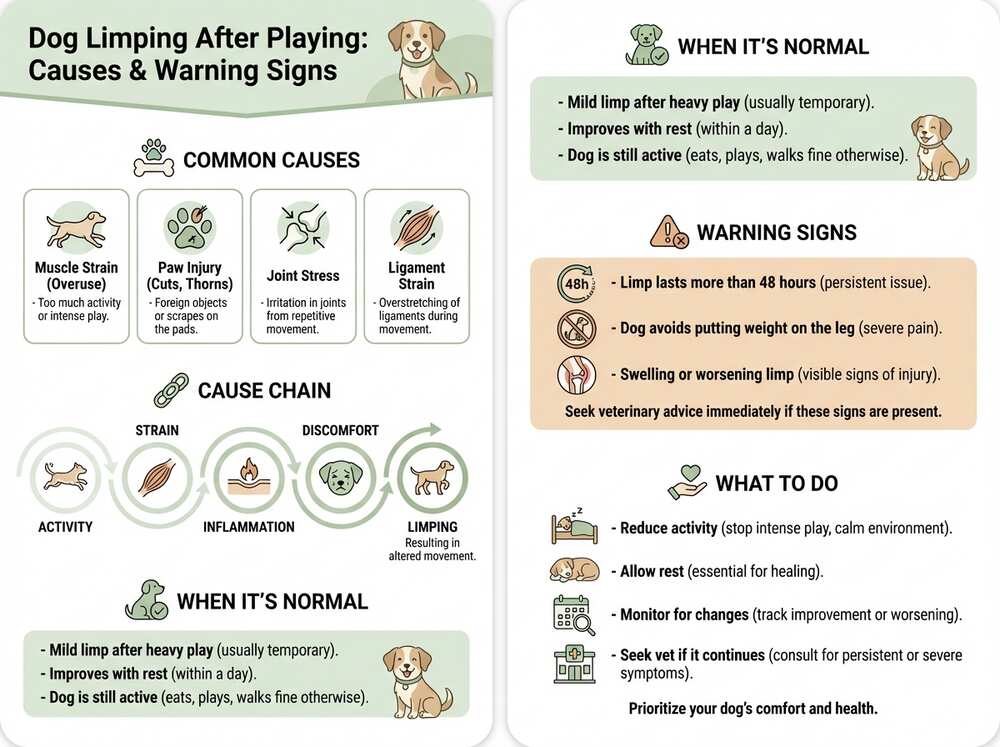
Dog limping after playing usually comes down to a handful of common triggers — muscle strain, minor injury, or joint stress being the most frequent.
Common causes of limping after play can vary in severity:
| Cause | Common After Playing | Severity |
| Muscle strain | Yes | Mild |
| Paw injury | Yes | Mild–Moderate |
| Ligament injury | Sometimes | Moderate–Severe |
| Joint issue | Sometimes | Moderate–Chronic |
Muscle Strain or Overuse
Rough play with sudden movement, quick turns, or chasing can put stress on muscles and soft tissues.
Cause chain:
rough play → muscle strain → soreness → limping
This type of dog limping after playing often improves with rest over a few days.
Minor Paw Injuries
Small cuts, thorns, or irritated paw pads can cause limping. These injuries are easy to miss at first.
A dog may limp but show no clear pain. This is why a dog limping but not in pain can still have a hidden paw issue.
Joint Stress or Early Joint Issues
Play and exercise can put pressure on joints, especially in active or older dogs.
Cause chain:
joint stress → inflammation → discomfort → limping
This may be more common in large breeds or dogs with early joint changes.
Why Different Types of Play Trigger Limping
Not all play puts the same kind of stress on a dog’s body. The type of activity often shapes the kind of strain involved, which is why understanding what a dog was doing helps make sense of where a limp might be coming from.
Fetch and Chasing
Games like fetch involve a lot of acceleration, sharp turns, and repeated bursts of sprinting and stopping. That kind of repeated stop-and-go motion puts real stress on tendons and ligaments — including the cruciate ligament in the knee — even when nothing dramatic seems to happen during the game itself. This is why a dog can limp after fetch even without any obvious crash or fall — the strain builds up from the pattern of movement rather than one clear moment.
Roughhousing and Dog-Park Play
Play that involves other dogs — whether at daycare or the dog park — adds a different kind of risk. Pushing, twisting, and sudden collisions can lead to soft-tissue injury or impact-related pain, and this kind of injury doesn’t always come with a visible wound. A dog limping after wrestling or body-checking at the park may be dealing with a hidden injury that isn’t obvious just from looking at the leg.
Rough or Slippery Ground
The surface a dog plays on matters too. Rough or abrasive ground can cause repeated contact stress on paw pads, toes, and nails, leading to soreness, a torn or broken nail, or general pad irritation. A dog that licks its paw more after playing on rough ground may be reacting to this kind of surface-related wear.
Slippery footing — like wet grass, ice, or snow — creates a different kind of risk than rough ground. A quick loss of traction is one of the clearest single-moment triggers behind a play-related limp, since the connection between the slip and the limp is usually easy to spot right away.
Monitor, Vet Soon, or Emergency
A mild limp after a short play session, with no swelling, is usually fine to watch and doesn’t need immediate concern.
Limping that keeps happening after fetch or rough play is worth checking with a vet soon, especially if the pattern repeats more than once.
Visible swelling, an inability to put weight on the leg, or severe pain after a collision or a slip are signs that call for same-day veterinary attention. For a fuller breakdown of urgency levels across sudden limping situations more broadly, see dog suddenly limping: when to take your dog to the vet.
This section focuses on the mechanics behind different types of play-related limping — how the movement itself creates stress on the body — rather than covering every possible cause. Jumping and sustained running each put their own kind of strain on a dog’s joints and muscles, and those patterns are worth reading about on their own.
Can fetch cause limping even without one obvious injury?
Yes. Fetch involves a lot of acceleration, sharp turns, and repeated bursts of sprinting and stopping, and that stop-and-go motion can stress tendons and ligaments even when nothing dramatic seems to happen during the game. This is why a dog can end up limping after fetch with no obvious crash or fall.
Limping During Play vs. Immediately After vs. Later
When a limp shows up can be just as telling as what caused it. A limp that starts during play, one that appears right after the game ends, and one that only becomes noticeable later after resting can all point toward different things happening in the body.
During Play
A limp that starts in the middle of play often means something happened in that moment — a twist, a painful step, or a paw catching on something. The dog may yelp, stop suddenly, or hesitate before continuing, and the limp shows up right away rather than building gradually.
Immediately After Play
Some limps only become obvious once the game is over, since excitement can make it easy to overlook minor soreness while play is still happening. A dog that seems fine mid-play but starts limping shortly after lying down is a common example — the limp seems to appear all at once, even though the strain was likely building the whole time.
Later, After Resting
A different pattern shows up after a longer rest, like a nap or a full night’s sleep. Stiffness or mild inflammation can become more noticeable once the dog stands back up, and the limp is often most obvious in the first few steps. This is sometimes called a limp that “warms out,” since it tends to ease as the dog keeps moving — some dogs even look more uneven at a slow walk than at a faster pace, since a quicker gait can temporarily smooth over unevenness that shows up more at slower speeds. This is a different mechanism than the immediately-after pattern above — one is soreness becoming noticeable as excitement fades, while this one is stiffness that improves with movement.
After Every Session
If a limp shows up after every play session, that pattern is worth paying closer attention to, since it may mean the same tissue keeps getting irritated before it has a chance to fully heal. A dog limping on and off after repeated activity is a pattern with its own considerations worth reading about separately.
Monitor, Vet Soon, or Emergency
A brief limp that improves with rest and doesn’t happen often is usually fine to watch at home.
A limp that shows up after every play session, or one that lasts more than 24 to 48 hours, is worth checking with a vet soon.
A limp that begins during play along with a yelp, an inability to bear weight, or visible swelling calls for same-day veterinary care.
Why did the dog start limping only after calming down?
Excitement during play can make it easy to overlook minor soreness, so the discomfort becomes more noticeable once the dog settles down. A dog that seems fine mid-play but starts limping shortly after lying down is a common example of this delayed pattern.
Puppy Limping After Playing
Puppies limp after play for a lot of the same reasons adult dogs do, but their bodies are still developing, which means a limp shouldn’t automatically be written off as “just growing.”
Why Puppies Deserve Extra Caution
A growing puppy has bones, joints, and coordination that are still developing, and that ongoing growth can make awkward movement or activity more likely to cause discomfort than it would in a fully grown dog. Conditions like panosteitis, osteochondritis dissecans, hip dysplasia, and luxating patella — growth-related issues documented by the Merck Veterinary Manual — are examples of problems that can show up as limping after activity, though figuring out exactly what’s causing a puppy’s limp isn’t something to sort out at home.
What Owners Commonly Notice
A puppy limping after a burst of play is a common pattern, and it can look a little different than what’s typical in an adult dog. The limp may shift from one leg to another, or seem to come and go rather than staying consistent. A puppy might also seem completely unbothered and still eager to keep playing, or might seem sore either right after activity or later after resting.
This shifting, come-and-go quality is worth noticing, since it’s a bit different from the more single-leg, single-tissue pattern that’s typical in adult dogs after play. That difference doesn’t mean something is necessarily wrong, but it’s a good reason not to dismiss a puppy’s limp too quickly just because puppies are “supposed to” be a little clumsy or sore sometimes. Senior dogs can also seem slower to bounce back after play, but that’s more often tied to aging joints than to growth, so it’s worth keeping the two patterns separate in your mind.
Monitor, Vet Soon, or Emergency
A very mild, short-lived limp with no other signs can be watched briefly, but puppies are generally worth a lower threshold for checking in with a vet compared to adult dogs.
Any puppy limp that keeps happening, seems to be getting worse, or sticks around longer than expected is worth having evaluated soon rather than waiting to see if it resolves on its own.
A puppy that won’t put weight on the leg at all, has visible swelling, or seems to be in significant pain needs to be seen the same day.
Should I worry about a puppy limping after playing, or is it just growing pains?
It shouldn’t automatically be written off as just growing, since a puppy’s bones, joints, and coordination are still developing. Conditions like panosteitis or osteochondritis dissecans are examples of growth-related issues that can show up as limping after activity, so an unexplained puppy limp is worth having evaluated rather than waiting it out.
Temporary Soreness vs. a Possible Injury
After a long or intense play session, it can be hard to tell whether a dog is just a little sore or dealing with something that needs attention. Looking at a few specific signs together, rather than any single one on its own, gives a clearer picture than guessing.
Comparing the Signs
| Temporary Soreness | Possible Injury | |
| Weight-bearing | Still uses the leg, just a little less confidently | Avoids putting weight on the leg, or won’t use it at all |
| Direction of change | Improves with rest | Stays the same or gets worse |
| Swelling | None noticeable | New or increasing swelling |
| Behavior | Comfortable, otherwise acting normal | Guarding the leg, distressed, or reluctant to be touched |
| Movement | Mild unevenness in the steps | Noticeable change in how the dog walks |
| Recurrence | A single episode after one session | Returns after every session |
A dog that’s sore but otherwise normal still uses the leg, just less confidently, and that discomfort tends to ease with a bit of rest. A dog dealing with something more serious often shows the opposite pattern — the leg looks swollen, hot, or painful to touch, and the limp doesn’t improve or starts coming back after every session.
One Intense Moment vs. General Overdoing It
It’s worth separating two different situations here. One is a single burst of intense play — a hard sprint, a rough wrestling match, a long game of fetch — that leads to temporary muscle fatigue or strain. The leg still bears weight, and the limp tends to fade with rest. This is different from a dog that’s generally been overdoing it across many sessions or a longer stretch of time, which is more about cumulative activity than any one moment and is worth reading about separately.
What These Signs Don’t Tell You
These comparisons are meant to help with pattern recognition, not to identify exactly what’s wrong. Weight-bearing, swelling, behavior, movement, and recurrence are separate things to watch — a dog can show one of these signs without the others, and none of them on their own confirms what’s actually happening inside the leg. A limp that seems mild and short-lived is often just soreness, but that’s not a guarantee, and any of these signs changing is worth paying attention to.
Monitor, Vet Soon, or Emergency
A mild limp with no swelling, where the dog still bears weight and comfort is improving, is usually fine to watch at home.
A limp that keeps happening, doesn’t improve, or gets worse over time is worth checking with a vet soon.
A dog that won’t put any weight on the leg, has noticeable swelling, shows an obviously abnormal leg shape, or seems to be in serious pain needs same-day veterinary care.
Signs Your Dog’s Limp May Be Serious
Quick warning signs to watch:
- limp lasts more than 48 hours
- dog avoids putting weight on the leg
- swelling or pain increases
Physical Warning Signs
Some physical signs suggest the limp after playing may not be minor. These signs should not be ignored.
- not putting weight on the leg
- visible swelling or deformity
- limping back leg or front leg getting worse
These changes may point to a deeper issue affecting the affected limb.
Behavioral Changes
Dogs often show changes in behavior when discomfort increases. These signs can appear even if the dog is not crying.
- reduced activity or energy
- reluctance to walk, run, or play
- signs of discomfort without obvious pain sounds
A dog limping but not in pain can still be dealing with hidden discomfort.
Cause Chain Insight
A serious limp often follows a clear biological pattern:
injury → inflammation → pain → altered movement → limping
If these signs are present or worsen over time, it is important to seek veterinary evaluation.
Dog Limping But Still Running — What It Means
Some dogs hide pain naturally. This is a survival behavior, so they may not show clear signs even when something feels wrong.
A mild injury may not stop a dog from playing right away. A dog may keep playing, running, and jumping even after strain or minor trauma.
Cause chain:
activity → adrenaline release → reduced pain response → continued movement → limping later
This explains why a dog limping but not in pain can still have a real problem. The discomfort may appear after activity ends or when the body cools down.
If the limp keeps returning, gets worse, or affects movement, it is important to seek veterinary evaluation.
How to Check a Dog Safely After Play
If a dog starts limping after play, it’s natural to want to check the leg right away. Doing this safely matters just as much as doing it at all, since the wrong kind of handling can make things worse.
Safe Observation Sequence
The safest place to start is by watching rather than touching. Watch the dog stand still, then take a few slow, controlled steps. This gives a good sense of how much weight the dog is willing to put on the leg and whether the gait looks even or uneven.
From there, a visual check of the paw can help spot anything obvious. Look for cuts, debris caught between the toes, a torn nail, or any swelling, without pressing or squeezing the area. A dog that lifts a paw, avoids putting full weight on it, or has a paw that looks swollen, dirty, or irritated is showing signs worth noting during this visual check. Licking between the toes or at the nails afterward is another sign worth watching for.
When to Stop the Exam
Some dogs won’t tolerate even a gentle check, and that reaction is important information on its own. A dog that flinches when the paw is touched, or one that refuses the exam and becomes defensive, is showing that handling the leg further isn’t a good idea right now. Pushing past that resistance risks causing more pain or making an existing injury worse, so pulling away or crying out is a clear signal to stop.
What Not to Do
A few things are worth avoiding entirely during a home check. Don’t bend or rotate the joints, squeeze any area that seems painful, force the dog to walk, try to “test” the leg by encouraging play, or attempt to remove an object that seems deeply lodged in the paw.
Looking and watching is something any owner can do safely. Bending, rotating, or squeezing the leg is a different kind of handling altogether, and it’s best left to a veterinarian who can examine the leg properly.
Monitor, Vet Soon, or Emergency
A dog that’s cooperative during the check, has a mild limp, and shows only a minor visible paw issue can usually be watched a little longer at home.
A dog that keeps pulling away during checks, has a limp that isn’t improving, or has a visible wound on the paw is worth seeing a vet soon.
A dog that cries out, becomes very distressed, has a deep wound, or has a leg that looks visibly out of place — a possible sign of a fracture or dislocation — needs same-day veterinary care. Stop the exam right away in this situation.
When should I stop trying to examine the leg myself?
Stop the exam if the dog flinches when the paw is touched, pulls away, or becomes defensive, since this shows that further handling isn’t a good idea right now. Pushing past that resistance risks causing more pain or making an existing injury worse.
What to Do During the First Day
The first day after a dog starts limping from play is really about limiting further strain and keeping a close eye on things, rather than trying to figure out exactly what’s wrong right away.
Stop Activity and Control Movement
Once a limp shows up, the most useful first step is simply to stop the play session. Continuing to run, jump, or roughhouse puts more strain on a leg that’s already reacting to something, so ending the activity gives the tissue a chance to settle rather than getting further irritated.
For the rest of the day, movement should stay controlled. A short leash walk for bathroom breaks is fine, but free running or extended activity should wait. A stable, non-slip surface for resting also helps, since a dog that’s already favoring a leg can struggle for traction on smooth or slippery flooring.
Cold Compress and Documentation
If there’s any visible swelling, a gentle cold compress applied directly to that area can help in the first day or two. It shouldn’t be pressed firmly or applied to the whole leg — just the specific spot that looks swollen, and only for short periods.
This is also a good time to start keeping track of what’s happening. Noting which leg is affected, how much weight the dog is putting on it, and taking a short walking video can make a real difference later, especially if the limp doesn’t resolve quickly or a vet visit becomes necessary.
Medication Safety
It can be tempting to give a dog something for the pain, but human pain medication should never be used — Brinker Veterinary Hospital confirms even common over-the-counter options like ibuprofen or acetaminophen can be toxic to dogs. The same goes for any leftover prescription medication from a previous issue; it shouldn’t be given unless a veterinarian has specifically directed it for this situation.
Monitor, Vet Soon, or Emergency
A mild limp with no swelling, where the dog is otherwise acting normal, can usually be watched at home for now.
A limp that continues, keeps coming back, or comes with swelling, heat, or noticeably less comfort is worth checking with a vet soon.
A dog that won’t put any weight on the leg at all, has a visibly deformed limb, is in obvious severe pain, or is dragging the leg needs same-day veterinary care.
This first-day approach is about containment and keeping a record of what’s happening — not about diagnosing the injury or starting any kind of long-term treatment plan. A cold compress on a specific swollen spot is a small, safe step, but it’s not the same as a broader icing routine or treatment protocol.
Should I use a cold compress if there’s swelling?
A gentle cold compress applied directly to a specific swollen spot can help in the first day or two. It shouldn’t be pressed firmly or applied to the whole leg, and it’s meant as a small containment step rather than a full treatment plan.
When Can a Dog Return to Play?
Once a limp seems to have faded, it’s tempting to assume the dog is back to normal. But a limp going away doesn’t always mean the underlying issue is actually resolved, and jumping back into full play too soon can undo whatever healing has happened so far.
Why the Limp Going Away Doesn’t Mean Recovery
A limp can fade with a bit of rest even when the tissue underneath hasn’t fully healed. If a dog goes right back to full play once the limping stops, that leg gets loaded again before it’s ready, and the same strain that caused the limp in the first place can easily return. A dog that looks completely normal at rest but starts limping again after another play session is showing exactly this pattern — the rest helped in the moment, but it wasn’t enough on its own.
Why Enthusiasm Is Not a Safety Test
It’s easy to assume that if a dog wants to play, the leg must be fine. But a dog’s eagerness doesn’t actually tell you much about how healed the leg is. Excitement and adrenaline can override caution, and a dog that keeps asking to play or seems “too happy to be injured” isn’t necessarily giving an accurate signal about what’s happening underneath. Relying on that enthusiasm as proof of recovery is how injuries get re-triggered before they’ve had a real chance to heal.
It’s worth remembering that how a leg looks and feels at rest is different from how it holds up under actual play. Just because a dog seems fine standing still doesn’t mean the leg is ready for sudden turns, sprinting, or rough play again.
Monitor, Vet Soon, or Emergency
A dog that’s been improving steadily with rest and stays comfortable even without jumping back into play can usually be monitored cautiously as activity slowly increases.
A limp that comes back every time play resumes is worth checking with a vet soon, since that pattern suggests the leg isn’t fully ready yet.
A dog that becomes unable to bear weight or shows pain again right after returning to activity needs same-day veterinary care.
Should I let my dog play again once the limp goes away?
A limp going away doesn’t always mean the underlying issue has fully healed, so it’s worth easing back into activity slowly rather than jumping straight into full play. A dog that looks normal at rest but starts limping again after another play session shows why caution matters here.
Information to Record If the Limp Returns
If a limp keeps coming back after play, a little bit of tracking can make a real difference in figuring out what’s going on. Instead of relying on memory, writing a few details down each time gives a clearer picture of the pattern.
What to Record Each Time
A few specific details are worth noting whenever the limp shows up:
- What kind of play was happening, and what surface the dog was playing on
- Whether there was a specific moment that seemed to trigger it, like a slip, a collision, or a fall
- How much time passed between the play session and when the limping started
- Which leg was affected — front or back, left or right
- How much weight the dog was putting on the leg, and roughly how long the limp lasted
- Any swelling, changes in the paw, or shifts in behavior or appetite
- Whether this same pattern has shown up after previous play sessions
A limp that happens after specific types of play, or one that keeps affecting the same leg more than once, is exactly the kind of detail that becomes much easier to spot once it’s written down rather than just remembered.
Why a Walking Video Helps
A short video of the dog walking can capture things that are easy to miss in the moment, or easy to describe accurately after the fact. Gait, stride, and subtle shifts in weight-bearing often show up more clearly on video than they do in memory, and that kind of detail can be genuinely useful if a limp doesn’t resolve and a vet visit becomes necessary.
This kind of tracking is really meant for repeat episodes, not a single one-time limp. A single limp after one play session doesn’t need this level of detail. But once a pattern starts showing up across multiple sessions, comparing what’s recorded each time becomes a lot more useful than trying to piece it together from memory alone.
What should I record before contacting the vet?
Useful details include the type of play and surface involved, any specific triggering moment like a slip or collision, which leg was affected, how much weight the dog was putting on it, and how long the limp lasted. Noting any swelling, paw changes, or behavior shifts each time helps too, and a short walking video can capture gait or weight-bearing changes that are easy to miss in the moment.
Can a Dog Limp From Too Much Exercise?
Yes, a dog can limp from too much exercise or activity. This is more common after longer or more intense running than after a typical play session — see why is my dog limping after running for the full picture on exercise-related limping.
If limping after play keeps returning or gets worse, it is important to seek veterinary evaluation.
Will a Dog Limp Heal on Its Own?
When It May Improve
Some cases of dog limping after playing may improve on their own. This usually happens when the issue is mild.
Common examples include:
- mild muscle strain from activity
- minor paw irritation, such as a small cut or rough surface
Cause chain:
minor strain → slight inflammation → mild discomfort → temporary limping
These cases often improve within a few days with rest and reduced activity.
When It Will Not
A limp is less likely to improve on its own if an underlying issue is present.
Examples include:
- ligament injuries that affect stability
- joint problems that cause ongoing stress
- chronic conditions that worsen over time
Cause chain:
underlying issue → ongoing inflammation → repeated discomfort → persistent limping
If the limp does not improve, keeps returning, or worsens, it is important to seek veterinary evaluation.
FAQ Section
What to do if my dog is limping after playing?
A dog should rest and reduce activity. Watch the dog closely for a few days. If the limp does not improve or gets worse, seek veterinary evaluation.
Why is my dog limping but acting normal?
Dogs often hide pain as a natural behavior. A mild injury may not stop activity right away. This is why a dog limping but not in pain can still have an underlying issue.
Is it normal for a dog to limp after playing?
It depends on a few signs together rather than any one on its own. A dog that’s simply sore still uses the leg, just less confidently, and that discomfort tends to ease with rest, while a dog dealing with something more serious often shows swelling, guarding, or a limp that doesn’t improve or keeps coming back.
How to tell if a dog’s limp is serious?
A limp may be serious if the dog avoids putting weight on the leg, shows swelling, or the limp worsens over time. Sudden severe limping should also be checked by a veterinarian.
How long should a dog limp before going to the vet?
If the limp lasts more than a few days or keeps returning, it is best to seek veterinary advice.
Can rough play with another dog cause a hidden injury?
Yes. Roughhousing at daycare or the dog park involves pushing, twisting, and sudden collisions, which can lead to soft-tissue injury or impact-related pain that isn’t always visible. A dog limping after wrestling or body-checking at the park may be dealing with an injury that isn’t obvious just from looking at the leg.
Can playing on ice, snow, mud, or smooth flooring cause limping?
Yes. Slippery footing like wet grass, ice, or snow can cause a quick loss of traction, which is one of the clearest single-moment triggers behind a play-related limp. Rough or abrasive ground causes a different kind of problem, leading to sore paw pads, a cracked nail, or general pad irritation over time.
Can my dog still have an injury if he wants to keep playing?
Yes. A dog’s eagerness to play doesn’t reliably tell you how healed the leg actually is, since excitement and adrenaline can override caution. Relying on that enthusiasm as proof of recovery is how injuries can get re-triggered before they’ve had a real chance to heal.
Will a dog limping heal by itself?
Some mild cases improve on their own. These include minor strains or paw irritation. Ongoing or worsening limping may need veterinary evaluation.
Did the dog turn sharply, stop suddenly, or collide with something or someone?
A quick change in direction can put sudden stress on a muscle, tendon, or ligament, and a collision can cause bruising or soft-tissue trauma. Both of these often lead to a dog favoring one leg right away, which makes them some of the easiest triggers for an owner to trace back to an exact moment.
Was this play session longer or more intense than usual?
A session that ran longer or pushed the dog harder than usual can make a strained muscle or joint more likely. It also helps to think about whether that same leg has been sore after play before, since a repeat pattern can point toward an injury that never fully healed.
How can I tell if my dog played too hard during one session versus overdid it generally?
A single burst of intense play, like a hard sprint or a long game of fetch, can lead to temporary muscle fatigue where the leg still bears weight and the limp fades with rest. This is different from a dog that’s been generally overdoing it across many sessions or a longer stretch of time, which is more about cumulative activity than any one moment.
Why does the dog limp after every play session?
A limp that shows up after every session may mean the same tissue keeps getting irritated before it has a chance to fully heal. Tracking a few details each time — like which leg is affected and how long the limp lasts — makes this kind of pattern much easier to spot than relying on memory alone, and a dog limping on and off after repeated activity is a related pattern worth reading about separately.
How do I check my dog’s leg without hurting it further?
Start by watching the dog stand and take a few slow, controlled steps rather than touching the leg right away. A visual check of the paw for cuts, debris, a torn nail, or swelling can also help, without pressing or squeezing the area.
Can I give my dog anything for the pain at home?
Human pain medication should never be used, since even common over-the-counter options like ibuprofen or acetaminophen can be toxic to dogs. Leftover prescription medication from a previous issue shouldn’t be given either, unless a veterinarian has specifically directed it for this situation.
Is post-play limping different in a puppy than in an adult dog?
It can look a bit different, since a puppy’s limp may shift from one leg to another or come and go rather than staying consistent. This shifting, come-and-go quality is a bit different from the more single-leg pattern that’s typical in adult dogs after play.
Sources & References
- Merck Veterinary Manual
https://www.merckvetmanual.com/dog-owners/bone,-joint,-and-muscle-disorders-of-dogs/lameness-in-dogs - VCA Animal Hospitals
https://vcahospitals.com/know-your-pet/lameness-in-dogs - American Kennel Club (AKC)
https://www.akc.org/expert-advice/health/why-is-my-dog-limping/ - PetMD
https://www.petmd.com/dog/general-health/why-my-dog-limping - Brinker Veterinary Hospital
https://brinkervet.com/blog/dog-limping/
These sources provide trusted veterinary guidance on dog limping, its causes, and when to seek care.
A dog limping after playing may improve with rest, but it should not be ignored if it continues. Monitoring small changes can help catch problems early. To understand the bigger picture, see why is my dog limping.
If the limp lasts more than a few days, keeps returning, or gets worse, it is important to seek veterinary advice. Early evaluation helps prevent further complications and supports the dog’s long-term mobility.
Update Note
This article was reviewed and updated on August 2, 2026 to add new sections on identifying what triggered the limp, how different types of play affect the risk of limping, how limp timing can signal what’s going on, a safe at-home leg check, a first-day response plan, guidance on returning to play, puppy-specific limping patterns, and what to record if the limp keeps coming back — along with an updated soreness-vs-injury comparison and an additional veterinary source. This article is for educational purposes only and is not a substitute for professional veterinary care. If your dog’s limping doesn’t improve, keeps returning, or is accompanied by other symptoms, a veterinarian can help confirm the cause and recommend next steps.