
TL;DR
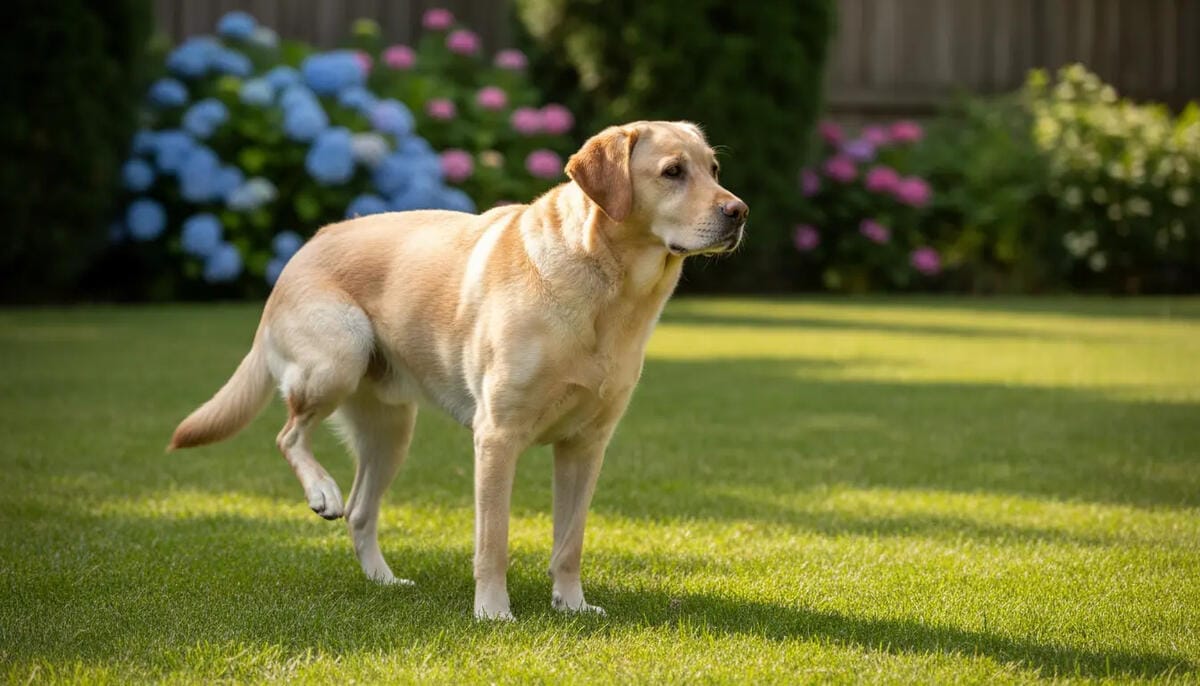
A dog not putting weight on a back leg at all should usually be seen by a vet the same day, especially if there’s pain, swelling, or any sign of nerve trouble. Common causes include torn knee ligaments, a kneecap that slips out of place, hip dysplasia with arthritis, and broken bones. Even without a witnessed injury, sudden non-weight-bearing can point to something serious and shouldn’t be watched for more than 24 hours without veterinary advice. A mild limp that still bears some weight can sometimes be watched briefly, but a limp that lingers or gets worse needs a vet’s evaluation.

Quick Answer Box
Weight-bearing refusal in a back leg means a dog holds that leg completely off the ground and won’t load any weight onto it — and in most cases, that calls for a same-day vet visit, especially alongside pain, swelling, or nerve-related signs. Severity runs on a spectrum, from a mild limp that still bears weight up to true non-weight-bearing, unlike the broader limping causes covered in why dogs limp in general.
Common causes include torn knee ligaments, a slipping kneecap, hip dysplasia with arthritis, fractures, soft-tissue strains, and nerve problems such as a slipped disc. The clearest marker of severity comes down to one distinction: does the dog still touch and use the leg despite limping, or does it hold the leg up entirely, even while standing still? Veterinary teams generally treat that second pattern as the most severe end of the spectrum, warranting same-day evaluation.
Red flags like an oddly angled limb, heavy swelling, an open wound, or nerve-related signs push things from “monitor” toward “call today.” A simple three-tier framework — Monitor, Vet Soon, or Emergency — helps sort out which tier fits, while owners keep activity restricted in the meantime.
Table of Contents
When to Worry: Dog Not Putting Weight on Back Leg
Weight-Bearing Severity Spectrum
Weight-bearing severity in a dog’s back leg falls somewhere on a spectrum, and the single most useful marker of how serious it is comes down to one question: does the dog still touch and use the leg at all, even with a limp, or does it hold the leg up completely, including while standing still? That second pattern — true non-weight-bearing — marks the most severe end of the spectrum and calls for a same-day veterinary visit.
Veterinarians commonly grade lameness on a numbered scale that runs from Grade 0 (no detectable lameness) up to Grade 4 (typically non-weight-bearing), a framework reflected in published gait-analysis research on lameness in dogs. In practical, owner-visible terms, that scale breaks into four stages:
| Severity | What It Looks Like |
| Mild | A subtle hitch in the step, or an occasional shortened stride |
| Moderate | A clear limp; the dog still uses the leg but shifts weight away from it |
| Severe | Toe-touching; the dog barely taps its nails on the ground |
| Non-weight-bearing | The dog holds the leg up consistently, never loading it, even while just standing |
The cause behind the limp often lines up with how it looks. A partial CCL tear or a mild soft-tissue strain usually stays contained to mild-to-moderate, weight-bearing lameness — the ligament or tissue damage is real, but limited enough that the dog can still load some weight. A complete CCL rupture, an acute fracture, or some cases of patellar luxation cross a different threshold: the joint loses enough stability or structural support that the dog can no longer bear weight on the leg at all, and the lameness turns sudden and non-weight-bearing.
One pattern worth watching for: a dog with a nerve-related problem doesn’t always show a classic pain limp. Nerve issues can instead show up as scuffing, knuckling, or the paw turning over as the dog walks — even at the most severe, non-weight-bearing level. Owners who only look for signs of pain can miss this distinction.
How do I tell if my dog isn’t putting ANY weight down versus just limping?
Watch the paw itself. A dog that’s limping but still bearing some weight will touch the paw down and put at least some pressure on it, even if unevenly. A dog with true non-weight-bearing keeps the paw lifted the entire time, including while just standing — not just while walking.
Does the amount of weight my dog puts down tell me anything about how serious this is?
Yes. In general, the less weight a dog puts on the leg, the more likely the underlying cause is serious — a mild, weight-bearing limp more often points to a strain or early joint issue, while complete non-weight-bearing more often points to a fracture, a complete ligament rupture, or a nerve problem needing same-day care.
Monitor / Vet Soon / Emergency Decision Framework
Deciding whether a dog’s weight-bearing refusal needs a same-day emergency visit, a vet appointment within a day or two, or just careful monitoring comes down to three tiers, each with its own clear signs.
| Tier | Signs | Action |
| Monitor | Mild, weight-bearing limp; bright, normal appetite; no swelling, deformity, or recent trauma | Watch up to ~24 hours; call the clinic if it persists |
| Vet Soon | Clearly lame or intermittently non-weight-bearing but still walking; mild swelling or warmth; no improvement over 24–48 hrs | Examine within a day or two |
| Emergency | Can’t use the leg at all — completely non-weight-bearing; abnormal limb position; marked swelling; open wound; sudden trauma onset; severe pain signs; neurologic signs; loss of bladder/bowel control; collapse | Same-day veterinary care |
Monitor fits a very mild, weight-bearing limp in a dog that otherwise seems bright — normal appetite, no swelling, no deformity, and no history of a recent fall or collision. Even in this tier, a limp lasting beyond about 24 hours is worth a call to the clinic rather than more waiting.
Vet Soon fits a dog that’s clearly lame or intermittently non-weight-bearing but can still walk, along with mild swelling or warmth in the leg, or a limp that hasn’t improved — or has come back — after 24 to 48 hours of rest. These dogs generally need an exam within a day or two.
Emergency fits a dog that can’t use the leg at all — completely non-weight-bearing — along with any of the following: an oddly angled or abnormal-looking leg, heavy swelling, an open wound, a sudden onset right after a fall, collision, or other trauma, obvious pain behaviors like whining, trembling, or panting, nerve-related signs such as dragging or knuckling the paw, loss of bladder or bowel control, or an inability to get up. Any of these signs moves the situation into emergency territory.
This framework covers weight-bearing refusal specifically. For general limping urgency signs that apply beyond this particular symptom, a broader urgency guide covers the full range of limping scenarios.
When can I just watch and wait versus when do I need to call today?
Watching briefly only fits the Monitor tier — a mild, weight-bearing limp in a dog that’s otherwise acting normal, with no swelling, no deformity, and no recent trauma. Calling today applies to anything in the Emergency tier: complete non-weight-bearing, an abnormal-looking leg, heavy swelling, an open wound, or any nerve-related sign like dragging or knuckling.
What specific signs mean this is an emergency, not just a bad limp?
A dog that won’t put any weight on the leg at all, combined with an abnormal limb position, marked swelling, an open wound, sudden onset after a trauma, severe pain behaviors, dragging or knuckling, loss of bladder or bowel control, or an inability to stand — any one of these moves the situation into emergency territory.
Symptoms / Signs
A dog with back-leg weight-bearing refusal shows more than just the limp itself — the whole body often reflects the problem. Hopping on three legs is one of the most obvious signs, with the affected leg tucked up and away from the ground rather than trailing behind. Some dogs favor a shortened stride instead, taking quicker, lighter steps on the healthy legs to spend less time loading the sore one.
Posture often shifts too. A pelvic tilt — leaning the hips to one side, away from the affected leg — is a common way dogs unconsciously redistribute their weight. Over time, uneven use can lead to visible muscle asymmetry, with the healthy leg looking noticeably more developed than the one the dog has been avoiding.
Pain behaviors vary from dog to dog. Some pant, pace, or seem restless; others go unusually quiet and withdrawn, seeking out a spot to lie down rather than moving around. A dog might also lick or chew at the affected leg, or flinch when that area is touched.
Not every sign points to pain, though. Knuckling — where the paw folds under and the top of the paw drags or scuffs the ground instead of the pad — and dragging the leg altogether can both signal a nerve-related problem rather than a purely orthopedic one. These signs are worth paying attention to on their own, since a dog with a nerve issue doesn’t always show the pain behaviors owners expect.
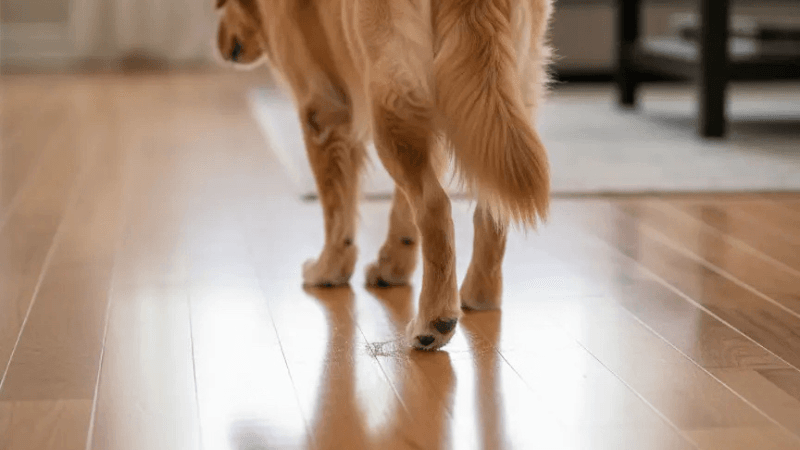
Because these signs overlap with joint pain more broadly, it’s worth knowing the fuller range of signs of joint pain in dogs beyond this specific acute presentation.
Causes
Causes of Discrete Back-Leg Weight-Bearing Refusal
Several categories of problems can leave a dog unable or unwilling to put weight on a back leg. Orthopedic causes are the most common: a torn cruciate ligament (CCL), a kneecap that slips out of place (patellar luxation), hip dysplasia with underlying arthritis, or an outright fracture or dislocation. Muscle and soft-tissue injuries — sprains, strains, or a tendon injury — can also produce sudden, significant lameness, even without a break or tear in the joint itself.

Neurologic and spinal causes, such as a slipped or bulging disc (intervertebral disc disease) or lumbosacral disease, sit in a separate category altogether: these affect the nerves controlling the leg rather than the joint or bone directly, and canine joint health issues like arthritis can sometimes complicate the picture further as dogs age.
A smaller but more urgent subset of causes deserves particular attention: fractures, a severe or complete CCL rupture, an acute hip luxation, septic arthritis, tick-borne disease, and immune-mediated polyarthritis. These tend to produce more severe, faster-onset lameness and are more likely to need same-day veterinary care rather than a wait-and-see approach.
Which of these causes tend to come on suddenly versus gradually?
Sudden-onset causes typically involve trauma or acute structural failure — a complete CCL rupture, a fracture, or a sudden hip luxation. Gradual-onset causes tend to be degenerative — hip dysplasia, osteoarthritis, or a partial ligament tear that slowly worsens over weeks or months. That said, a gradual, degenerative problem can still produce a sudden-looking flare-up, since the underlying joint may have been silently weakening long before the visible limp appeared.
Activity-triggered scenarios are also common — a dog that suddenly starts limping after a hard run or an intense play session may be dealing with a strain rather than a structural injury, and limping that starts after exercise is worth exploring as a related but distinct scenario.
No Witnessed Injury Scenario
Sometimes a dog stops using a back leg with no accident, no yelp, and no obvious moment where anything went wrong. This doesn’t mean the cause is minor. Degenerative problems — a partial CCL tear or ongoing joint disease — can silently worsen for a long time before finally reaching a breaking point: a chronically weakening ligament undergoes gradual, silent progression, and that progression eventually leads to sudden final failure, which shows up to the owner as a sudden-seeming case of a dog not putting weight on the back leg with no injury seen. The leg looked fine yesterday because the ligament was still (barely) holding — not because nothing was wrong. For a broader look at what typically triggers a dog to suddenly start limping — including cases with no witnessed incident at all — see why is my dog suddenly limping.
My dog wasn’t doing anything unusual — why would this happen out of nowhere?
A structure that’s been quietly weakening for weeks or months can fail at any ordinary moment — stepping off a curb, jumping off the couch, or even just standing up. The failure feels sudden to the owner, but the underlying damage usually wasn’t.
Does no visible injury mean it’s probably minor?
No. A lack of visible injury doesn’t rule out a serious cause — some of the most significant orthopedic problems, like a degenerative CCL tear, develop with no witnessed trauma at all.
What causes sudden hind leg weakness in dogs but no pain?
Weakness without obvious pain can point toward a neurologic cause rather than a purely orthopedic one — nerve compression or disc-related problems can affect a dog’s ability to use the leg normally without necessarily producing the guarding or crying that owners associate with pain. It’s a different mechanism from a ligament or bone injury, and it’s one more reason a no-pain, sudden-seeming presentation still deserves veterinary evaluation rather than a wait-and-see approach.
Arthritis-Linked Gradual Onset vs. Acute Injury Onset
A dog’s sudden refusal to use a back leg usually points toward trauma — an acute CCL rupture, a fracture, or another injury the owner can often recall a specific moment for. Gradual onset points more toward arthritis: osteoarthritis, hip dysplasia, or a partial ligament tear that worsens slowly over weeks or months rather than appearing all at once. As noted above, gradual disease can still produce a sudden-seeming presentation, which is why onset pattern alone isn’t always a reliable way to separate the two.
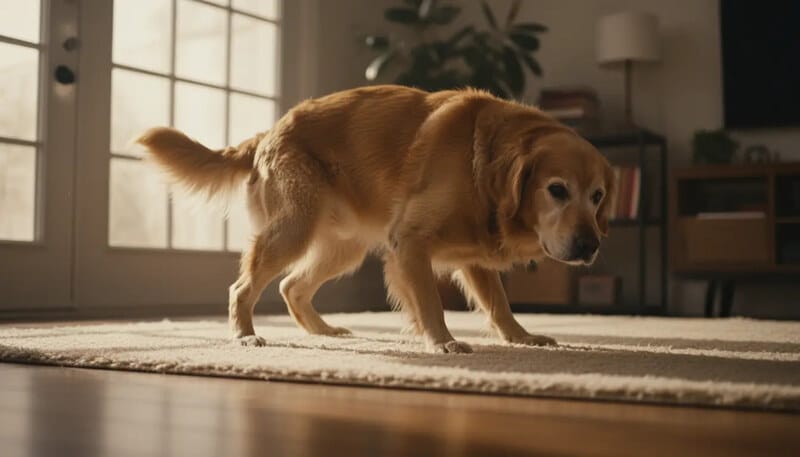
For a fuller picture of how arthritis progresses over time, a dedicated guide covers the condition’s typical stages in depth.
Could this be arthritis getting worse, or is it more likely a new injury? A history of stiffness, slow worsening, or previous joint issues points toward arthritis progression. A clean prior history with a sudden, dramatic change points more toward a new injury. Either way, a vet exam is the most reliable way to tell the two apart.
What These Symptoms Mean
Compensation and Secondary Strain
A dog that avoids putting weight on one back leg doesn’t just favor that leg — the rest of the body compensates too. The opposite hind leg and the front legs pick up the extra load, and that uneven weight distribution can turn into its own problem over time.
The pattern usually runs in one direction: pain leads to a weight shift, the weight shift leads to overuse of the “good” legs, and that overuse eventually produces secondary lameness in a leg that wasn’t hurt to begin with. A second pattern often runs alongside it — an unresolved limp leads to reduced activity, reduced activity leads to muscle loss or weight gain, and both of those make the original mobility problem worse.
Owners can sometimes spot compensation before it becomes obvious lameness. The “good” back leg may develop noticeably thicker muscle from carrying extra weight, while the shoulders or elbows in front may start to look sore or overworked from the same shift. The affected thigh, meanwhile, often shows the opposite — visible muscle loss from disuse. A dog compensating this way may also tilt its pelvis to one side or favor an unusual sitting position that keeps weight off the sore leg.
Can favoring one back leg cause problems in my dog’s other legs?
Yes. Shifting weight onto the other three legs for an extended period puts extra strain on joints and muscles that weren’t designed to carry that load, and that strain can eventually turn into its own source of pain or lameness.
How long can a dog safely compensate before it becomes its own issue?
There’s no fixed timeline, but the longer a dog avoids a leg, the more likely compensation is to cause secondary problems. A limp lasting more than a day or two is one more reason not to wait on a veterinary evaluation — not just for the original injury, but to prevent a second one from developing.
Comparison Block: Arthritis vs. Acute Injury, Neurologic Weakness vs. Joint Pain, Muscle Soreness vs. Fracture
Three distinctions come up often when trying to make sense of a dog’s back-leg symptoms, and it’s worth keeping each one separate rather than blending them together.
| Comparison | Pattern A | Pattern B |
| Arthritis vs. Acute Injury | Gradual onset, stiffness that improves after rest | Sudden onset, marked lameness that doesn’t ease with rest |
| Neurologic Weakness vs. Joint Pain | Knuckling, stumbling, or crossing the legs while walking | Guarding the leg, reluctance to move it, tenderness in one spot |
| Muscle Soreness vs. Fracture | Moderate limp, still bears weight, improves with rest | Consistent non-weight-bearing, obvious distress, no improvement |
Arthritis vs. acute injury often comes down to how the limp started and whether rest helps. Arthritis tends to build slowly, with stiffness that eases once the dog gets moving or improves with rest, especially after sleep. An acute injury looks different: it shows up suddenly, the lameness is usually more marked, and rest alone doesn’t meaningfully improve it.
Neurologic weakness vs. joint pain is a distinction that’s easy to miss, since both can look like “something’s wrong with the leg.” Neurologic weakness tends to show up as knuckling, stumbling, or the legs crossing awkwardly while walking — signs of a coordination or nerve problem rather than pain itself. Joint pain looks more like guarding: the dog protects the leg, resists having it touched, and shows tenderness localized to one area.
Muscle soreness vs. fracture matters because the two can look similar at first glance but point to very different levels of urgency. A sore muscle usually still bears some weight, produces a moderate limp, and gets noticeably better with rest. A fracture is far less forgiving — the dog typically can’t bear weight at all, shows obvious distress, and doesn’t improve no matter how much rest it gets.
Two of these distinctions come up often enough on their own to deserve their own dedicated pages: the difference between joint pain versus muscle pain, and what it means when a dog is limping without obvious pain — both worth a closer look for owners trying to narrow down what they’re seeing. Neurologic patterns like dragging or knuckling also warrant their own deeper explanation beyond this comparison.
What to Do
Diagnostic Process
Figuring out exactly what’s causing a dog’s weight-bearing refusal starts with a conversation before any hands-on exam. A vet typically asks about when the limp started, whether the owner witnessed any trauma, and whether the lameness has been getting better, worse, or staying the same.
From there, the exam moves to watching the dog move — gait and posture observation can reveal things a still dog won’t show, like which leg bears less weight or how the dog compensates while walking. The hands-on portion follows: palpation to check for pain, swelling, or heat; a cranial drawer test and tibial thrust test to check for cruciate ligament instability; and gentle manipulation of the kneecap to look for patellar luxation — exam techniques outlined in veterinary orthopedic exam guidance from WSAVA. A neurologic screening, including a check of conscious proprioception (whether the dog can properly sense and reposition its own paw), helps rule in or rule out a nerve-related cause.
Imaging often follows the physical exam. Radiographs can reveal fractures, joint changes, or signs of arthritis, while a CT or MRI gives a more detailed look when a straightforward X-ray doesn’t provide enough information — particularly for spinal or nerve-related concerns. Joint fluid analysis and bloodwork round out the picture when infection or an immune-mediated cause is suspected.
What will the vet actually do to figure out what’s wrong? Expect a combination of questions about how the limp started, a hands-on exam that includes specific tests for ligament and kneecap stability, a check of the dog’s nerve function, and — depending on what’s found — imaging like X-rays or an MRI to confirm the diagnosis.
Practical Owner Decision Support Checklist
A few straightforward questions can help sort out how urgently a dog’s weight-bearing refusal needs attention:
- Is the dog completely refusing to use the leg at all?
- Is there visible swelling, an odd-looking deformity, or an open wound?
- Did the limp start suddenly after a jump, fall, or collision?
- Are there any nerve-related signs, like dragging the paw or knuckling?
A “yes” to any of these points toward same-day care. If the dog is still using the leg but the limp has lasted beyond 24 hours, or it keeps coming back, an exam within a day or two is the safer path.
A few things are worth avoiding in the meantime. Comparing a dog’s leg to internet photos isn’t a substitute for an actual exam — swelling and posture can look similar across very different underlying causes. Splinting or bandaging a leg without veterinary guidance can also do more harm than good, since the wrong technique can cut off circulation or worsen an unstable injury.
For a fuller decision guide beyond this quick checklist, a call-now-or-wait decision guide walks through the broader range of limping scenarios in more depth.
Immediate At-Home Care While Awaiting Veterinary Evaluation
While waiting for a vet visit, restricting activity is the most useful thing an owner can do. That means confining the dog to a small space, keeping bathroom breaks on a leash instead of loose in the yard, and skipping running, jumping, or stairs entirely until the leg has been evaluated.
Handling matters too, especially for a dog that’s very lame or in pain. A towel or harness sling under the belly can support the hindquarters during a short walk, and a two-person lift — one person supporting the front, one the back — is safer than trying to carry a larger dog alone. Keeping the dog’s spine level during any lift or carry helps avoid adding strain to an already painful area.
A gentle check of the paw itself can catch an obvious problem, like a thorn, a cut, or a broken nail, without requiring any manipulation of the leg further up. Taking a short video of the dog’s gait can also be useful — it gives the vet a look at exactly how the dog is moving, which can change by the time the appointment actually happens.
A few things should never happen at home. Never force a dog to bear weight or walk on a leg it’s avoiding. Never aggressively manipulate or stretch the leg trying to “test” it. And never give a dog human pain medication — over-the-counter drugs like Tylenol or ibuprofen can be fatal to dogs, even at doses that seem small. If there’s bleeding, an obvious deformity, severe pain, or any neurologic sign, calm and prompt transport to a vet or emergency clinic takes priority over anything else on this list.
For dogs whose hind-leg weakness becomes an ongoing issue rather than a passing injury, ongoing home support for hind-leg weakness covers longer-term strategies beyond this acute first-hour guidance.
What should I actually do right now, before I can get to the vet?
Restrict activity, avoid forcing the dog to walk on the leg, and use a sling or two-person lift if the dog needs to move at all. Skip human pain medication entirely, and head to the vet promptly if there’s bleeding, severe pain, or any nerve-related sign.
Is there anything I could do at home that would make this worse?
Yes — forcing the dog to walk or bear weight, manipulating the leg to see how it reacts, and giving any human pain medication can all make things worse or introduce a new danger. Splinting or bandaging without guidance falls into the same category.
FAQ
Why is my dog not putting weight on his back leg?
Most often it comes down to pain or instability serious enough that using the leg becomes difficult or impossible — common causes include a torn cruciate ligament, a slipping kneecap, hip dysplasia with arthritis, a fracture, or a soft-tissue strain. The single biggest clue to how serious it is comes down to whether the dog still touches and uses the leg at all, even with a limp, or holds it up completely.
Why is my dog not walking on his back leg?
A dog that won’t walk on a back leg at all is showing true non-weight-bearing lameness, which sits at the more serious end of the spectrum compared to a limp that still loads some weight. This level of symptom — especially without improvement over a few hours — generally warrants a same-day veterinary evaluation rather than a wait-and-see approach.
What are the most common reasons a dog suddenly won’t use a back leg?
The most frequent causes include cruciate ligament tears, a kneecap that slips out of place, hip dysplasia, fractures, and soft-tissue strains or sprains. Less commonly, a nerve-related problem like a slipped disc can also cause a dog to stop using a back leg, sometimes without the pain signs owners expect to see.
How to tell if a dog’s back leg is sprained?
A sprained leg typically causes a limp that still bears some weight, mild swelling around a joint, and lameness that tends to ease somewhat with rest rather than staying constant. Unlike a fracture or complete ligament tear, a sprain usually doesn’t cause an obviously abnormal limb position or complete refusal to use the leg — though only a vet exam can reliably tell a sprain apart from a more serious injury that looks similar early on.
How long will a dog limp on a sprained leg?
A mild sprain often improves within a few days to about a week with rest and restricted activity, while a more significant sprain can take several weeks to fully resolve. A limp that isn’t improving, or that gets worse instead of better, is a sign the injury may be more than a simple sprain and worth a veterinary recheck.
What are signs of a severe dog leg sprain?
A severe sprain tends to cause more pronounced swelling, a limp that doesn’t bear much or any weight, and little to no improvement after a few days of rest — patterns that overlap with what a more serious injury like a partial ligament tear can look like. Because a severe sprain and a more significant orthopedic injury can appear similar from the outside, a limp this pronounced is worth a veterinary exam rather than continued at-home monitoring.
Sources & References
- Brown Veterinary Hospital. Dog Not Putting Weight on Back Leg: Causes and Treatments. Brown Veterinary Hospital; 2026.
- Nielsen MBM, et al. Kinetic gait analysis in healthy dogs and dogs with osteoarthritis. Animals (Basel). 2020;10(12)
- Lameness Localization in Dogs. Thieme Connect.
- World Small Animal Veterinary Association (WSAVA), Veterinary Information Network (VIN). The Efficient Orthopedic Exam. WSAVA Congress Proceedings.
- World Small Animal Veterinary Association (WSAVA), Veterinary Information Network (VIN). Patellar Luxation. WSAVA 2014 Congress Proceedings.
Soft CTA
Every dog’s situation is a little different, and a hands-on exam is the only way to know exactly what’s causing this. If the limping continues or gets worse, a veterinarian can pinpoint the cause and guide the right next steps for recovery.
Reviewed / Published Note
Originally published March 23, 2026. Last updated July 21, 2026.
This article was substantially expanded and updated to give dog owners a clearer, more complete picture of what it means when a dog won’t put weight on a back leg. The update added a step-by-step severity scale that translates how veterinarians grade limping into signs owners can actually observe at home, from a subtle hitch in the step up to a dog holding the leg completely off the ground. It also added a three-tier framework for deciding whether to simply watch and wait, book a vet visit within a day or two, or seek emergency care right away.
New sections cover what it means when a dog suddenly stops using a leg with no witnessed injury, how to tell arthritis-related stiffness apart from a new injury, how a dog’s body compensates when it favors one leg, and a side-by-side comparison of arthritis versus acute injury, nerve-related weakness versus joint pain, and muscle soreness versus a possible fracture. The article now also walks through what a veterinary exam for this symptom typically involves, a quick checklist for deciding how urgently to seek care, and safe first-hour home care while waiting for a vet visit.
This article is for educational purposes only and is not a substitute for professional veterinary advice, diagnosis, or treatment. If a dog is not putting weight on a back leg, a veterinarian should always be consulted to determine the exact cause and the right next steps for care.