
TL;DR
Why is my dog limping? Limping usually means a dog is protecting a sore leg — often from a paw injury, muscle strain, or joint problem. Sometimes it appears suddenly after running, rough play, or a small accident.
Some dogs limp but do not cry. This can make the problem hard to notice. A dog may still limp without obvious pain or may hide discomfort. Dogs often try to protect the affected limb even when they do not cry.
Certain warning signs need fast veterinary attention. A dog that cannot bear weight, shows severe swelling, has an irregular angle, or a dangling limb may need urgent veterinary care. These signs can mean the dog may have a serious injury.
Veterinarians usually start with a physical exam. They may check the paw, joints, and the affected limb. In some cases, tests such as blood work or tick testing may help identify the underlying cause of the limp.
For a broader understanding of joint pain and mobility issues, see the dog joint pain relief guide.
Quick Answer Box
Why is my dog limping?
A dog limping can happen because of a paw injury, muscle strain, torn ligament, joint problem, or another health issue. Sometimes lameness in dogs appears after running, rough play, or a small accident.
Is limp without crying still serious?
Yes. Some dogs hide pain well. A dog may be limping but not crying or limping but not in pain, while still protecting the affected limb.
When should a vet be called?
Veterinary care may be needed if the dog:
- cannot bear weight on a leg
- shows visible swelling or severe pain
- has an irregular angle or dangling limb
- keeps limping for more than a day
These signs may suggest a more serious injury.
When is dog limping an emergency?
- Monitor: mild limp, still walking normally, no swelling
- Vet soon: limp lasts more than 24–48 hours or keeps returning
- Emergency: cannot bear weight, severe pain, swelling, or leg looks abnormal
The Monitor tier is safe to watch at home; Vet Soon and Emergency both call for professional evaluation, with Emergency requiring same-day care.
Can back leg limping mean joint trouble?
Yes. Back leg limping can sometimes be linked to hip, knee, or ligament problems. Conditions such as hip dysplasia or luxating patella may affect the joints and lead to limping.
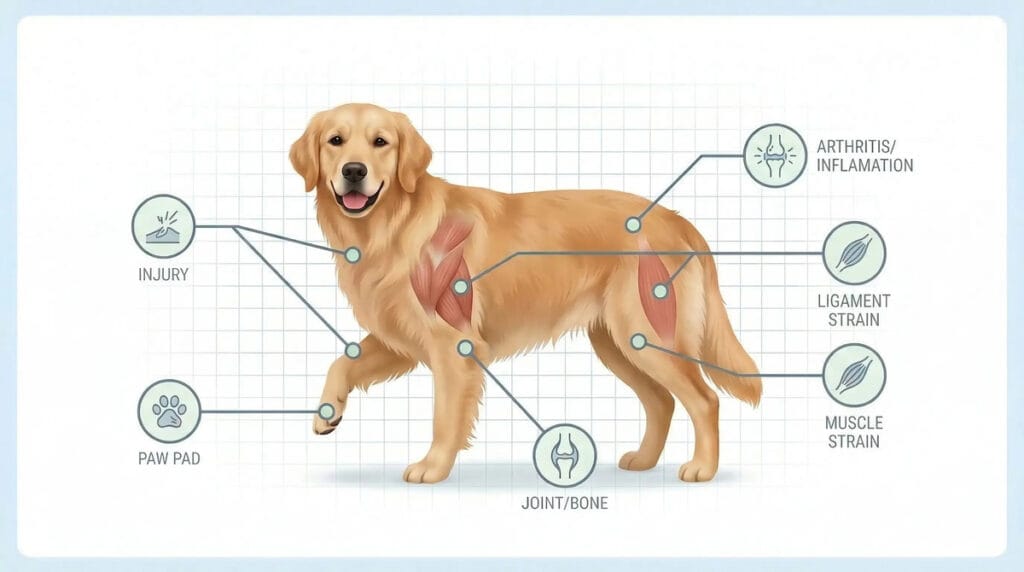
Table of Contents
Why Dogs Limp
Why is my dog limping?
A dog may limp because of a paw injury, muscle strain, joint problem, ligament damage, arthritis, or infection. Limping in dogs is a sign that the dog is protecting a painful or irritated limb.
A limp is a sign, not a diagnosis
When a dog is limping, it usually means something is affecting the leg, paw, or joint. A limp is only a visible sign of a problem. The real reason can vary from a small paw issue to joint stress or injury.
In many cases, lameness in dogs starts when the body tries to protect an affected limb. The cause often follows a simple pattern:
minor injury → inflammation → pain → limping
Finding the underlying cause is important. A veterinarian can examine the dog and decide what may be affecting the limb or joint.
Why some dogs limp but act normal
Some dogs continue normal behavior even when they have discomfort. Animals often hide weakness because it is part of natural survival behavior.
This is why a dog limping but acting normal can still have a problem. The dog may still run, play, or eat normally while protecting one leg.
Owners may notice small changes instead, such as:
- favoring one leg
- slower movement
- avoiding pressure on one paw
- a dog that limps when walking but not running
A dog showing several of these at once is more likely masking real discomfort than just being naturally cautious.
Why some dogs limp but do not cry
Many owners worry when my dog is limping but not crying. Lack of crying does not always mean the dog feels no pain.
Dogs experience discomfort differently. Some dogs stay quiet even when pain is present. A dog may simply shift weight away from the sore limb.
Signs that discomfort may still exist include:
- dog not putting weight on back leg
- dog limping but not whining
- trembling or licking a paw
- holding one leg slightly off the ground
Common signs that often appear with limping
Different signs point to different things. Grouping them by what they usually mean can help owners narrow down what’s happening.
Signs of pain or joint irritation:
- favoring one leg or shifting weight
- licking or chewing one spot
- swelling, heat, or redness in a joint or paw
Signs of stiffness:
- slow or stiff walking, especially right after rest
- movement that loosens up after the dog has been walking for a few minutes
Signs of weakness or a nerve-related issue:
- wobbling
- dragging toes
- poor coordination
Behavioral signs that discomfort may still be present:
- reduced activity or less play
- hesitation to move, jump, or climb stairs
Together, these signs give a fuller picture than any single one on its own.
If a dog starts limping out of nowhere or the limp lasts more than a day, a vet should check the dog to identify the cause.
Sudden Limping vs. Gradual Limping — What the Timing May Suggest
How fast a limp appears can offer an early clue about what may be going on. A limp that shows up suddenly often points to a different kind of problem than one that builds up slowly over weeks or months. Veterinarians often use how quickly a limp appeared, along with the dog’s recent activity, to help narrow down the likely cause, according to Cornell University’s Riney Canine Health Center.
What Sudden-Onset Limping Often Points To
A dog that starts limping right away, with no warning, is often reacting to something acute. Paw trauma, a torn nail, a strain, a fall, a ligament injury, a sting, or a foreign object stuck in the paw can all cause a limp to appear almost instantly. This pattern is sometimes called sudden lameness, or acute lameness in dogs, since acute simply means the problem started quickly rather than building up over time.
Owners often describe this pattern as the dog coming up limping out of nowhere. It tends to happen after play, jumping, rough terrain, or a visible paw injury. The dog was moving normally, and then suddenly was not. For a full breakdown of sudden-onset causes and immediate warning signs, see why is my dog suddenly limping.
What Gradual-Onset Limping Often Points To
A limp that builds up slowly usually points to a different type of problem. Arthritis, chronic joint disease, structural joint problems, progressive muscle loss, and some bone conditions tend to develop this way.
Instead of a sudden change, owners may notice morning stiffness, less interest in exercise, or a limp that comes and goes over time. Some dogs seem to work into movement, meaning they look stiff at first and then loosen up once they have been walking for a few minutes.
Why Timing Helps but Doesn’t Diagnose
Timing narrows down what body system is likely involved, but it does not rank how serious the problem is on its own. A slow, gradual limp can suddenly get worse overnight if the underlying problem flares up. A sudden limp can also come from something as minor as a sore paw, not necessarily a major injury.
This is why persistent or worsening limping matters more than how quickly it started. A flare-up of an existing condition can look exactly like a brand-new injury to an owner, even though the underlying problem was already there.
A few patterns show up often:
Trauma, a torn nail, a sting, or a foreign object can lead to sudden pain, which shows up as an abrupt limp with obvious guarding or a refusal to run.
Arthritis or chronic joint disease causes ongoing inflammation, which builds into stiffness over time, leading to an intermittent or progressive limp.
An old problem can flare up or get worse under stress, so the pain increases overnight and the limp looks new, even though the issue was already present.
Whether the limp appeared suddenly or gradually, a limp that keeps returning or does not improve deserves a veterinary evaluation.
Common Causes of Dog Limping
| Possible Cause | Typical Signs |
| Paw injury | Dog licking paw, limping on one leg |
| Muscle strain | Limp after running or jumping |
| Torn ligament | Dog not putting weight on back leg |
| Hip dysplasia | Stiffness, back leg limping |
| Luxating patella | Sudden skipping step while walking |
| Arthritis | Limp after rest or when getting up |
| Tick-borne disease | Limping with fever or tiredness |
Other possible causes to consider:
- nerve or spinal problems (affect movement control and balance)
- injuries from hot ground or rough surfaces (paw damage)
- insect bites or small stings (sudden localized pain)
- objects stuck in paw (hidden discomfort causing limping)
- age-related muscle weakness (reduced support for joints)
- more serious causes like bone tumors or immune-related joint problems
These are worth ruling out especially if the common causes above don’t seem to fit, or if limping continues despite rest.
Paw and foot problems
Paw injuries are a common reason for dog limping. Small problems on the paw can make a dog avoid pressure on one leg. Even a minor injury can make the dog protect the affected limb.
Common paw problems include:
- foreign objects such as thorns or small stones
- torn nails that cause pain when walking
- cuts on the paw pads
- a sore paw after rough ground or long walks
- a swollen paw caused by irritation or injury
When a dog has a paw problem, the dog may favor one leg or lick the paw often.
Muscle strains and minor soft tissue injuries
Dogs can strain muscles during active play. This may happen after running, jumping, or sudden movement.
Common causes include:
- rough play with other dogs
- slipping on smooth floors
- jumping off furniture
- sudden turns while running
The cause chain often looks like this:
overstretched muscle fibers → micro-tearing in the tissue → localized swelling and tenderness → pain each time the muscle contracts during a stride → limping
Limping after activity may sometimes be caused by this type of strain. In some cases, comparing the signs of joint pain vs muscle pain in dogs may help owners better understand whether stiffness or soreness is more likely involved.
Torn ligaments and joint injuries
Ligament injuries can affect how the joint moves. Some dogs may also begin slipping on smooth floors because unstable joints reduce traction and balance. These injuries can cause a dog suddenly limping back leg or avoiding weight on one leg.
Possible problems include:
- torn ligaments in the knee joint
- joint instability
- a sudden back leg limp
Dogs with ligament problems may not put weight on the back leg or may hold the leg slightly raised.
Hip dysplasia and luxating patella
Some dogs limp because of joint structure problems. Two known examples are hip dysplasia and luxating patella.
These conditions affect how joints move. They may lead to discomfort, especially during activity.
These issues are:
- more common in larger breeds
- sometimes seen in active or growing dogs
- linked to joint instability over time
Joint problems can lead to this chain:
Hip dysplasia: a loosely fitting hip joint → abnormal friction between the ball and socket with every step → gradual cartilage wear and chronic inflammation → limping that builds up over time, often worse after exercise
The Merck Veterinary Manual similarly describes how hip dysplasia can lead to lameness, stiffness, and joint pain in dogs.
Luxating patella: the kneecap slips out of its normal groove → the knee temporarily can’t extend properly → the dog briefly can’t bear weight → a sudden skipping step, then the leg returns to normal once the kneecap slips back into place
Arthritis and joint wear
Joint wear can also cause lameness in dogs. Arthritis affects the joint surface and may lead to stiffness.
Dogs with joint problems may show:
- joint pain
- stiffness after rest
- a dog that limps when getting up but runs fine
Over time, the pattern may appear as:
cartilage gradually wears down → bones move with less cushioning between them → the joint becomes inflamed and stiff, especially after rest → limping that often eases somewhat once the dog has been moving for a few minutes
Older dogs may show these signs more often. In many cases, stiffness in joints plays a key role, and supportive care can help improve comfort and mobility in dogs with joint problems.
Infections and tick-borne disease
Some infections can also affect a dog’s ability to walk normally. Lyme disease and other tick borne illnesses may sometimes lead to limping.
In these cases, the limp may appear along with other signs such as:
- tiredness
- fever
- swelling around joints
- shifting leg discomfort
If limping in dogs appears with other unusual symptoms, a veterinarian should evaluate the dog.
How to Tell Which Leg or Part of the Leg Is Affected
Owners often ask how to tell which leg a dog is limping on, or how they can check a dog’s leg at home safely. Before a cause is known, it helps to figure out which leg is actually bothering the dog. Watching how a dog moves usually gives more clues than trying to feel the leg by hand. Lameness can affect a single leg or shift between legs depending on the underlying condition, according to VCA Animal Hospitals.
Watching Your Dog Walk Safely
The safest way to check is to watch, not touch. Have the dog walk away, then walk back, then move past from the side on a flat, open area. This gives a clear view of the stride from every angle.
This kind of check is visual only. There is no need to press on the leg or ask the dog to move in unusual ways.
A short video of the dog walking at a normal pace can also help. Dogs often look better once they reach the vet’s office, so a video taken at home may show the limp more clearly than the exam room does.
Signs That Point to the Front Leg
A front-leg problem often shows up as a head-bob. The dog lowers its head when the healthy front leg touches the ground, then raises its head when the sore leg lands. Vets sometimes describe this as the dog being “down on sound,” since the head dips toward the leg that is not in pain.
A dog favoring one leg, taking a shortened step on one side, licking one paw, or holding a front leg up while standing all point to a front-leg problem.
Signs That Point to the Rear Leg
Rear-leg pain tends to look different. Instead of a head-bob, the dog may hop, skip, or lift the hip on one side to take weight off the sore leg. This can look like a “bouncy” step, especially at a faster walk or trot.
Reduced push-off from one back leg is another clue. If one hind leg seems to do less work while walking, that leg is often the one causing trouble.
What Not to Do During Observation
It helps to know what to avoid, too. Do not force the leg to bend, press on a spot that looks sore, or keep testing the dog once it shows signs of discomfort. Repeating this can make the pain worse without giving any new information.
Watching a dog move stays passive, brief, and calm. This is different from a hands-on exam, which a veterinarian is trained to do safely.
Dog Limping by Leg and Pattern
Dog limping on back leg
A dog limping on back leg can happen when the dog tries to protect the hind limb. Many owners notice slower walking or reduced pressure on one hind leg.
Signs may include:
- dog not putting weight on back leg
- holding the leg slightly raised
- stiffness when standing up
Back leg limping can involve the hip, knee, or surrounding muscles. A veterinarian can examine the joint and identify the underlying cause if the limp continues.
Dog limping on front leg
A dog limping on front leg may look different from hind leg limping. The dog may shift body weight to the other front leg to reduce pressure.
Owners may notice:
- a front leg limp while walking
- shorter steps on the affected side
- frequent licking of the paw or leg
Front leg problems sometimes start from paw injuries, joint irritation, or soft tissue strain.
Dog limping on one leg
Sometimes a dog begins limping on one leg without much warning. This can feel like the dog started limping suddenly and is protecting the affected limb. When movement slows down along with limping, it may be linked to stiffness, discomfort, or reduced joint movement.
Possible reasons include:
- paw irritation or injury
- minor joint stress
- muscle strain
Because dogs move quickly during play, a small problem can appear suddenly.
Weight-Bearing vs. Non-Weight-Bearing Limping
Not every limp looks the same, and one of the most useful things to notice is whether the dog is still putting weight on the leg at all. This difference can point to how urgent the problem is.
What Counts as Weight-Bearing
A weight-bearing limp means the paw still touches the ground. The dog may press down with less force, take a shorter step on that side, or shift weight away from the leg, but the leg is still doing some of the work.
One thing can make this tricky to judge. A dog may briefly touch its toes to the ground without actually putting real weight on the leg. This toe-touch pattern can look like weight-bearing at a glance, even though the leg isn’t sharing much of the load.
What Counts as Non-Weight-Bearing
A non-weight-bearing limp is different. The dog refuses to use the leg at all, or holds it up completely while moving. Owners often describe this as the dog walking on three legs, barely touching the toes down, not putting the foot down at all, or simply a dog that won’t walk on the paw.
This pattern deserves faster attention. A fracture, a dislocation, or a severe ligament injury can all cause a dog to stop using a leg entirely. A dog that can’t put weight on a leg, or won’t put any weight on it at all, needs a veterinary look sooner rather than later.
Why Vocalizing Isn’t a Reliable Severity Gauge
Whether the leg is bearing weight matters more than whether the dog cries. Some dogs stay quiet even with a serious injury. A dog can have real pain and still avoid whining, yelping, or vocalizing in any obvious way.
Checking how much weight the leg is carrying gives a clearer picture than listening for sounds of pain. A silent dog can still be seriously hurt, so the absence of crying should never be read as reassurance on its own.
Dog limping after running, playing, or jumping
Some dogs may limp after running or active play. Sudden turns, jumps, or high-impact movement can place stress on muscles and joints. This often happens after activity, especially after impact from jumps.
This pattern may appear when:
- a dog runs hard during play
- the dog jumps off furniture
- the dog slips while moving fast
the typical chain can look like:
overuse → muscle irritation → inflammation → limping
Rest and observation are often helpful, but a vet should evaluate the dog if the limp lasts more than a day.
Dog limps when getting up but runs fine
Some dogs limp when getting up but run fine once they start moving. This pattern is often linked to stiffness after rest, which may improve as the joints warm up and movement becomes easier.
Owners may notice:
- stiffness after lying down
- slow first steps
- movement improving after walking
This pattern can sometimes relate to joint stiffness or joint stress.
Dog limping on and off
A dog limping on and off may have an intermittent problem. The limp may appear for a short time and then disappear.
Common patterns include:
- dog limps on and off during activity
- the limp returns after rest or exercise
- discomfort appears only on certain days
When limping continues to return, a veterinarian should examine the dog to check joint health and rule out injury.
Why a Limp May Move From One Leg to Another (Shifting-Leg Lameness)
Sometimes a limp doesn’t stay on the same leg — a dog favors one leg one day, then seems to favor a different leg the next. This is often linked to compensation, where pain in one limb shifts extra weight onto another, or to a broader process affecting multiple joints at once. For a full breakdown of same-leg versus shifting-leg patterns, see why is my dog limping on and off.
Dog Limping but Not in Pain: What It Can Mean
Pain vs fear: how to tell the difference
More likely pain:
- dog used stairs or activity before but now struggles
- limping with stiffness or reduced movement
- reacts when leg or joint is touched
More likely fear:
- problem started after a fall or bad experience
- dog moves normally on flat ground
- tail tucked, hesitant, or refuses certain areas
Sometimes both can happen together, especially if pain started first. For a closer look at this pattern specifically in the back leg, see limping without obvious pain.
Limping With Other Symptoms — When It May Be More Than a Leg Injury
A limp does not always stay isolated to the leg. Sometimes it shows up alongside other signs that point to a bigger problem than a sore paw or joint.
Signs Suggesting a Local Problem
Some signs point to a problem staying in one spot. Paw licking, a swollen area, a torn nail, or heat and tenderness around one leg usually mean the pain is local. A limp that starts right after an impact, like a jump or a fall, also tends to fit this pattern.
A wound, torn nail, or swollen spot causes localized pain, so the dog licks the area and favors that one limb. This kind of pattern usually points to a local problem rather than something affecting the whole body.
Signs Suggesting Possible Systemic Illness
Other signs suggest the problem may reach beyond the leg. Fever, low energy, reduced appetite, or a limp that seems to move between legs can point to something systemic. More than one joint appearing painful at the same time is another clue worth noticing. A leg that feels unusually cold to the touch, along with limping, is also worth mentioning to the vet, since it can point to a circulation concern rather than a joint or muscle problem.
Limping that comes with symptoms like lethargy, swelling, or loss of appetite may point to a more serious condition and can justify prompt veterinary care, according to BluePearl’s emergency veterinary guidance.
When a limp shows up along with fever, fatigue, or a poor appetite, it may point to a broader inflammatory process rather than a single injury. A dog with this combination often seems unwell overall, not just sore in one leg, and this calls for a veterinary assessment.
Signs That Need Emergency Attention
A few signs mean the situation needs immediate care, no matter what caused the limp. Repeated crying, collapse, changes in breathing or heavy panting, pale gums, severe trembling, an inability to stand, or vomiting along with marked weakness are all emergency-level signs.
A limping dog who also feels sick is more concerning than a limping dog who stays bright and eats normally. Local, orthopedic-only signs are different from whole-body illness signs, and telling them apart helps decide how quickly the dog needs to be seen.
Mild or can be monitored: mild limping with no fever, shaking, or loss of appetite, no visible wound or swelling, and a dog who stays bright and comfortable.
Needs a vet soon: limping along with low energy or lethargy, reduced appetite or a dog that stops eating, fever, shaking, or pain that keeps coming back.
Needs emergency care: repeated crying, collapse, pale gums, breathing changes, an inability to stand, or vomiting paired with marked weakness.
Warning Signs That Need Fast Veterinary Care
Call a Vet Immediately If Your Dog Shows These Signs
- The dog cannot bear weight on a leg
- The leg has an irregular angle
- There is severe swelling
- The dog shows severe pain
- The limp lasts longer than 24 hours
A dog that shows these signs may have a serious injury. Quick veterinary care helps protect the dog’s health and prevents further complications. For a clearer decision guide, see when to take dog to vet for limping.
What a Vet May Check for a Limp
Physical exam and history
When a dog arrives at the clinic with a limp, the veterinarian usually begins with a physical exam. This helps identify the underlying cause of dog limping, such as joint problems, injuries, or other health issues. The vet may ask the owner questions about when the dog started limping and what the dog was doing before it appeared.
Important details may include:
- when the dog started limping
- whether the limp appeared suddenly
- if the dog had rough play, a fall, or a slip
- how long the limp has lasted
This history helps the vet understand the possible cause. If the limp appeared suddenly or seems severe, it is important to understand when to take your dog to the vet for sudden limping.
Checking the paw, joints, and affected limb
Next, the vet carefully examines the affected limb. This check helps identify pain points or visible problems.
The vet may look for:
- foreign objects in the paw
- cuts, swelling, or a sore paw
- joint stiffness or reduced movement
- signs that the dog cannot bear weight
Pinpointing the exact location — paw versus joint versus higher up the limb — often narrows down whether the cause is orthopedic, soft tissue, or something else entirely.
When blood work or tick testing may be needed
Sometimes limping is linked to infection or other health problems. In these cases, the vet may suggest blood work.
Tests may also include tick testing if the dog may have been exposed to tick borne diseases such as lyme disease.
These tests help rule out conditions that can affect the joints and cause limping in dogs.
When imaging may be recommended
If the cause is not clear from the physical exam, the vet may recommend imaging tests. These tests help examine bones and joints more closely.
Imaging may help detect:
- joint injury
- torn ligaments
- bone damage
- structural problems such as hip dysplasia
This step helps the vet understand what may be happening inside the limb.
How the treatment plan depends on the underlying cause
After the exam and tests, the veterinarian develops a treatment plan based on the findings. The plan focuses on the dog’s overall health, comfort, and recovery.
The approach may aim to:
- relieve pain
- reduce inflammation
- support joint health
- prevent further injury
A soft-tissue strain often needs little more than rest and activity restriction, while a torn ligament or advanced joint disease may call for surgery, long-term medication, or a structured rehabilitation plan.
What Dog Owners Can Do Before the Vet Visit
Rest and leash walks only
When dog limping is noticed, rest is one of the safest first steps. Limiting activity can help prevent further injury to the affected area.
Short leash walks for bathroom breaks are usually safer than free running. Rest allows the body time to settle inflammation while the pet’s condition is observed.
Limit rough play and jumping
Active play can place extra pressure on joints and muscles. If a dog is limping, owners should pause games that involve running, jumping, or wrestling. High movement can increase strain on the affected limb. Reducing activity helps protect joint health until the dog can be evaluated.
Simple home safety steps
- add rugs or non-slip surfaces to prevent slipping
- limit stairs or keep the dog on one level
- improve lighting so the dog can see clearly
- avoid jumping on furniture or into cars
- provide easy access to food, water, and resting areas
These changes matter most for dogs with existing joint issues, since a single bad slip can turn a mild limp into a more serious injury.
Check the paw for visible problems
A quick paw check can sometimes reveal simple causes of dog paw limping. Small injuries or objects stuck in the paw may cause discomfort.
Owners can gently look for:
- foreign objects such as small stones or thorns
- cuts or torn nails
- visible swelling in the paw
- signs the paw feels hot or tender
If anything unusual is found, a vet should examine the dog.
Use heat or ice packs only if a vet has advised it
Some veterinarians recommend heat and ice packs to help reduce swelling or ease discomfort in certain situations.
However, these methods should only be used if a veterinarian has already advised it. Incorrect use may irritate the area or worsen the problem.
Avoid human pain medicine
Owners should never give human pain medicine to a dog without veterinary guidance. Many medications that are safe for people can harm a pet’s health.
Even small amounts may affect the dog’s overall health or cause serious reactions. Always ask a vet before giving any medication.
Watch for changes in swelling, weight bearing, and behavior
Before the vet visit, owners can observe how the limp changes over time. Small details may help the veterinarian understand the situation.
Things to watch include:
- whether the dog can bear weight on the leg
- changes in swelling or tenderness
- signs the dog is experiencing pain
- changes in walking, appetite, or energy
A vet who knows the limp has been getting worse over three days, for example, will investigate differently than one who’s told it just started this morning.
What to Record Before Calling the Vet
A clear picture of the limp helps the vet get to the cause faster. A few details, noted before the call, can make the difference between a vague description and a useful one.
Key Details Vets Usually Ask About
When a dog is limping, vets usually want to know when it started and whether it came on suddenly or built up slowly. They also want to know which leg is affected, whether the dog is still putting weight on it, and what the dog was doing right before the limp appeared.
It also helps to know whether the limp changes with activity or rest, and whether it comes and goes or stays constant. A detailed history like this leads to better triage, helping the vet diagnose the cause of the limp faster and focus on the likely injury or illness. This ties closely into what a vet may check for a limp once the appointment begins.
Additional Observations Worth Noting
A few other details round out the picture. Swelling, heat, licking, or damage to the paw are all worth noting, along with any changes in appetite, energy, fever, or shaking.
Recent history matters too. Falls, long walks, rough play, jumps, recent vaccines, and tick exposure can all point the vet toward a likely cause.
Recording a Short Walking Video
A short video can say more than words alone. Capturing the dog from the front, back, and side, at a normal walking pace, gives the vet a clearer look than a description can.
The video should show the dog walking naturally. There’s no need to repeat painful turns or make the dog move in extra passes just to get a better shot. The goal is simply to capture normal, safe movement, since a short video often captures a gait that looks fine again by the time the dog reaches the clinic.
What Treatment May Involve
Pain relief and reducing inflammation
When a dog is limping, the veterinarian may focus first on comfort. The goal is to relieve pain and help reduce inflammation in the affected area.
Pain and swelling often follow a simple pattern:
tissue stress → inflammation → discomfort → limping
Managing inflammation can help the dog move more comfortably while the underlying cause is evaluated.
Joint support and physical therapy
If the limp is linked to joint stress or mobility problems, the vet may recommend ways to support joint health.
This may include:
- controlled activity
- joint-support strategies
- physical therapy guided by professionals
The goal is rebuilding strength gradually — pushing too hard too soon on a joint that’s still healing can undo the progress already made.
Rehabilitation exercises
In some cases, veterinarians suggest rehabilitation exercises. These exercises help restore normal movement after injury or joint strain.
Slow, guided activity may help with:
- rebuilding muscle support
- improving joint flexibility
- helping the dog bear weight more evenly
Rehabilitation should always follow veterinary guidance.
Follow-up care based on the cause
Treatment plans vary because limping in dogs can have many causes. The veterinarian adjusts care based on the dog’s condition, age-related joint problems, breed, and health history.
Follow-up visits may help track progress and ensure the treatment plan continues to support the dog’s overall health.
Why appropriate treatment helps prevent further injury
Early care helps protect the leg from additional strain. Without proper support, a dog may shift weight and stress other joints.
This pattern can develop like this:
limping → uneven weight bearing → extra joint strain → further injury
Addressing the original limp promptly is often easier and less costly than treating the secondary joint damage that can follow months of uneven weight bearing.
General Recovery-Time Expectations for a Limping Dog
One of the most common questions is simple: how long will this last? Owners often ask how long a dog will limp with a sprain, or how long a dog should rest for a limp, and the honest answer is that it depends on
what’s actually causing it.
Why Recovery Time Varies So Widely
Minor paw irritation or a mild strain often improves fairly quickly, sometimes within a few days of rest. A minor strain or sore paw → a short rest may help → the limp improves over days, though it’s still worth watching for it to come back.
Joint, ligament, or spinal problems tend to take a different path. These issues can take much longer to resolve and may need ongoing care rather than a quick fix. A ligament, joint, or spinal problem → a longer healing or management phase → the limp persists or returns → a vet determines the actual timeline.
Why the Vet Exam — Not Guesswork — Sets the Timeline
A limp that doesn’t improve within 24 to 48 hours is usually treated as a sign that veterinary guidance is needed, rather than something to keep waiting out. It’s worth keeping expectations rough here, since promising a specific number of days isn’t realistic without knowing the actual cause.
The threshold that matters most isn’t a fixed number of days — it’s whether the limp is getting worse, coming back, or simply not improving. If it doesn’t improve after a few days, the underlying issue likely hasn’t resolved on its own, and that’s the point where a recheck makes sense.
When Limping May Be Linked to Arthritis or Long-Term Joint Problems
Some cases of limping may be related to arthritis or other long-term joint problems that develop slowly over time.
How arthritis can cause a limp
Sometimes dog limping is linked to long-term joint problems such as arthritis. Arthritis affects the joints and can make movement uncomfortable.
When joint surfaces wear down, the body may react with irritation inside the joint. This discomfort can make a dog shift weight away from the sore leg.
Over time, the dog may move differently to protect the joint, which can lead to limping in dogs or stiffness during walking.
Cause chain
joint damage → inflammation → pain → limping
This progression is consistent with findings from the Merck Veterinary Manual, which notes that arthritis can cause lameness, stiffness, and difficulty rising, especially after rest.
Arthritis often develops through a simple process inside the joint.
As joint tissue becomes irritated, swelling can develop. This may reduce normal movement and cause the dog to favor one affected limb.
The limp may appear more clearly after rest or long activity.
Why larger breeds may face higher joint stress
Some larger breeds may experience more stress on their joints. Greater body weight can increase pressure on hips, knees, and other joints.
Over time, this pressure may contribute to joint wear or conditions such as hip dysplasia. These problems may affect the dog’s joint health and mobility.
However, joint issues can affect dogs of many sizes and breeds.
Weight Management as a Joint-Stress Factor
Breed size is not the only factor that affects how much stress the joints carry. A dog’s body weight plays a role too, and it’s one owners can actually influence.
How Excess Weight Adds to Joint Stress
Extra body weight increases the mechanical load the joints carry with every step. Over time, that added load can put more stress on cartilage, making discomfort or limping episodes more likely. This matters most for an overweight dog limping more than would be expected for its age or activity level. Excess weight is a recognized contributor to joint disease in dogs, since it adds extra force on the joints and can worsen inflammation over time, according to Cornell University’s College of Veterinary Medicine.
Owners may notice slower movement, less interest in jumping, or a dog that tires more easily. A limp that seems worse after activity, or a dog that seems stiffer after resting, can also point to this kind of added joint stress.
Why This Is Supportive, Not Curative
This is a mechanical point, not a treatment plan: more weight on the body generally means more stress on the joints. It’s a separate idea from diagnosing any specific orthopedic disease, and it doesn’t replace a proper veterinary evaluation.
Keeping a dog at a healthy weight is a supportive factor that may ease some of that mechanical strain, not a cure for an underlying joint problem. This section stays general on purpose, since specific diet or weight-loss plans are a conversation for a veterinarian.
When repeated limping should not be ignored
A limp that appears again and again should be taken seriously. Dogs limping on and off may be showing signs of an underlying joint problem.
Repeated limping can appear after activity, when getting up, or during longer walks. These patterns may suggest the dog is protecting a painful joint.
If a dog keeps limping or the problem continues, a vet should evaluate the dog’s overall health and movement.
How Life Stage Changes the Most Likely Causes of Limping
A dog’s age can shift which causes are more likely, even though it never confirms the exact reason for a limp. Puppies, adult dogs, and senior dogs tend to run into different problems. The most likely causes of limping tend to shift as a dog ages, with developmental issues more common in puppies and degenerative joint conditions more common in older dogs, according to the PDSA.
Puppies and Growing Dogs
Young, growing dogs often limp because of paw injuries or too much activity. Growth-plate injuries and developmental joint conditions, such as panosteitis, can also cause limping in puppies. These problems are worth taking to a vet rather than assuming they will pass on their own.
Owners may notice a puppy avoiding activity after a play session. This kind of temporary, shifting-leg discomfort in a young dog still deserves veterinary evaluation, even if it seems to come and go.
Adult Active Dogs
Adult dogs that stay active tend to limp for different reasons. Strains, paw injuries, ligament damage, and impact injuries are common in this group, often tied to overuse.
Active adult dogs → strain, paw injury, ligament tear, or impact injury → a sudden limp appears after play or exercise
Senior Dogs
Senior dogs, sometimes described by owners simply as an old dog limping more than before, more often deal with chronic joint disease (also called degenerative joint disease), muscle loss, old injuries, or neurologic and spinal problems that can affect movement. Bone disease is another possibility that a vet may need to rule out.
Arthritis can play a role here, but an older dog’s limp is not automatically arthritis. Age changes the likelihood of certain causes, not the diagnosis itself. For a closer look at when arthritis typically begins, see when dog arthritis usually starts.
Can a Mild Limp Be Monitored at Home?
The Monitor tier in the answer box above covers cases that are truly mild. This section explains what that looks like in practice, so owners can tell the difference between a limp worth watching and one that needs a vet visit sooner. A mild limp may sometimes be monitored briefly at home, but persistent or worsening limping should be evaluated by a vet, according to VCA Animal Hospitals.
When Brief Monitoring May Be Reasonable
A limp may be reasonable to watch at home for a short time when it is mild, the dog still bears weight on the leg, and there is no swelling, wound, deformity, or severe pain. The dog should also seem otherwise alert and comfortable, without signs of illness elsewhere in the body.
This kind of monitoring usually goes hand in hand with restricted activity. A short observation period, often around 24 to 48 hours, gives the body a chance to settle down while the owner watches for any change.
When Monitoring Should Stop
Monitoring is meant to be a short-term step, not a stand-in for a diagnosis. If the limp is recurring, getting worse, or not improving, it has moved past the point where watching and waiting makes sense. This is usually the point where an owner starts to wonder whether they should take the dog to the vet, or worry that something more serious is going on.
“Mild” specifically means the signs stay stable and the dog’s overall behavior stays normal throughout the observation period. A limp that comes back after seeming to improve, or one that starts looking worse instead of better, has already changed categories and calls for veterinary assessment.
The safest approach is simple: if the limp stays mild and steady through the observation period, brief home monitoring is reasonable. The moment it changes — lasting longer than a day or two, getting worse, or coming back after it seemed to settle — it’s no longer a “watch and wait” situation, and it’s time to call the vet. If the dog stops using the leg entirely, shows a visible deformity, or seems to be in serious pain, that calls for same-day care rather than continued monitoring.
Naming Additional Causes and Observable Details
A few other conditions can also lead to limping, even though they don’t come up as often. Naming them helps owners recognize signs that might otherwise be mistaken for something else.
Elbow Dysplasia
Elbow dysplasia is a structural problem in the front-leg joint. It can lead to forelimb lameness, stiffness after exercise, reduced weight bearing, and muscle loss over time. It’s a developmental joint condition that can cause limping, particularly in larger breeds, according to Cornell University’s Riney Canine Health Center.
Owners may notice the front leg held awkwardly, or the paw turning inward as the dog walks. Elbow dysplasia is a different joint from hip dysplasia, even though both involve a similar structural problem with how the joint fits together.
IVDD (Intervertebral Disc Disease)
IVDD is a spinal problem, not a leg problem, though it can look like limping from the outside. It can cause back pain, weakness, and mobility changes that affect how a dog walks.
IVDD → spinal nerve compression → back pain or limb weakness → a mobility change that may resemble limping
Owners may notice back pain, trouble climbing or jumping, or a stiffer rear end rather than a classic paw-only limp. Sudden inability to walk, marked weakness, incoordination, or changes in bladder or bowel control need same-day veterinary attention.
What Clicking or Popping May Mean
An audible click or pop during movement can point to joint instability, such as luxating patella. On its own, though, the sound doesn’t confirm a diagnosis.
A brief, mild sound with no pain, weakness, or progression may not need immediate concern. Persistent front-leg lameness, stiffness after exercise, or repeated clicking is worth a vet visit, and severe pain alongside spinal signs needs urgent care.
Limping in Specific Situations
Dogs may limp in different situations, and the cause often depends on when the limp starts.
- dog limping after running may happen due to muscle strain or overuse
- dog limping after playing may happen after sudden turns or rough movement
- dog limping after jumping may happen because of impact on joints or soft tissues
- dog limping after a vaccine may happen due to soreness at the injection site
- dog limping after sleeping or resting may happen because joints stiffen during rest, causing the first few steps to look awkward until the dog warms up and moves more easily.
Each situation may point to a different underlying cause.
Do Dogs Limp for Attention?
Dogs can sometimes learn that limping gets a reaction, especially when it’s followed by extra attention or comfort — some dogs do seem to limp more when someone is watching. But that doesn’t mean the limp is fake. Dogs often hide pain in general, which is part of why behavior alone can’t be used to rule out a real problem.
A dog that appears to limp for attention should still be treated as if something could be genuinely wrong until a vet rules out a medical cause. This matters because a learned attention response can happen at the same time as real pain, not instead of it. A dog limping when watched → the owner suspects behavior → the limp still needs a medical rule-out before assuming it’s just for show.
Some owners notice the limp switches on the moment they walk into the room. That pattern can be confusing, since the dog may move normally at other times. But behavior explaining part of the picture doesn’t rule out injury, joint pain, or a neurologic issue. A persistent or recurring limp still belongs in the veterinary category first, regardless of when it shows up.
Frequently Asked Questions
Why is my dog limping with no visible injury?
A dog may limp even when no injury is visible because the problem can be inside the joint or soft tissues. Muscle strain, early joint irritation, or inflammation may not be seen from the outside. If the limp continues or worsens, a veterinary exam is recommended.
Why is my dog limping but not crying?
A dog may limp without crying because many dogs naturally hide pain. Instead of vocalizing, a dog may protect the affected limb by shifting weight or walking differently. If limping continues or the dog avoids putting weight on the leg, veterinary care is recommended.
Why is my dog limping on the back leg?
A dog limping on the back leg may have a muscle strain, ligament injury, or joint problem affecting the hip or knee. Conditions such as hip dysplasia or luxating patella can also cause rear leg limping. A veterinarian can examine the dog to identify the exact cause.
What causes a dog to limp on the front leg?
Front leg limping often happens because of paw injuries, foreign objects, muscle strain, or joint irritation. The shoulder, elbow, or wrist joints may also be affected. A veterinary exam helps determine which part of the leg is causing the limp.
Can a dog limp from arthritis?
Yes. Arthritis can cause limping in dogs when joint inflammation leads to pain and stiffness. Dogs with arthritis may limp after resting or show stiffness when getting up. A veterinarian can evaluate the dog and confirm whether joint disease may be involved.
How long should a dog limp before a vet visit?
A dog that continues limping for more than 24 hours should be examined by a veterinarian. Immediate veterinary care is needed if the dog cannot bear weight, shows severe swelling, or appears to be in significant pain. Early evaluation helps identify the cause and prevent further injury.
Why is my dog limping out of nowhere?
A dog may start limping suddenly due to a small injury, muscle strain, ligament issue, or something stuck in the paw. Even if no clear cause is visible, the dog may be protecting a painful area. If the limp does not improve within 24 hours, a veterinarian should check the dog.
Why does my dog keep limping on and off?
Recurring limping often points to joint problems, ligament weakness, or early arthritis. The limp may improve with rest but return after activity. If this pattern keeps happening, a veterinarian should examine the dog to find the underlying cause.
Why is my dog limping and licking its paw?
This often means the problem is in the paw. A cut, thorn, irritation, or infection may cause discomfort. Dogs lick the area to relieve pain. The paw should be checked carefully, and a vet should examine the dog if the issue does not improve.
Do dogs limp for attention?
Some dogs do seem to limp more when they know someone is watching, but that doesn’t rule out real pain. A vet should still confirm there’s no medical cause before assuming it’s behavioral.
When should a dog owner worry about limping?
A limp deserves attention if certain warning signs appear. A dog owner should seek veterinary help if the dog shows:
- inability to bear weight on a leg
- severe swelling or visible deformity
- signs of severe pain
- a dangling limb or abnormal angle
- limping that lasts more than a day
These signs may indicate a more serious injury.
What does lameness mean in dogs?
Lameness in dogs means abnormal movement or difficulty using one or more legs. It is a sign rather than a specific disease.
Lameness can appear as:
- dog limping
- reduced weight bearing
- stiffness when walking
Veterinarians use the term to describe changes in normal movement caused by pain or joint problems.
How can I check my dog’s leg at home?
Watch the dog walk away, come back, and move past from the side on a flat, open area — this kind of visual check often reveals more than touching the leg. A head-bob usually points to a front-leg problem, while a hop, skip, or hip-lift points to the rear leg. A short video of the dog walking at a normal pace can also help, since dogs often move more smoothly by the time they reach the vet’s office. It’s best to avoid pressing on sore spots or bending the leg, since that kind of hands-on check is safest left to a veterinarian.
How do vets diagnose the cause of a limp?
Vets usually start with a physical exam and a history of when the limp began, whether it appeared suddenly or built up slowly, and what the dog was doing beforehand. They then check the paw, joints, and affected limb for swelling, pain, or reduced movement, and may recommend blood work, tick testing, or imaging if the cause isn’t clear from the exam alone. A short video of the dog walking naturally can also help, since some dogs look better once they’re in the clinic. A detailed history from the owner often leads to faster, more accurate triage.
Why does a dog limp after getting up?
Some dogs limp briefly after resting. This pattern may happen when joints feel stiff after lying down.
Stiffness can follow this pattern:
rest → reduced joint movement → stiffness → limping when standing
If the limp improves with movement but returns often, a vet may check the dog’s joint health.
Why is my dog limping on different legs?
A limp that moves from one leg to another, sometimes called shifting-leg lameness, is often caused by compensation — pain in one limb shifts extra weight onto another limb, which can then start hurting too. It can also come from a broader issue, such as tick-borne illness or immune-related joint inflammation affecting more than one joint at different times. This pattern usually points to compensation or a wider process rather than a single isolated paw injury. If the shifting limp shows up along with fever or low energy, a veterinary visit is worth scheduling soon.
How long will a dog limp, and how long should it rest?
Recovery time depends on the cause. A minor strain or sore paw often improves within a few days of rest, while a joint, ligament, or spinal problem can take much longer and may need ongoing care. There’s no fixed number of days that fits every dog, so it helps to watch whether the limp is improving, staying the same, or getting worse rather than counting days. If it hasn’t improved within 24 to 48 hours, a veterinary exam is the safest way to find out what’s really going on.
Can a dog’s limp go away on its own?
Some mild problems, such as small muscle strains or minor paw irritation, may improve with rest.
However, if dog limping continues, worsens, or returns repeatedly, the dog should be evaluated by a veterinarian. Persistent limping may indicate an underlying cause that needs professional attention.
Is it bad to ignore a limping dog?
Ignoring a limp isn’t necessarily harmful if it’s mild, the dog is still bearing weight, and there’s no swelling, wound, or sign of illness — brief home monitoring for a day or two can be reasonable in that case. But a limp that’s ignored while it worsens, keeps returning, or comes with other symptoms can let an underlying problem go untreated longer than it should. Watching and waiting only makes sense as a short-term step, not a replacement for veterinary care. If the limp doesn’t improve within 24 to 48 hours, or changes in any concerning way, it’s time to call the vet rather than continue waiting.
Sources & References
The information in this article is based on veterinary educational resources and professional animal health references.
- Merck Veterinary Manual – Lameness in Dogs
https://www.merckvetmanual.com/dog-owners/bone-joint-and-muscle-disorders-of-dogs/lameness-in-dogs - Merck Veterinary Manual – Overview of Musculoskeletal Disorders in Dogs
https://www.merckvetmanual.com/dog-owners/bone-joint-and-muscle-disorders-of-dogs/overview-of-musculoskeletal-disorders-and-diseases-in-dogs - Merck Veterinary Manual – Osteoarthritis in Dogs and Cats
https://www.merckvetmanual.com/musculoskeletal-system/osteoarthritis-in-dogs-and-cats/osteoarthritis-in-dogs-and-cats - Merck Veterinary Manual – Hip Dysplasia in Dogs
https://www.merckvetmanual.com/dog-owners/bone-joint-and-muscle-disorders-of-dogs/hip-dysplasia - Merck Veterinary Manual – Diagnosis of Musculoskeletal Disorders
https://www.merckvetmanual.com/musculoskeletal-system/musculoskeletal-system-introduction/diagnosis-and-treatment-of-musculoskeletal-disorders-in-animals - Cornell University Riney Canine Health Center – What to Expect When Taking Your Limping Dog to the Veterinarian
https://www.vet.cornell.edu/departments-centers-and-institutes/riney-canine-health-center/canine-health-information/what-to-expect-when-taking-your-limping-dog-to-the-veterinarian - VCA Animal Hospitals – Lameness in Dogs
https://vcahospitals.com/know-your-pet/lameness-in-dogs - BluePearl – Dog Limping Guide: When to Seek Emergency Vet Care
https://bluepearlvet.com/hospital/irvine-ca/specialties-services/emergency-medicine/dog-limping/ - PDSA – Limping and Stiffness in Dogs
https://www.pdsa.org.uk/pet-help-and-advice/pet-health-hub/symptoms/limping-and-stiffness-in-dogs - VCA Animal Hospitals – First Aid for Limping Dogs
https://vcahospitals.com/know-your-pet/first-aid-for-limping-dogs - Cornell University Riney Canine Health Center – Elbow Dysplasia
https://www.vet.cornell.edu/departments-centers-and-institutes/riney-canine-health-center/canine-health-topics/elbow-dysplasia
What to Do Next
Dog limping can have many causes. Some may be minor, while others may need veterinary attention.
If a dog cannot bear weight, shows swelling, appears in pain, or the limp lasts more than a day, a veterinary check is the safest next step.
Careful observation of movement, behavior, and changes over time can help identify when a problem may be more serious.
Related Topics About Dog Limping
- Why Is My Dog Limping After Running
- Dog Limping After Sleeping
- Dog Limping On and Off
- Dog Not Putting Weight on Back Leg
- Dog Limping Front Leg
Update Note
This article was reviewed and updated on September 11, 2026. The shifting-leg lameness section was trimmed and now links out to a dedicated article on intermittent and recurring limping for a fuller breakdown of that specific pattern. Nine claims throughout the article — covering emergency signs, joint conditions, weight and joint stress, age-related causes, and home monitoring — were connected to their supporting veterinary sources for easier verification.
This article is for educational purposes only and is not a substitute for professional veterinary advice, diagnosis, or treatment. If a dog is limping, showing signs of pain, or not putting weight on a leg, a veterinarian should always be consulted to determine the exact cause and the right next steps for care.