
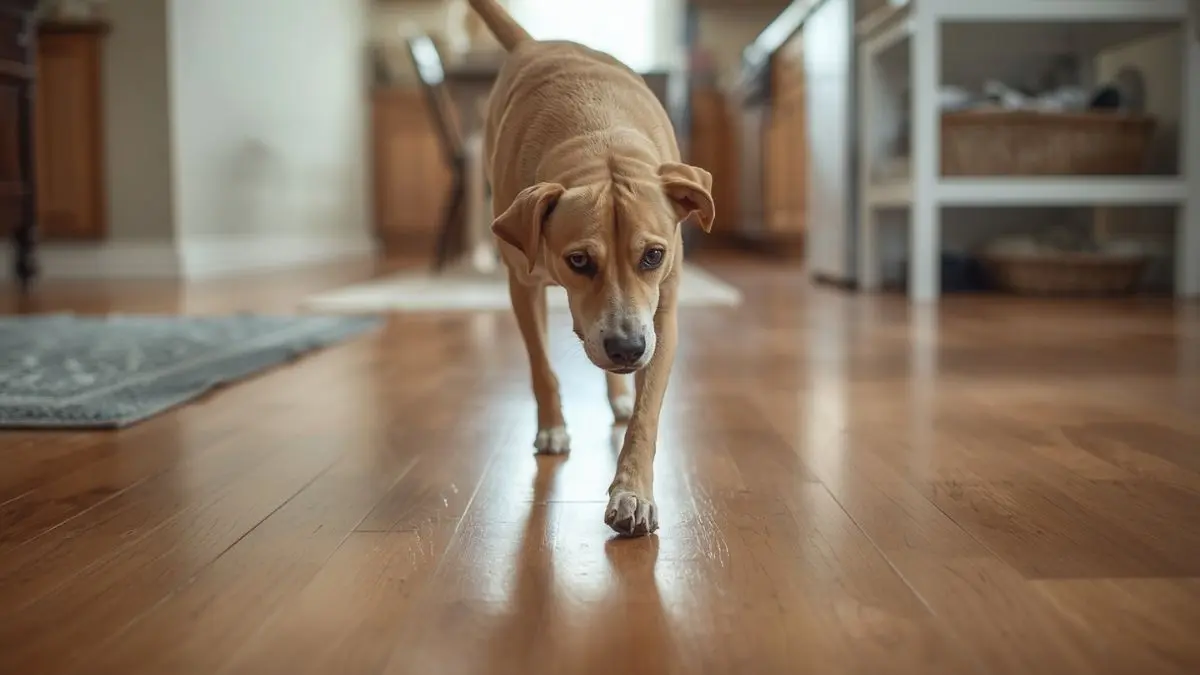
TL;DR
Dogs often slip because of slippery floors, weak back legs, arthritis, poor traction, long nails, muscle loss, or balance problems.
Mild slipping may improve with simple support, such as non-slip rugs, better traction, and regular nail care.
Owners should not ignore frequent slipping. A dog that keeps sliding, knuckling, falling, or showing weakness may need a vet check.
Sudden trouble standing or walking is an emergency. This can point to a serious mobility, nerve, or balance problem.
Common reasons dogs slip include:
- slippery hardwood, tile, vinyl, or laminate floors
- long nails that reduce paw pad contact
- fur between the paw pads
- weak back legs
- arthritis or joint pain
- muscle loss in senior dogs
- poor balance or neurologic problems
- fear after a previous slip or fall
Quick Answer
Why is my dog slipping on the floor?
If owners ask, “why is my dog slipping on the floor,” the most common reason is reduced traction on smooth surfaces like hardwood, tile, laminate, or vinyl floors.
Some dogs simply lose grip on slippery floors. Others slip because of weakness, arthritis, long nails, muscle loss, poor balance, or nerve problems. A useful way to tell them apart: a dog that moves normally on carpet or grass but slips only on smooth floors is likely dealing with a traction problem, while a dog that slips on multiple surfaces or shows wobbling, toe dragging, or slow recovery may have an underlying health issue.
A dog may also start slipping more after pain, aging, weight gain, or reduced confidence indoors. In some cases, repeated slipping can make dogs afraid of shiny floors because they fear falling again.
Mild slipping may improve with:
- non-slip rugs
- nail trims
- paw care
- better traction around the home
Frequent slipping, wobbling, knuckling, or falling should not be ignored. These signs may point to a more serious mobility problem that needs veterinary attention.
Do older dogs slip more on hardwood floors?
Yes. Older dogs often slip more on hardwood floors because aging can reduce muscle strength, coordination, balance, and joint stability.
Senior dogs may also develop:
- arthritis
- stiffness
- weak back legs
- slower balance correction
- reduced paw grip
Long nails and fur between the paw pads can make the problem worse. Some older dogs also become nervous after slipping several times. This may lead to slower walking, hesitation before crossing rooms, or fear of certain surfaces.
Hardwood, tile, and other slippery floors can be harder for senior dogs because smooth surfaces reduce traction during turning, standing, or rising from rest.
Can slipping be a sign of arthritis or weakness?
Yes. Slipping can sometimes be an early sign of arthritis, weakness, or mobility decline. Some dogs may also show other signs commonly linked to joint pain in dogs.
Painful joints may make it harder for dogs to stay stable on slippery surfaces. Arthritis can also cause stiffness, shorter steps, and slower movement. This may increase the risk of sliding or losing balance.
Weak muscles, especially in the back legs, can also reduce recovery after a slip. Some dogs wobble, drag their paws, or struggle to stand because of weakness rather than pain alone. Owners who notice these changes may also find it helpful to read Why Is My Dog Dragging His Back Legs? What It Could Mean and When to Act.
In more serious cases, slipping may be linked to neurologic or balance problems. Sudden worsening weakness, collapse, or inability to walk needs urgent veterinary care.
Table of Contents
When to Worry
Mild slipping that owners can monitor
Some dogs slip only once in a while on very smooth floors. Mild slipping is often less concerning when:
- it happens only on slippery areas
- the dog recovers quickly
- walking stays normal afterward
- traction improves with rugs or runners
A dog may also slide briefly after running too fast indoors or turning sharply on tile or hardwood floors. In many mild cases, better floor grip, trimmed nails, and safer walking surfaces help reduce slipping.
Owners should still monitor for changes. Slipping that slowly becomes more frequent may point to a developing mobility problem. Dogs that are slipping because of weakness, balance problems, or declining mobility may also benefit from the practical home-support strategies discussed in How to Help a Dog With Weak Hind Legs at Home.
Mild vs Serious Slipping Signs
| Mild / Monitor | Vet Soon | Emergency |
| Occasional slipping on smooth floors | Worsening slipping frequency | Sudden inability to stand |
| Improves with rugs or traction | Hind-end weakness | Sudden inability to walk |
| Normal recovery after sliding | Difficulty standing | Collapse |
| Mild hesitation on hardwood floors | Paw dragging or knuckling | Severe wobbling |
| Brief stiffness after rest | Visible muscle loss | Loss of bladder or bowel control |
| Slipping only during fast turns | Fear walking indoors | Severe pain or crying |
| Walking remains mostly normal | Worsening balance problems | Refusal to move |
Signs a dog should see a vet soon
Frequent slipping should not be ignored, especially if the dog seems weaker or less stable over time.
Owners should schedule a veterinary visit if a dog has:
- worsening slipping on floors
- hind-end weakness
- difficulty standing up
- wobbling or poor balance
- paw dragging or knuckling
- slower walking
- fear walking indoors
- hesitation on shiny floors
- visible muscle loss around the hips or legs
Some dogs become scared of slippery floors after repeated falls. Others may avoid certain rooms, stairs, or normal daily movement because they no longer feel stable.
These changes can happen with arthritis, weakness, balance disorders, or neurologic problems. Early evaluation may help identify the cause before mobility worsens.
Emergency warning signs
Some symptoms need urgent veterinary attention.
Owners should seek emergency care if a dog:
- suddenly cannot stand
- suddenly cannot walk
- collapses
- shows severe wobbling
- loses bladder or bowel control
- cries from severe pain
- refuses to move
- reacts aggressively when touched because of pain
Sudden slipping together with severe weakness or loss of coordination can signal a serious spinal, nerve, or orthopedic problem. These signs should never be monitored at home without veterinary guidance.
Symptoms / Signs
Common signs dogs lose traction indoors
Owners asking “why is my dog slipping on the floor” often notice small movement changes before severe weakness appears.
Many dogs first show traction problems on hardwood, tile, laminate, or other smooth floors. Common signs include:
- sliding during walking
- legs splaying outward
- scrambling to regain balance
- slipping during fast turns
- difficulty stopping on slick surfaces
- hesitation on shiny floors
Some dogs walk normally on carpet or grass but struggle indoors. Others may move slowly across slippery rooms because they no longer trust the surface under their paws.
Dogs with poor traction may also spread their legs wider to stay balanced. This can make movement look awkward or unstable.
Mobility and weakness signs owners may notice
Some slipping problems happen because of weakness, stiffness, or mobility decline rather than floor traction alone. Some dogs that struggle with slipping indoors may also show signs related to why is my dog limping.
Owners may notice:
- slower walking
- stiffness after rest
- lagging behind during walks
- trembling during movement
- difficulty rising from the floor
- shorter steps
- wobbling
- muscle loss around the hips or thighs
A dog with weak back legs may slide more easily after turning or standing up. Some dogs also drag their paws slightly or struggle to recover after a slip.
Older dogs with arthritis or reduced muscle strength may move carefully because painful joints make balance harder to maintain. Some may shift weight before standing or take longer to settle comfortably after rest.
Fear and confidence-related behavior changes
Repeated slipping can affect confidence as well as mobility.
Some dogs become scared of the floor after falling or losing balance several times. Owners may notice that a dog:
refuses certain rooms
avoids stairs
hesitates near tile or hardwood floors
walks nervously indoors
freezes before crossing shiny surfaces
stays close to rugs or carpeted areas
Fear-related movement changes can slowly reduce activity levels. Over time, less movement may contribute to further muscle weakness and worse stability indoors.
Causes of Why a Dog Is Slipping on the Floor
Common Causes of Dogs Slipping on Floors
| Cause | Common Signs | Typical Dogs Affected |
| Slippery hardwood or tile floors | Sliding, scrambling, legs splaying | Dogs living on smooth flooring |
| Long nails or paw fur | Reduced grip, unstable walking | Dogs overdue for nail or paw care |
| Weak back legs | Wobbling, difficulty rising | Older or inactive dogs |
| Arthritis and joint pain | Stiffness, cautious movement | Senior dogs |
| Neurologic or balance problems | Knuckling, paw dragging, severe instability | Dogs with nerve or spinal problems |
| Excess weight | Poor balance, slower recovery after slips | Overweight dogs |
| Fear after falling | Hesitation indoors, avoids rooms | Dogs with repeated slipping experiences |
Slippery hardwood, tile, and laminate floors
For many owners asking “why is my dog slipping on the floor,” the biggest cause is simply poor traction on smooth surfaces.
Hardwood, tile, laminate, and polished vinyl floors reduce grip under the paws. Dogs may slide, scramble, or lose balance when turning quickly or trying to stop suddenly. Research from Chulalongkorn University’s Faculty of Veterinary Science found that non-slip floor mats measurably improved joint range of motion during movement, supporting the case for traction changes at home.
Some dogs walk normally outdoors on grass or dirt but struggle indoors because slippery surfaces make balance harder. Larger dogs, senior dogs, and dogs with weak back legs often have more trouble recovering after a slip.
Long nails and fur between paw pads
Long nails are a common reason dogs lose traction indoors.
When nails become too long, the paw pads cannot fully contact the floor. This reduces grip and makes sliding more likely on smooth surfaces.
Fur growing between the paw pads can also worsen slipping. The extra fur may act like a slick layer under the feet, especially on hardwood or tile floors.
Some owners notice improvement after regular nail trims and paw care because better paw pad contact improves stability.
Weak back legs and muscle loss
Weak back legs can make dogs slip more often, even on floors that are only mildly slippery. In some cases, owners may wonder about sudden hind leg weakness in dogs when mobility problems appear unexpectedly.
Dogs use their hind legs to support balance, turning, and standing. When the muscles become weak, the body cannot recover quickly after a slide or stumble.
Muscle loss around the hips and thighs is more common in older dogs and less active dogs. Reduced muscle strength may lead to:
- wobbling
- slower movement
- difficulty rising
- unstable walking
- legs sliding apart during movement
Over time, reduced movement can create another problem. Weakness may lead to less activity, which can cause even more muscle loss and instability. In senior dogs, this cycle of weakness and muscle loss may eventually lead to episodes of old dog back legs collapsing during walking, standing, or turning.
Arthritis and joint pain in older dogs
Arthritis is another common cause of slipping, especially in senior dogs.
Painful joints can make movement stiff and cautious. Dogs with arthritis often take shorter steps and move more carefully on slippery floors because painful hips, knees, or other joints reduce stability.
Some dogs slip because they cannot react quickly enough to regain balance. Others avoid putting full weight on painful legs, which can make traction problems worse.
A senior dog slipping on the floor may not always show obvious limping. Frequent slipping and cautious movement may sometimes appear alongside other early signs of arthritis in dogs. Sometimes the first signs are slower walking, stiffness after rest, hesitation on hardwood floors, or tiring more quickly during activity. ToeGrips’ veterinary-reviewed guide on early arthritis signs lists reduced traction and hesitation on smooth floors among the more overlooked early indicators.
Neurologic or balance problems
Some slipping problems happen because of neurologic disease or balance disorders rather than joint pain alone.
Dogs with nerve or spinal problems may show:
- paw dragging
- knuckling
- severe wobbling
- poor coordination
- unusual leg placement
- sudden weakness
Balance problems can also affect how dogs move indoors. A dog may lean, stumble, or struggle to stay upright on smooth floors.
Sudden worsening weakness or loss of coordination should always be checked by a veterinarian quickly.
Weight gain and reduced stability
Excess weight can make slipping worse by increasing pressure on the joints and muscles.
Heavier dogs may have more difficulty stopping, turning, or recovering after sliding. Extra weight can also worsen arthritis pain and reduce overall stability.
Dogs carrying excess weight may tire faster and move less confidently on slippery surfaces. Reduced activity can slowly weaken muscles even more over time.
Fear after previous slipping or falling
Some dogs continue slipping because they become nervous after earlier falls or painful experiences.
A dog scared of the floor may walk slowly, freeze before crossing shiny areas, or avoid certain rooms completely. Fear can change normal movement patterns and reduce confidence indoors.
This often creates a cycle:
- slipping
- fear of movement
- reduced activity
- muscle weakness
- worse balance
- more slipping
Dogs that repeatedly fall on hardwood or tile floors may become increasingly cautious even when no major injury is present.
What Slipping on the Floor Can Mean
Slipping from poor traction vs true weakness
Not every dog that slips indoors has a serious medical problem. Sometimes the issue is mainly poor traction on smooth floors.
Dogs with normal strength may still slide on hardwood, tile, or laminate floors if the surface is very slippery. These dogs usually recover quickly after slipping and move normally on carpet, grass, or other non-slip areas.
True weakness looks different. A weak dog may:
- wobble while standing
- struggle to rise
- drag the paws
- slip repeatedly even on safer surfaces
- have trouble recovering balance after sliding
This difference matters because slipping from poor traction alone is not the same as slipping caused by weakness, pain, or neurologic disease. Owners unsure whether slipping may be connected to discomfort or stiffness may benefit from learning how to tell if your dog has joint pain.
Arthritis-related instability and stiffness
Arthritis can make dogs unstable even when the floor itself is not extremely slippery.
- Painful joints often cause:
- stiffness after rest
- shorter steps
- guarded movement
- slower walking
- hesitation during turns
Dogs with arthritis may also shift weight away from painful legs. This can reduce balance and increase slipping on hard floors.
Some senior dogs move carefully because they fear pain or falling. Others become less active over time, which may slowly weaken the muscles that support stability.
Cause → effect mobility decline patterns
Slipping problems often become worse through gradual mobility decline patterns.
One common pattern is:
pain → stiffness → weakness → instability
Pain may reduce movement. Less movement can weaken muscles, reduce balance, and increase slipping risk over time.
Another common pattern is:
slipping → fear → reduced movement → muscle loss
Some dogs become nervous after repeated slips or falls. They may avoid walking across shiny floors or move less throughout the day. Reduced activity can slowly lead to muscle loss, worse coordination, and more instability indoors.
These patterns are common in older dogs with arthritis, weakness, or mobility problems.
When slipping may point to neurologic disease
Sometimes slipping is linked to neurologic or balance disorders instead of traction problems alone.
Neurologic disease may affect how the brain, spine, nerves, or muscles control movement. Dogs with these problems may show:
- knuckling
- paw dragging
- severe wobbling
- crossing legs awkwardly
- sudden weakness
- poor coordination
Some dogs lose awareness of where their feet are placed. Others struggle to control the back legs properly during walking or turning.
Sudden worsening balance problems, collapse, or inability to walk should always be treated as urgent veterinary concerns.
How to Tell If Slipping Is From the Floor or From the Dog
Not every dog that slips indoors has a health problem. But not every dog that slips is fine either. The difference matters — and it comes down to where the slipping happens, how the dog moves on other surfaces, and how quickly things recover.
Signs the Floor Is the Main Problem
A healthy dog with good strength can still slide on tile, hardwood, or laminate. Smooth floors give paws very little to grip, especially during fast turns or sudden stops. When the floor is the main cause, the slipping tends to be surface-specific.
Signs that point toward a floor problem rather than a health problem:
- Dog runs and moves normally outside on grass, dirt, or carpet
- Slipping happens mainly on smooth indoor surfaces
- Dog recovers quickly after each slide with no lingering wobble
- Adding a rug or runner in that area noticeably reduces the problem
Long nails and fur between the paw pads can make this worse. When nails grow too long, the paw pads lift slightly off the floor and lose contact. Fur between the pads acts like a smooth layer underfoot. Both reduce grip even on surfaces that are only moderately slippery.
If better traction completely solves the slipping, the floor was likely the main issue.
Signs a Health Problem May Be Causing Slipping
Health-related slipping looks different. It tends to appear on more than one surface, worsen over time, and come with other movement changes.
Arthritis and muscle loss reduce joint stability. Painful joints alter the way a dog carries its weight, often shifting more to the front legs or to one side. This makes the dog less balanced on any surface — and more likely to spread-eagle or stumble when rising on a slippery floor.
Some dogs slip consistently toward the same side. This often happens when pain or weakness in one limb causes the dog to offload weight onto the opposite side. Over time, that creates uneven muscle development and a subtle sideways lean that makes balance correction harder on smooth floors.
Signs that may point toward a health problem:
- Hind end wobbles or sways even on carpet or grass
- Dog stumbles or crosses legs rather than taking clean steps
- Slipping happens on multiple surfaces, not just the slickest ones
- Recovery after a slip is slower than it used to be
- Dog avoids the spot where a slip occurred
- Nails scrape or click more than usual — scuffed tops of toes may suggest dragging
Traction products may help these dogs move more comfortably, but they are unlikely to fully resolve the slipping on their own.
What Proprioception Means and Why It Causes Slipping
Dogs with neurologic problems sometimes slip even on surfaces with reasonable grip. This is often linked to reduced proprioception — the brain’s ability to sense where the limbs are in space.
When proprioception is affected, a dog may place a paw too far forward, cross its legs awkwardly, or leave a paw folded under without correcting it. These are not simply clumsy moments. The brain is not receiving or processing accurate information about where the feet are landing.
Neurologic slipping looks different from arthritis-related slipping:
- Arthritis: stiffness after rest, shorter steps, difficulty rising, weight-shifting away from painful joints — often improves after gentle warm-up
- Neurologic: toe dragging, knuckling, inaccurate foot placement, instability that does not improve after moving around
A dog whose paw folds under and stays there — knuckling — without immediate self-correction is showing a sign that warrants veterinary attention. This can point to problems along the spine or in the nervous system rather than in the joints alone. SEV Neurology’s veterinary team notes that persistent knuckling — a paw that stays folded under without self-correction — is one of the clearer indicators of a spinal or nervous system problem rather than ordinary clumsiness.
Dogs with neurologic involvement on one side may also show circling, leaning, or repeated slipping in the same direction.
How to Watch Your Dog on Different Surfaces
One of the most useful things an owner can do is watch the dog move across several different surfaces and compare.
Walk the dog on smooth tile or hardwood indoors, carpet or rugs, grass or dirt outdoors, and concrete. Pay attention to stride length, whether the back legs track evenly, whether the nails drag or scuff, and how easily the dog recovers after any stumble or slide. Note whether slipping happens consistently to one side.
If traction improvements — rugs, nail trims, grip products — solve the slipping completely, the floor was likely the main cause. If slipping continues or worsens despite better traction, or if new signs appear such as knuckling, head tilt, or circling, a veterinary evaluation is the right next step.
Dogs that slip on multiple surfaces, or that show sudden changes in how they move, should not be monitored at home without veterinary guidance.
Is my dog slipping because of the floor or because of weakness?
If slipping happens only on smooth surfaces, improves with rugs or traction aids, and the dog moves normally elsewhere, the floor is likely the main reason. If slipping happens on multiple surfaces, comes with wobbling, toe dragging, or difficulty rising, or does not improve with traction changes, a health problem may be involved.
Why does my dog walk fine outside but slip inside?
Outdoor surfaces like grass, dirt, and concrete give paws much better grip than indoor hardwood, tile, or laminate. A dog that moves normally outside but struggles indoors is often dealing with a traction problem on smooth floors rather than a mobility problem — especially if adding a few rugs helps noticeably.
Why does my dog slip even when the floor is not that slippery?
This can happen when reduced proprioception affects a dog’s ability to sense where its feet are placed. Neurologic disease, spinal cord problems, and some age-related changes can reduce this body awareness, causing inaccurate foot placement, knuckling, or toe dragging even on surfaces with reasonable grip.
What does it mean if my dog always slips to one side?
Consistent slipping in one direction often points to muscle asymmetry or neurologic involvement. Pain or weakness in one limb can cause a dog to lean away from that side, creating uneven weight distribution. Neurologic conditions affecting one side of the nervous system can also cause a dog to circle or fall toward the affected side repeatedly.
What is proprioception and why does it matter for slipping?
Proprioception is the brain’s ability to know where the body’s limbs are in space. When it is reduced — usually because of spinal cord or neurologic disease — a dog may misplace its feet, leave a paw knuckled under, or fail to correct stumbles in time. This causes slipping even on surfaces that would normally provide enough grip for a healthy dog. Signs of proprioceptive problems include knuckling, toe dragging, and scuffed nails from dragging.
Why Slipping Can Get Worse Over Time
Slipping that starts mild can become a bigger problem over months. The conditions that cause slipping — arthritis, muscle loss, neurologic disease — do not stay the same. They tend to get worse gradually, and the slipping usually follows.
How Arthritis, Muscle Loss, and Neurologic Disease Worsen Slipping Gradually
Canine osteoarthritis is a degenerative condition. As joint pain and stiffness increase over time, dogs move less. Less movement leads to muscle wasting, especially in the hind limbs. Weaker muscles mean less joint support, slower recovery after a slide, and more frequent slipping overall.
The signs of gradual worsening are often subtle at first. Owners may notice slipping more often on the same floors than a few months ago, a longer time to steady after standing especially on hard surfaces, hindquarters that look thinner or weaker, and new or increasing toe scuffing sounds or visible scraping on the tops of paws.
Neurologic conditions follow a different pattern but can be just as progressive. With conditions such as degenerative myelopathy or spinal cord disease, coordination problems and ataxia gradually worsen over time. Owners may first notice occasional toe scuffing when the dog walks. That may progress to actual dragging, and eventually to difficulty keeping the feet underneath the body even on grippy surfaces. For dogs showing this pattern, a veterinary evaluation is important early.
How Repeated Falls and Fear Create a Worsening Cycle
Each fall adds to the problem. Repeated sliding and splayed-leg falls strain muscles and ligaments and can increase joint inflammation, particularly in dogs that already have joint disease. A painful fall often leads to less movement the next day. Less movement accelerates deconditioning, which means the dog is weaker and less stable when it does need to move.
Fear can make this cycle worse. As slipping becomes more frequent, many dogs — especially older or arthritic dogs — start to avoid certain floors altogether. This reduced activity further weakens the muscles that support balance and stability.
What owners may not expect is that fearful dogs do not always slow down. Some rush frantically across slippery areas, trying to get through as quickly as possible. That sudden burst of movement on a smooth floor is just as likely to cause a slip as slow hesitant movement. Both patterns increase the chance of another fall, which deepens the fear and reduces confidence further.
Owners may notice the dog freezing at the edge of a room, detouring around smooth areas, or rushing across certain floors with an unusual urgency. All of these can be signs that fear is beginning to affect movement.
Medications and Cold Weather That Can Make Slipping Worse
Two causes of worsening slipping that owners sometimes miss are medications and cold weather.
Some medications can temporarily increase slipping risk. Sedatives, anti-anxiety medications, and certain anti-seizure drugs can cause drowsiness, mild incoordination, or ataxia. Pain medications at higher doses or in dogs that are more sensitive can also cause brief weakness or sedation. If slipping worsens shortly after a new medication is started or a dose is changed, that connection is worth discussing with a veterinarian. Medication doses should never be adjusted without veterinary guidance.
Cold weather and cold flooring have a separate effect. Arthritic joints become stiffer and more painful in cold conditions, especially first thing in the morning or after a period of rest. This extra stiffness increases stumbling on hard floors. Cold and wet paws from rain or dew also reduce paw-pad friction on smooth surfaces, making slips more likely when a dog comes back inside. Stiffness and slipping that are clearly worse on cold or damp mornings are a pattern worth tracking over time.
How to Tell If Slipping Is Progressing or Just a Temporary Setback
Not every increase in slipping means the condition is getting worse. A temporary setback can follow a single hard fall, a very active day, or a recent medication change. These usually improve within a few days to a couple of weeks, and slipping returns to the previous level.
True progression looks different. Slipping frequency increases steadily over weeks or months. Slipping begins on surfaces that were previously manageable. Recovery after slips takes longer. New signs appear alongside slipping — weakness, gait changes, or toe dragging.
Fear-related avoidance can sometimes look like physical decline. A dog avoiding certain floors or becoming more hesitant may be responding to anxiety rather than true physical worsening. The difference is often visible: fear-related avoidance tends to improve when traction is added and the dog feels safer. Physical decline tends to continue regardless of traction improvements and usually comes with other movement changes.
Monitoring slipping frequency alongside activity levels, balance, and confidence over several weeks gives a much clearer picture than any single observation. Repeated falls should not be dismissed as normal aging. Any sudden dramatic worsening — especially if accompanied by severe weakness, collapse, or inability to stand — warrants same-day veterinary attention.
For owners beginning to notice a pattern of gradual progression, understanding how arthritis advances by stage can help explain what they are seeing.
Why is my dog slipping more than before?
Slipping often increases gradually because arthritis, muscle loss, and neurologic disease reduce strength and balance over time. Repeated falls can also cause pain and fear that lead to less movement, which weakens muscles further. Cold weather, new medications, and reduced confidence indoors can all temporarily make slipping worse.
Why is my dog getting worse on hardwood floors?
Hardwood and other smooth floors leave no room for weakness to hide. As balance and muscle strength decline — whether from arthritis, age-related muscle loss, or a neurologic condition — hardwood floors become harder to navigate because even small missteps are difficult to correct on a low-friction surface.
Could a new medication be causing my dog to slip more?
Yes. Some medications — including sedatives, anti-anxiety drugs, anti-seizure medications, and some pain medications — can cause temporary drowsiness, mild incoordination, or weakness that increases slipping risk. If slipping worsened shortly after starting or changing a medication, that connection should be discussed with a veterinarian before any medication changes are made.
Does cold weather make slipping worse?
Cold weather can make slipping noticeably worse for dogs with arthritis. Cold temperatures stiffen joints and make them more painful, especially after rest or first thing in the morning. Cold and wet paws from rain or dew also reduce grip on hard floors. If slipping is consistently worse on cold or damp mornings, that pattern is worth noting and discussing with a veterinarian.
How do I know if slipping is progressing or just occasional?
A temporary setback — such as extra slipping after a hard fall or very active day — usually improves within a few days and returns to the previous level. True progression means slipping frequency steadily increases over weeks, begins appearing on surfaces that were previously fine, recovery takes longer, or new signs appear such as weakness or gait changes. Monitoring frequency and recovery over time gives a clearer picture than any single observation.
Why Dogs Slip More in the Morning and After Rest
Many owners notice that slipping is worst first thing in the morning or right after a long nap. The dog seems unsteady on its feet for a few minutes, then gradually moves more normally. This pattern has a specific cause — and understanding it helps owners know when it is a manageable sign and when it may point to something more serious.
Why Joints and Muscles Are Stiffer After Sleep — and Why Smooth Floors Make It Worse
When a dog rests, joint fluid circulation slows and muscle temperature drops. The first steps after waking are often stiff and unsteady, particularly in older or arthritic dogs. This is not just general soreness. The joints have less lubrication and the muscles are slower to respond than they will be after a few minutes of movement.
On carpet or grass, that first-step stiffness may look mild — a slightly slow or cautious walk. On tile or hardwood, the same dog can splay, slide, or stumble. Smooth floors offer no grip to help correct small wobbles, so mild post-rest stiffness becomes visible slipping.
Cold weather makes this worse. Cold temperatures stiffen arthritic joints further after rest, and cold flooring gives paws even less friction on first contact. Dogs with arthritis may slip noticeably more on hard floors during cold winter mornings than they do at other times of day or year.
Owners may notice a useful behavioral clue here. Some dogs actively choose to walk on carpeted or rug-covered paths when they first get up, only crossing smooth floors once they have warmed up. This surface-seeking behavior is an early and reliable sign that post-rest stiffness is affecting floor confidence.
Other things to look for during first morning movement include stiff, choppy, or very short first steps on tile or hardwood, more splaying or sliding when rising from a dog bed or sofa, and noticeably worse slipping and stiffness on cold or damp mornings.
The Warm-Up Effect — Why Slipping Often Improves After Moving Around
In many dogs with arthritis, slipping in the morning is not permanent. As the dog walks around, joint lubrication improves and circulation increases.
This leads to a noticeable improvement in gait and stability after a few minutes of gentle movement. The dog that was stumbling near the back door may look mostly normal by the time it reaches the garden.
This warm-up pattern — stiff at first, then better — is a hallmark of chronic arthritis. It is different from neurologic slipping, where coordination problems tend to persist even after the dog has been moving for several minutes.
The distinction matters for owners. An arthritis post-rest pattern shows stiffness and slipping after rest that improves clearly with gentle movement and may worsen again after heavy activity or cold weather. A neurologic or significant weakness pattern shows toe dragging, knuckling, or ongoing instability that does not resolve with movement and is not limited to the first few steps.
If slipping after rest is improving within a minute or two and the dog walks normally afterward, that pattern is more consistent with arthritis-related stiffness. If instability persists beyond the first few minutes, or if toe dragging or knuckling does not resolve after the dog has been moving, a veterinary evaluation is worth scheduling.
Over time, the warm-up period itself tends to get longer as arthritis progresses. A dog that used to recover in thirty seconds may take three or four minutes as the condition advances. Owners who track this change can share it with their veterinarian as a useful indicator of disease progression. Morning stiffness and post-rest slipping are among the early signs of arthritis in dogs that owners often notice before other symptoms become obvious.
Simple Steps to Reduce Slipping During First Morning Movement
The most effective single change for morning slipping is placing a rug or runner directly beside the dog’s sleeping spot. This is the highest-priority traction placement for any dog that slips after rest. The dog needs grip immediately on rising — before it has warmed up and before it has taken more than one or two steps.
Beyond that, a safe traction path from the sleeping area through the first few rooms the dog typically walks helps reduce the number of risky steps taken during the stiff period.
Practical steps to reduce post-rest slipping include placing a rug or runner immediately beside the dog’s bed, sofa spot, or favorite resting area, creating a connected traction path from the sleeping area to the main walking route, observing whether slipping improves with movement over a few minutes, noting if morning slipping is worse on cold days, and watching for changes in warm-up duration over weeks.
For dogs that are already struggling to rise, an orthopedic bed with a lower profile can reduce the distance the dog has to push up from, which decreases the load on stiff joints at the moment of standing.
When Morning Slipping May Signal a More Serious Problem
Post-rest slipping that used to resolve in seconds but now takes several minutes is a sign that mobility is declining. Slipping that has started appearing on surfaces where the dog previously had no difficulty — after rest and at other times of day — suggests the underlying condition is progressing.
Dogs that begin to hesitate before rising, vocalize when standing, or need encouragement or assistance to get up are showing signs of more advanced disease. These changes go beyond the normal warm-up effect and should not be attributed to normal aging without veterinary evaluation.
Neurologic signs that persist after warm-up are a separate concern. If toe dragging or knuckling is still present after the dog has been walking for several minutes, that warrants veterinary attention rather than home monitoring. Dogs that are struggling to stand up after rest, beyond the normal brief stiffness, may need a full mobility assessment to understand what is contributing to the difficulty.
For owners who notice that the stiff period is getting longer month over month, recording this change and sharing it at a veterinary visit gives the clinician important context that cannot be observed during a short clinic appointment.
Why does my dog slip more in the morning?
Dogs often slip more in the morning because joints and muscles are stiffer after a period of rest or overnight sleep. Joint fluid circulation slows during inactivity, and the first steps are less coordinated as a result. Smooth floors magnify this stiffness into visible slipping. Slipping usually improves after a few minutes of gentle movement as the joints warm up.
Why does slipping improve after my dog moves around for a while?
This is the warm-up effect, which is common in dogs with arthritis. As the dog moves, joint lubrication improves and circulation increases, gradually restoring more normal coordination and stability. The stiff period usually lasts seconds to a couple of minutes in mild cases. A warm-up period that is getting longer over weeks or months may indicate that arthritis is progressing.
Is morning slipping a sign of arthritis?
Morning slipping after rest is one of the more common signs of arthritis in dogs. Stiffness after lying down or sleeping is a hallmark symptom of joint disease, and smooth floors make that stiffness more obvious as slipping. Morning slipping alone does not confirm arthritis, but in older dogs, or when paired with other signs such as slower movement, hesitation before rising, or shorter steps, it is worth discussing with a veterinarian.
What can I do to reduce slipping when my dog first wakes up?
Place a rug or runner directly beside the sleeping spot so the dog has grip immediately on rising. This is the single most effective change for morning slipping. Adding a connected traction path from the sleeping area helps further. Avoid smooth flooring in the first few steps the dog takes after waking. For dogs that struggle to rise, a lower orthopedic bed reduces the effort needed to stand from stiff joints.
How long should morning stiffness last before I call a vet?
A brief warm-up period of a minute or two that resolves clearly with gentle movement is typical in dogs with mild arthritis. If stiffness and slipping last longer than a few minutes, appear after shorter rest periods than before, are getting worse over weeks, or are accompanied by vocalization, hesitation before rising, or signs of neurologic change such as toe dragging that does not resolve, a veterinary evaluation is the right next step.
What to Do
How to stop a dog from slipping on the floor
Owners asking “why is my dog slipping on the floor” often see improvement after making simple traction changes at home.
Smooth surfaces like hardwood, tile, and laminate floors can become safer with:
- non-slip rugs
- hallway runners
- yoga mats
- traction zones near beds, food bowls, and doors
These changes help dogs keep better grip while walking, turning, or standing up. Many home traction and mobility adjustments used to help a dog with arthritis at home may also improve confidence on slippery floors. Many dogs also feel more confident when they can move across stable surfaces without sliding.
Best Areas of the Home to Make Safer First
Targeted traction in the right zones can produce meaningful safety improvements without replacing floors or carpeting the entire home.
Bed and Resting Areas — Priority Zone One
The area directly beside a dog’s bed, sofa spot, or favorite resting place is the single highest-priority traction zone in any home.
Rising from rest is the most physically demanding moment for a dog with arthritis or weak hind legs. Joints are stiff, muscles are slow to respond, and the dog is pushing up from a low position onto what may be a very slippery surface. When legs slide outward on hard floors at that moment, the dog either falls or learns to fear rising — both outcomes worsen mobility over time.
A rug or runner placed directly beside the sleeping spot gives the dog immediate grip on the first step. This one change often produces a noticeable difference before any other area of the home is addressed. Owners can confirm the need for this zone by watching for a dog that slips or sprawls when getting off the bed or sofa, or that hesitates before attempting to rise.
Supportive bedding also helps. A bed with a lower profile reduces the distance the dog has to push up from, which lessens the load on stiff joints at the moment of standing.
Feeding and Water Stations — Priority Zone Two
Food and water bowl areas are the second-highest priority — and an easy one to overlook because they seem simple.
Dogs do not stand still at their bowls. They pivot, shift weight, back up, and turn around during and after eating and drinking. Excitement before mealtimes can cause sudden movement on smooth floors. Water spills and drool around the bowl make the floor wet and even more slippery than usual.
Wet paw pads carry the problem further. A dog that has just been drinking walks away from the bowl with wet paws, which dramatically reduce grip on tile or hardwood for the next several steps.
A non-slip mat placed under the bowls prevents slipping during the movement around feeding time and also absorbs spills before they spread. Owners who notice a dog’s back legs sliding out when turning near the food or water bowl often see improvement immediately with this one addition.
Hallways, Doorways, and Entry Areas — Priority Zone Three
Hallways and doorways are high-risk zones for different reasons, and they need different solutions.
Hallways create acceleration. Many dogs speed up when moving toward a door, kitchen, or familiar destination. On smooth floors, that speed makes stopping or turning safely nearly impossible. The dog slides, skids, or crashes into doorframes. A long runner that covers the length of the hallway provides a continuous grippy path that allows dogs to slow down and turn without losing footing.
Doorways and entry areas carry a separate set of risks. Coming inside from outdoors, a dog has wet paws from rain, dew, or garden grass. Those wet paws hit smooth tile or hardwood and immediately lose grip. Add excitement — most dogs rush when coming through a familiar door — plus any step or threshold height change, and the combination creates a consistent slipping point that owners often see but may not immediately connect to the wet paw problem. Non-slip mats placed both inside and outside the door absorb moisture and provide grip at the transition point.
The higher-risk zones in most homes are the bed area, food and water stations, hallways, doorways, and stairs. Lower-risk zones — low-traffic rooms, areas the dog rarely passes through quickly — can wait until the priority zones are addressed.
Stairs and stair landings carry the highest fall risk for dogs that slip, but stair-specific safety guidance is a separate topic — the article on dog having trouble climbing stairs covers what to do when stairs become a mobility concern.
Where should I put rugs first for my slipping dog?
Start with the area directly beside the dog’s sleeping spot — this is where falling risk is highest because rising from rest is physically the most demanding moment for a dog with stiff or weak joints. Next, add a non-slip mat under the food and water bowls. Then cover hallways with a long runner and place mats at entry doors. These four zones address the most common slipping locations in most homes.
Which areas of the home are most dangerous for dogs that slip?
The highest-risk zones are the bed and resting area, the food and water bowl area, hallways where dogs accelerate, and doorways where wet paws and excitement combine. Stairs and stair landings also carry high fall risk. Low-traffic rooms and areas the dog rarely moves through quickly are lower priority.
Why does my dog slip near the food bowl?
Dogs pivot, shift weight, and back away from food and water bowls during eating and drinking. Excitement at mealtime can cause sudden movement on smooth floors. Water spills and drool make the surface around the bowl wet, and wet paw pads reduce grip on tile or hardwood for several steps after drinking. A non-slip mat under the bowls addresses all of these at once.
Why does my dog slip getting off the bed?
Rising from a resting position requires pushing up from a low height onto whatever surface is directly beside the sleeping spot. For dogs with arthritis or weak hind legs, joints are stiff at that moment and muscles respond more slowly. Smooth floors beside beds give the paws no grip during the push-up movement, causing legs to slide outward. A rug or runner placed directly beside the sleeping area gives immediate grip on the first step.
Why does my dog slip more when coming inside from outside?
Dogs come inside with wet paws from rain, dew, or garden grass. Wet paw pads lose grip on smooth tile or hardwood almost immediately on contact. The combination of wet paws, excitement at re-entering a familiar space, and any step or threshold at the door creates a consistent slipping point. Non-slip mats placed both inside and outside the door absorb moisture and provide grip at the moment of entry.
How to Rebuild Confidence After a Dog Slips or Falls
Why Dogs Become Afraid of Floors After Slipping — and Who Is Most at Risk
A dog that slips repeatedly on shiny floors often develops a genuine negative association with that surface. This is not stubbornness or disobedience. It is a learned response — the floor has become unpredictable and unsafe in the dog’s experience.
Signs that fear has set in include freezing at the edge of a smooth floor, wide-eyed or tense body posture, refusing to cross, and taking long detours around open flooring. A dog may navigate confidently along a path of rugs or mats but stop completely where the rug ends and bare tile begins.
Some dogs and situations carry higher risk of developing this fear. Arthritic and senior dogs already find movement more effortful — a fall on a slippery floor is more painful and more frightening for a dog that is already struggling. Dogs with a naturally anxious or fearful temperament are more likely to generalize one bad slip into broad avoidance of multiple floor types. Rescue dogs or dogs in new homes with unfamiliar flooring may have had no time to build confidence before experiencing a slip.
Anxiety changes the way a dog moves — and not always in the obvious direction. Fearful dogs do not always slow down. Some hesitate and creep across slippery floors. Others rush suddenly and frantically, trying to get through as quickly as possible. Both patterns increase missteps and make slipping more likely. Tense muscles, a crouched posture, and a lowered body position shift weight distribution and can destabilize joints even further.
The difference between normal caution and true floor anxiety is important. Normal caution after a single slip usually resolves within a few days once traction improves. The dog moves voluntarily again once the surface feels stable. True floor anxiety is persistent — the dog refuses despite traction improvements, avoids multiple surface types, and may need more structured support to recover confidence.
How to Rebuild Confidence Step by Step — Traction First Then Movement
The order of these steps matters. Improving traction must come before any attempt to encourage fearful dogs to walk across difficult surfaces. Without safer footing, repeated failed crossings deepen the fear and reduce the dog’s trust in the floor rather than building it.
The first step is to improve traction. Place non-slip rugs, runners, and mats to create connected safe paths before asking the dog to move across them. Address nail length and paw pad care so the dog has better grip on whatever surfaces remain exposed.
The second step is to create safe routes. Map out a connected path of traction through the areas the dog needs to move through most often — from sleeping spot to door, from kitchen to garden. The dog should be able to navigate the most important routes without encountering long bare floor sections.
The third step is to encourage voluntary movement only. Never force or drag a fearful dog across a floor it is avoiding. Forced crossings deepen fear rather than reducing it. Invite the dog toward the safe path with treats, a favourite toy, or calm praise. Reward each small successful crossing — even one or two steps counts.
The fourth step is to keep sessions short and positive. End each session before the dog becomes stressed. Several short positive sessions build confidence faster than one long pressured one.
The fifth step is to avoid removing all safe surfaces at once. Some owners believe taking away the rugs will force the dog to cross the floor. This approach, called flooding, usually makes floor anxiety worse rather than better. Safe surfaces should remain in place throughout the confidence-building process.
If avoidance persists despite good traction and several weeks of gentle encouragement, a veterinary consultation is worthwhile.
When Avoidance May Be Pain or Weakness Rather Than Fear
Not every dog that refuses slippery floors is doing so because of fear alone. Persistent avoidance — especially when combined with stiffness, limping, toe dragging, or new falls — may indicate an underlying physical cause that traction and confidence work alone cannot address.
Fear-based avoidance tends to look like freezing and hesitation at the edge of smooth floors, willingness to move on surfaces that have good traction, and gradual improvement as traction and confidence improve. The dog moves when it feels safe to do so.
Physical inability looks different. A dog that slips on carpet, grass, or outdoor surfaces as well as on smooth floors is showing something beyond fear. Difficulty standing regardless of surface, weakness or instability in multiple environments, and slipping that does not improve with traction changes alone all point toward a physical cause rather than a behavioral one.
Confidence loss and mobility decline can also occur together, which makes the picture harder to read. A useful observation point is whether the dog’s avoidance changes on days when traction has been improved. A dog that moves more freely when rugs are added is more likely to be fear-driven. A dog that avoids equally on safe and unsafe surfaces is more likely to have a physical cause.
If a dog shows new lameness, stiffness, or toe dragging alongside floor avoidance — even after traction improvements are in place — this warrants veterinary evaluation. The behavior may be masking undetected arthritis or an early neurologic problem.
Why is my dog suddenly afraid of the floor?
Dogs often develop floor fear after one or more painful or frightening slips on smooth surfaces. The floor becomes associated with falling, and many dogs begin to avoid it. Senior dogs, arthritic dogs, and naturally anxious dogs are most likely to develop this fear quickly. Sudden floor avoidance can also indicate a new pain or mobility problem — so if it appears without a clear history of slipping, a veterinary check is worthwhile.
How can I help my dog feel safe walking indoors again?
Start by improving traction — add rugs, runners, and non-slip mats to create connected safe paths before asking the dog to move across them. Once traction is in place, use treats, calm praise, or a favourite toy to invite voluntary movement. Keep sessions short, reward each small success, and never force or drag the dog across feared surfaces. Progress is usually gradual.
Should I encourage my dog to walk on the floor or leave them alone?
Gentle encouragement along a safe traction path is better than leaving the dog completely alone with the fear — avoidance tends to become more entrenched over time and leads to reduced activity and further muscle loss. Forcing the dog to cross feared surfaces makes the fear worse. The goal is to create conditions where the dog chooses to move voluntarily and is rewarded for doing so.
Can fear make slipping worse over time?
Yes. A fearful dog that avoids moving indoors becomes less active over time. Less activity leads to muscle loss and reduced joint stability, which makes slipping more likely when the dog does need to move. Fearful movement patterns — tense muscles, crouched posture, sudden rushing — also increase missteps on slippery surfaces. Untreated floor fear tends to worsen rather than resolve on its own.
How do I know if my dog is avoiding floors from fear or from pain?
A dog avoiding floors from fear tends to move freely on surfaces with good traction, hesitates at the edge of bare smooth areas, and shows gradual improvement as traction is improved. A dog avoiding floors from pain or weakness tends to slip and hesitate on carpet, grass, and other textured surfaces too, shows weakness or instability regardless of flooring, and does not improve meaningfully with traction changes alone. New lameness, stiffness, or toe dragging alongside floor avoidance should prompt a veterinary visit.
Simple Daily Slipping Log for Owners
What to Record Each Day
Dogs often move very differently at home than they do during a short veterinary clinic visit. A veterinarian seeing a dog once every few months gets a snapshot. An owner watching the same dog every day gets the full picture — but only if they record it.
Without consistent tracking, owners often underestimate how gradually things have changed. A dog that now slips three times a day was probably slipping once a day six weeks ago. That progression matters — but without records it is easy to forget, minimize, or misremember.
A simple daily log does not need to be complicated. A notebook, phone note, or printed chart all work equally well. What matters is using it consistently.
For each day, owners can record the number of slips and falls, the surface involved, the time of day, what the dog was doing when it slipped, how quickly it recovered, the confidence level, any new mobility signs observed, and whether slipping was worse on cold or damp days.
Under confidence level, owners can note avoidance of certain rooms, freezing near certain floors, wall-hugging, or reluctance to cross open spaces. Under new mobility signs, owners can note toe dragging, knuckling, hind-end wobbling, difficulty standing or turning, and reduced walking tolerance.
Consistent tracking over two to four weeks builds a record that gives a veterinarian far clearer information than memory alone. It also gives the owner a clearer picture of whether things are stable or changing.
How Tracking Helps Distinguish Fear From Physical Decline
One of the most useful things a log reveals is whether slipping is connected to specific times, activities, or conditions — or whether it is becoming more widespread and unpredictable.
Time-of-day patterns are particularly informative. Slipping that happens mainly in the first few minutes after waking — and then improves — points toward post-rest stiffness and a likely arthritis pattern. Slipping that worsens after heavy activity or a long walk points toward pain flares or overexertion. Slipping or stumbling that appears suddenly and without a clear trigger, especially if it comes with collapse, circling, or unusual weakness, points toward possible neurologic involvement and warrants immediate veterinary attention.
Tracking confidence changes separately from physical changes helps owners distinguish between fear-driven avoidance and true mobility decline. A dog whose avoidance changes on days when traction is better — moving more freely when rugs are in place — is more likely to be responding to fear. A dog whose hesitation and avoidance persist even on safe carpeted or outdoor surfaces is more likely to have a physical cause.
Recording neurologic signs specifically enables earlier detection. Knuckling, toe dragging, hind-end wobble, circling, and sudden weakness are signs that require documentation and often prompt urgent assessment. Owners should note which limbs are affected and whether the signs come and go or are constant.
Stable mobility looks like slipping frequency unchanged week to week, no new weakness signs, confidence remaining normal, and recovery time consistent after each slip. Declining mobility looks like more slips over time, more hesitation on previously safe surfaces, increasing stiffness, slower recovery, and new signs appearing alongside slipping. Tracking makes the difference between these two pictures clearly visible.
Patterns That Should Prompt a Veterinary Visit — and What to Tell the Vet
Owners who track slipping are in a much stronger position when they speak to a veterinarian. Instead of saying “he seems to be slipping more lately,” they can say “slipping went from once a day to four or five times a day over the past three weeks, always on tile, and twice he has limped briefly afterward.” That specific information helps the veterinarian plan the right assessment.
Red flag patterns that should prompt a scheduled veterinary visit include increasing slip frequency over two to four weeks, slipping beginning on surfaces where the dog previously had no difficulty, new weakness alongside slipping, new toe dragging or knuckling, worsening recovery after slips, and growing reluctance to move or increasing floor avoidance despite good traction. Any pattern of sudden collapse, severe wobbling, or inability to stand needs same-day or emergency care.
An occasional slip at a predictable location with normal recovery and no new signs is different from a progression pattern. One is an isolated event. The other is a trend that the log will reveal clearly.
What to bring to the veterinary visit from the log: the surfaces involved, the time-of-day patterns, recovery quality after slips, any new mobility signs and which limbs are affected, and any medication or weather changes that coincided with worsening. This information helps veterinarians distinguish temporary setbacks from true progressive decline — and may influence whether imaging, neurologic testing, or a mobility assessment is recommended next.
For owners seeing a pattern of progressive worsening, understanding what arthritis stages look like is useful context — the article on stages of arthritis in dogs explains how the condition advances over time. For owners whose logs show slipping alongside difficulty with veterinary diagnosis, the article on how do vets diagnose arthritis in dogs explains what the assessment process involves.
How do I know if my dog’s slipping is getting worse?
Compare the number of slips per day or per week over several weeks rather than relying on memory. A log makes gradual worsening visible. Red flags for true progression include increasing frequency, slipping on surfaces that were previously manageable, slower recovery after each slip, and new signs such as toe dragging, weakness, or growing floor avoidance.
What should I track at home to monitor my dog’s slipping?
Record the number of slips and falls, the surface involved, the time of day, what the dog was doing when it slipped, how quickly it recovered, the confidence level, any new mobility signs observed such as toe dragging or hind-end wobbling, and whether slipping is worse in cold or damp conditions. Any format used consistently works.
What should I tell my vet about my dog’s slipping?
Share the surfaces involved, the time-of-day patterns, how recovery quality has changed, any new mobility signs and which limbs are affected, and any medication or weather changes that coincided with worsening. Specific numbers are more helpful than general impressions — for example, “four to five slips per day for the past three weeks” gives a veterinarian much clearer information than “slipping more than usual.”
How many slips per day should concern me?
There is no single number that applies to every dog. What matters more than the number is the pattern — whether frequency is increasing over time, whether slipping is spreading to more surfaces, and whether recovery is getting slower. A dog that slips once per day consistently on the same surface may be stable. A dog that has gone from one to five slips per day in three weeks is showing a pattern worth investigating.
When should I stop monitoring at home and call a vet?
Schedule a visit when slipping frequency is steadily increasing, when slipping begins on surfaces that were previously safe, when recovery is getting slower, or when new signs appear alongside slipping such as weakness, toe dragging, or growing avoidance. Do not wait for monitoring if sudden collapse, severe wobbling, inability to stand, or loss of bladder or bowel control occurs — these need immediate veterinary attention.
Nail, paw, and traction care
Regular paw care can improve stability indoors.
Long nails reduce paw pad contact with the floor, which makes slipping worse. Trimming nails and trimming excess fur between the paw pads may improve traction on slippery surfaces.
Some dogs also benefit from:
- toe grips
- dog paw grippers
- anti slip pads for dogs
- traction booties
- paw traction products
Paw wax products may also provide some additional grip on smooth surfaces for dogs with dry or cracked paw pads, and may help older dogs with weakness or arthritis walk more confidently on hardwood or tile floors.
When arthritis is contributing to slipping or reduced confidence during movement, exercise routines may also need adjustment. Understanding how long to walk a dog with arthritis can help owners balance activity, recovery, and joint comfort while supporting long-term mobility.
Safe movement and exercise support
Gentle movement usually helps maintain strength and mobility.
Helpful activities may include:
- controlled walks
- short frequent walks
- grass or dirt surfaces
- low-impact movement
- slow steady walking
Safe movement can help maintain muscle strength and reduce stiffness over time.
Owners should avoid rough play or fast movement on slippery floors. Sharp turns and uncontrolled indoor running can increase the risk of falls, strains, or joint stress.
Safer vs Higher-Risk Movement
Home changes that improve mobility and confidence
Simple home adjustments may help dogs move more safely indoors.
Helpful changes can include:
- ramps for furniture or entry areas
- blocked stairs for unstable dogs
- orthopedic beds
- easier access to favorite rooms
- reduced need for jumping
Some dogs also benefit from smaller safe walking areas with better traction. This may help rebuild confidence after repeated slipping or falling.
Low-Cost Ways to Improve Traction at Home
- Non-slip rugs
- Hallway runners
- Yoga mats
- Regular nail trims
- Paw fur trimming
- Traction zones near beds and food bowls
- Stair blocking for unstable dogs
- Safer walking paths through the home
When veterinary rehab or physical therapy may help
Dogs with ongoing weakness, instability, or arthritis may benefit from veterinary-guided rehabilitation.
A veterinarian or canine rehabilitation professional may recommend:
- hydrotherapy
- balance exercises
- strengthening work
- controlled mobility exercises
- support harnesses
These approaches may help improve coordination, muscle support, and safer movement patterns.
Some dogs with weak back legs may also need extra support during walking, stairs, or standing.
These approaches may help improve coordination, muscle support, and safer movement patterns.
Some dogs with weak back legs may also need extra support during walking, stairs, or standing. When the front legs are weak as well, a front or full-support dog wheelchair can help a dog stay steady and keep moving.
Movements owners should avoid
Certain movements can worsen slipping and increase injury risk.
Owners should try to avoid:
- repeated jumping
- fast turns on slippery floors
- sprinting on hardwood floors
- rough indoor play
- forced overexercise
- long exhausting activity sessions
Too much activity can increase soreness, stiffness, or next-day limping in dogs with weakness or arthritis.
Gentle controlled movement is usually safer than intense or unpredictable activity.
FAQ
Why is my dog suddenly slipping on the floor?
Sudden slipping can happen because of slippery floors, weakness, injury, arthritis flare-ups, balance problems, or neurologic disease. Sudden worsening balance, collapse, or inability to walk should be checked by a veterinarian quickly.
Why do dogs slip on hardwood floors?
Dogs slip on hardwood floors because smooth surfaces give the paws less grip. Long nails, weak back legs, arthritis, poor balance, and fur between the paw pads can make slipping worse.
Why is my old dog slipping on the floor?
Older dogs may slip more because aging can reduce muscle strength, coordination, joint stability, and balance. Arthritis, stiffness, and weakness can make slippery floors harder for senior dogs to navigate safely.
Can arthritis make dogs slip?
Yes. Arthritis can make dogs slip because painful joints may reduce stability and make movement slower, stiffer, or less balanced on hardwood, tile, or laminate floors.
How can I keep my dog from slipping on hardwood floors?
Many dogs improve with non-slip rugs, hallway runners, yoga mats, regular nail trims, trimming fur between paw pads, toe grips, or other traction products. Dogs with weakness or arthritis may also need support harnesses or veterinary-guided rehabilitation.
Are hardwood floors bad for dogs’ hips?
Hardwood floors do not directly damage healthy hips, but slippery surfaces can increase instability and fall risk. Dogs with arthritis, weakness, hip problems, or poor balance may struggle more on hard smooth floors.
Why is my dog afraid to walk on hardwood floors?
Some dogs become afraid of hardwood floors after slipping or falling. They may hesitate, avoid certain rooms, walk slowly, or stay close to rugs because repeated slipping can reduce confidence indoors.
Do paw grippers or toe grips work for dogs?
Toe grips, dog paw grippers, and similar traction products may help some dogs walk more safely on slippery floors. They may improve grip and confidence, especially in older dogs or dogs with mild weakness, but results vary.
Should dogs with weak back legs use stairs?
Some dogs with mild weakness may manage stairs with supervision and good traction. Dogs with severe weakness, instability, or frequent slipping may be safer with blocked stairs, ramps, support harnesses, or assisted movement.
Is slipping always a sign of arthritis?
Slipping is not always caused by arthritis. Dogs may slip because of smooth flooring, long nails, poor traction, weak muscles, excess weight, fear after falling, or neurologic and balance problems.
Why does my dog walk fine outside but slip inside?
Outdoor surfaces like grass, dirt, and concrete give paws natural grip through texture and friction. Indoor floors — hardwood, tile, laminate, and vinyl — are smooth and offer very little traction, especially for dogs with longer nails, fur between the paw pads, or weak hind legs.
A dog that moves confidently outside but struggles indoors is often dealing with a traction problem rather than a mobility problem. The same strength and coordination that works well on grass simply cannot compensate for the low grip of a smooth interior floor.
If adding rugs or runners indoors clearly helps, the floor is likely the main issue. If slipping continues despite traction improvements, or if the dog also shows wobbling, hesitation, or weakness outdoors, a mobility or neurologic problem may be involved.
Why is my dog slipping more than before?
Slipping that gradually increases over weeks or months is often a sign that an underlying condition is progressing. Arthritis, muscle loss, and neurologic disease all tend to worsen slowly — and slipping on smooth floors is usually one of the first places that progression becomes visible.
Repeated falls can also contribute. Each fall may cause minor soft-tissue strain and a pain response that reduces movement the next day. Less movement leads to further muscle loss, which makes the next slip more likely. Fear of falling can create a similar pattern — a dog that avoids walking indoors loses muscle strength faster.
In some cases, worsening slipping follows a medication change or a run of cold, damp weather rather than true disease progression. If slipping worsened after a new medication was started, that connection is worth raising with a veterinarian before drawing conclusions about the underlying condition.
Any pattern of steadily increasing slipping — especially if accompanied by new weakness, toe dragging, or slower recovery after falls — deserves veterinary evaluation rather than continued home monitoring alone.
How do I know if my dog’s slipping is from the floor or a health problem?
The most useful test is to observe the dog across different surfaces and note whether the slipping is surface-specific or more general.
Floor-related slipping tends to happen mainly on smooth indoor surfaces, improve clearly when rugs or runners are added, resolve with immediate recovery and no wobbling or hesitation on other surfaces, and stay consistent rather than worsen over time.
Health-related slipping tends to appear on multiple surfaces including carpet or grass, persist or worsen despite traction improvements, come with other changes such as slower walking, stiffness after rest, wobbling, difficulty rising, or dragging paws, and worsen gradually over weeks or months.
A dog that slips only indoors on smooth floors and moves normally outside is more likely dealing with a traction problem. A dog that slips on multiple surfaces, recovers slowly, or shows any of the movement changes above may have an underlying mobility, joint, or neurologic condition. A veterinary evaluation can help identify the cause.
Can slipping cause other problems for my dog?
Yes. Repeated slipping and falling can create a set of connected problems that go beyond the slip itself.
Each fall can strain muscles and ligaments and increase inflammation in joints that already have arthritis. Pain flare-ups after falls often lead to less movement the next day. Less movement accelerates muscle loss, which makes the dog weaker and more likely to slip again.
Slipping also affects confidence. Dogs that fall repeatedly on smooth floors often begin to avoid movement indoors — walking less, hesitating near certain surfaces, or avoiding rooms entirely. This avoidance reduces activity further, which over time worsens muscle weakness and balance.
In some dogs, fear of slipping becomes persistent enough to affect quality of life — limiting movement even when traction improvements are in place. In others, the physical consequences of repeated falls, including soft-tissue injuries or increased joint inflammation, may accelerate an underlying mobility decline.
Addressing slipping early — through traction improvements, paw care, and veterinary evaluation where appropriate — reduces the risk of these downstream problems developing or worsening over time.
Sources & References
- Chulalongkorn University. Effect of Four Non-Slipping Floor Mat Types on the Stifle Joint Range of Motion in Dogs. Faculty of Veterinary Science, Chulalongkorn University. Available from Chulalongkorn University Digital Collections https://digital.car.chula.ac.th/cgi/viewcontent.cgi?article=75347&context=chulaetd
- DISA – Dachshund IVDD Support Australia. Slippery Floor Syndrome
https://ivdd.org.au/slippery-floor-syndrome/ - Pawsitively Fit Canine Rehab. Why Dogs Slip on Hard Floors
https://pawsitivelyfit.ca/why-dogs-slip-on-hard-floors/ - Texas A&M University College of Veterinary Medicine & Biomedical Sciences. (2021). A Little Support Can Go a Long Way: Mobility Care and Rehabilitation
https://vetmed.tamu.edu/news/pet-talk/dog-mobility-issues/ - WagWalking. (2024). Mobility Problems in Dogs – Symptoms, Causes, Diagnosis, and Treatment
https://wagwalking.com/condition/mobility-problems - Walkabout Canine Consulting. Slippery Floors & Dogs — Why Traction Matters for Comfort and Safety
https://www.walkaboutcanineconsulting.org/blog/kl5l1hji - VetAnswers. (2023). Why Slippery Floors Can Be Treacherous for Your Dog and Cat
https://www.vetanswers.com.au/blog/post/why-slippery-floors-can-be-treacherous-for-your-dog-and-cat/1014011/ - Steady Paws. (2025). Why Senior Dogs Struggle on Slippery Floors
https://steadypaws.com/our-blog/why-senior-dogs-struggle-slippery-floors/ - SEV Neurology. Knuckling in Dogs: What It Means and When to See a Neurologist
https://sevneurology.com/blog/knuckling-in-dogs - PetMD. Neurological Disorders in Dogs
https://www.petmd.com/dog/conditions/neurological/neurological-disorders-dogs - Ask a Vet. A Vet’s Guide to Helping Dogs with Arthritis in Cold Weather
https://askavet.com/blogs/news/a-vet-s-guide-to-helping-dogs-with-arthritis-in-cold-weather-2025 - Pet-GP. How Can You Support Your Dog’s Arthritis During Cold Weather?
https://pet-gp.co.uk/blog/how-can-you-support-your-dogs-arthritis-during-cold-weather/ - ToeGrips. 12 Signs of Arthritis in Dogs
https://toegrips.com/arthritis-in-dogs-signs/ - SpectrumCare. Dog Stiff After Lying Down: Causes & Solutions
https://spectrumcare.pet/dogs/symptoms/stiffness-after-rest - ToeGrips. 15 Tips to Stop Your Dog Slipping on the Floor
https://toegrips.com/dog-slipping-on-floor/ - Betterpet. Why Is My Dog Slipping on the Floor?
https://www.betterpet.com/learn/dog-slipping-on-floor - Pet Professional Guild. Slipping and Sliding
https://www.petprofessionalguild.com/barks/barks-magazine-blog/slipping-and-sliding/ - Veterinary Secrets. Is Your Dog Terrified of Walking on Hardwood Floors?
https://veterinarysecrets.com/dog-fear-of-hardwood-floors-solution/ - Dog Aging Project. Inside the Measurement and Mobility Activities
https://dogagingproject.org/inside-the-measurement-mobility-activities
Soft CTA
If owners are asking “why is my dog slipping on the floor,” it is important to watch for small mobility changes early. Frequent slipping, slowing down, stiffness, or hesitation indoors may become worse over time if ignored.
Simple home changes can often improve safety and confidence. Non-slip rugs, traction support, nail care, and safer walking paths may help many dogs move more comfortably on hardwood or tile floors.
Owners should also pay attention to worsening weakness, balance problems, repeated falls, or symptoms that worsen during a dog arthritis flare up. A veterinary evaluation can help identify arthritis, neurologic disease, muscle weakness, or other mobility problems before they become more serious.
Update Note
Last reviewed and updated: July 16, 2026
This update added a clearer way to tell floor-caused slipping apart from a health-related cause right in the opening summary, and connected key claims about traction, neurologic signs, and arthritis-related slipping to their supporting veterinary and research sources.
Educational content only. This article is not a substitute for professional veterinary advice, diagnosis, or treatment. Any dog showing sudden collapse, severe weakness, or inability to stand or walk should be evaluated by a veterinarian immediately.