
TL;DR
- Back-leg collapse is a sign, not a normal diagnosis of aging.
- Pain, weakness, instability, and poor coordination can overlap.
- Rear-leg buckling differs from whole-body collapse or fainting.
- Sudden loss of function, inability to stand, loss of consciousness, severe pain, or breathing difficulty changes the urgency.
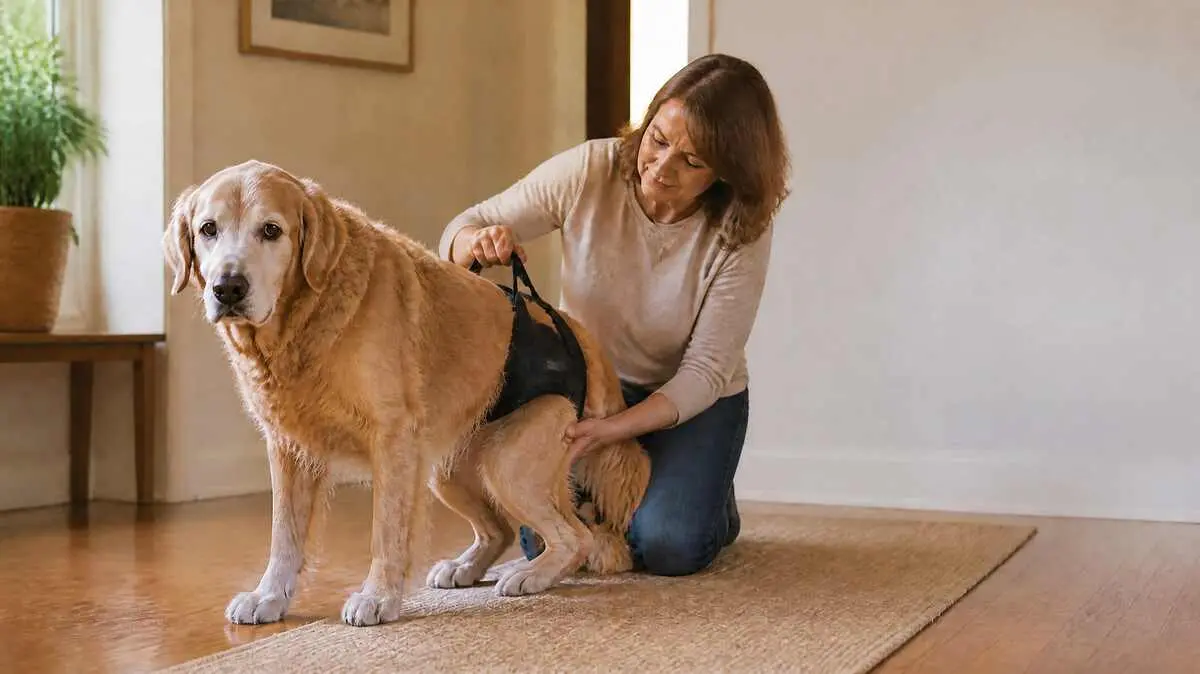
Many owners first notice old dog back legs collapsing when the dog struggles to stand, slips more often, wobbles while walking, or seems weaker in the rear end. In some cases, the back legs may briefly give out during movement or after exercise.
Occasional slipping on a smooth floor may not always be serious. However, repeated collapsing, worsening hind leg weakness, dragging the feet, or difficulty rising should not be ignored because these signs often point to an underlying mobility or neurologic problem.
Dogs that begin dragging their feet or back paws may be showing additional neurologic or mobility changes. Learn more in Why Is My Dog Dragging His Back Legs? What It Could Mean and When to Act.
A dog that suddenly cannot stand, loses control of the back legs, develops severe pain, or has new loss of bladder or bowel control together with sudden hind-leg weakness needs same-day veterinary care.
Quick Answer
Old dog back legs collapsing is usually a sign that something is affecting the dog’s ability to support weight, stay balanced, or move normally. Common causes include arthritis, muscle loss, hip dysplasia, degenerative myelopathy, intervertebral disc disease (IVDD), and other neurologic disorders that can weaken the hind legs or reduce coordination.
Arthritis is one of the most common reasons. Joint pain and stiffness can make an older dog move less over time. Owners who are new to mobility problems may also find this dog joint pain relief guide helpful for understanding how joint disease affects movement, stiffness, and quality of life. Less movement can lead to muscle loss, which reduces rear-leg strength and support. As a result, the back legs may wobble, give out, or collapse while walking or standing.
Hip dysplasia can also make the hips unstable and painful. Some dogs struggle to rise, turn, climb stairs, or support their weight on the rear legs. In other cases, weakness may come from problems affecting the spinal cord or nerves. Conditions such as degenerative myelopathy and IVDD can lead to hind leg weakness, poor coordination, toe dragging, or a gradual loss of back-leg function.
If an owner notices an old dog back legs giving out, repeated stumbling, loss of balance, or increasing difficulty standing, veterinary evaluation is important. Age alone is not a diagnosis. While aging can contribute to mobility decline, repeated back-leg collapse usually has an underlying cause that should be identified by a veterinarian.
Repeated back-leg collapse often develops alongside increasing difficulty standing. Owners who notice these changes may also want to learn more about why is my dog struggling to stand up and the most common causes behind this mobility problem.
Table of Contents
Is It Your Old Dog’s Back Legs Giving Out, or Is the Whole Dog Collapsing?
Alert or Limp? Telling Rear-Leg Buckling From Fainting
Owners often say the legs “gave out” for two different events. In one, the back legs buckle but the dog stays alert. In the other, the whole body goes limp. That is syncope, a sudden, short loss of consciousness and muscle tone caused by too little blood or oxygen reaching the brain. Many dogs recover within seconds or minutes.
The key clue is whether the dog stayed aware. A dog with buckling rear legs may look back, answer to its name, or keep the front end up. A fainting dog loses that response. Fainting can also start with brief wobbliness, so it may first sound like old dog back legs giving out.
Three details help the vet most when an owner asks, “Why is my senior dog collapsing?” Did the dog respond? Did only the hindquarters drop, or the whole body? Did recovery come at once, take minutes, or stay incomplete?
Four Patterns and What Each One Points To
The table organizes what owners may see. It does not diagnose the cause.
| Observed pattern | What the owner may see | Appropriate direction |
| Slip on a slick surface | A brief loss of footing on a smooth floor. The dog stays alert. | Monitor if it happens once, with no pain, breathing change, or lasting weakness. A repeat, or a slip on non-slip flooring, needs a vet visit. See Why Is My Dog Slipping on the Floor? |
| Rear legs buckle while the dog stays alert | The hind limbs cannot hold or place the body, so the hindquarters fold, but the dog responds. | Vet soon. Repeated buckling, worsening coordination, poor recovery after activity, or weakness with unexplained panting or poor appetite cannot be blamed on aging without an exam. |
| Sudden inability to support or move the hind legs | The dog cannot stand or use the back legs. | Emergency. More follows the table. |
| Whole body goes limp or consciousness is lost | The dog is unresponsive, or recovery is slow or incomplete. | Emergency. Call an emergency vet at once, even if the dog looks normal afterward. A serious problem may remain. |
Sudden spinal causes, whole-body illness and the metabolic or heart conditions that can cause sudden weakness are a related but separate topic covered in What Causes Sudden Hind Leg Weakness in Dogs? Common Causes and Warning Signs.
When Panting or Appetite Loss Comes With the Collapse
Heart or breathing problems can look like a leg problem at first, especially when weakness comes just before the collapse. Rapid, noisy, or labored breathing, pale, white, blue, or gray gums, no response, or a slow recovery point to a whole-body emergency, not a simple mobility issue.
Panting or a poor appetite does not prove the cause on its own. With a collapse, though, the picture changes. Cases of old dog back legs collapsing and panting with no clear reason raise concern for pain or illness. So do cases of old dog back legs collapsing not eating. Neither should be treated as ordinary aging. An owner who says, “my 15 year old dog keeps collapsing,” still needs an exam, because age alone does not explain it.
When to Worry
Not every case of old dog back legs collapsing is an emergency. Some dogs show mild age-related mobility changes that can be monitored at home. However, repeated collapse, worsening weakness, or sudden loss of function should never be ignored.
Signs That Can Usually Be Monitored
These signs are often mild but should still be watched for changes:
- Mild slipping on smooth or slippery floors
- Brief stiffness after resting or sleeping
- One isolated slip on a clearly slippery surface, followed by immediate normal standing and walking, with no pain, weakness, coordination change, or recurrence. Repeated wobbling, unexplained buckling, or collapsing on non-slippery ground belongs under veterinary evaluation.
- Slight slowing down during walks
- Mild hesitation before standing up
If these signs remain stable and do not worsen, they may reflect early mobility decline. However, a veterinary visit is still a good idea if they become more frequent.
Signs That Need a Vet Visit Soon
A dog should be examined by a veterinarian if any of the following signs appear:
- Repeated back-leg collapse
- Difficulty standing up without help
- Dragging the toes while walking
- Nail scuffing from poor foot placement
- New limping that was not present before
- Back legs weak and shaking
- Noticeable loss of balance
- An old dog struggling to walk or complete normal daily activities
- Senior dog hind leg weakness that continues to worsen
These signs may suggest arthritis progression, muscle loss, hip problems, spinal disease, or neurologic disorders affecting coordination and strength.
Signs That Need Same-Day Veterinary Care
Some symptoms require urgent evaluation because they may indicate a serious spinal, neurologic, or pain-related problem.
Seek same-day veterinary care if a dog has:
- Sudden inability to stand
- Sudden loss of back-leg function
- Severe pain
- Collapse accompanied by crying, trembling, or distress
- New loss of bladder or bowel control together with sudden hind-leg problems is an emergency warning sign, while long-standing incontinence with no sudden change in movement should be assessed in the context of the dog’s existing health.
- Paralysis
- An inability to stand or walk
A dog that suddenly loses use of the back legs should always be treated as a medical emergency until proven otherwise. For a broader breakdown of urgency levels across different sudden limping and mobility situations, see dog suddenly limping: when to take your dog to the vet.
Is back-leg collapse always an emergency?
Not every isolated slip is an emergency. Sudden inability to stand, loss of hind-leg function, severe pain, breathing difficulty, loss of consciousness, or whole-body collapse requires urgent veterinary guidance.
The first goal is to prevent another fall and avoid forcing movement while deciding whether urgent veterinary care is needed.
- Stay calm and keep the dog quiet.
- Keep the dog on a secure, non-slip surface away from stairs.
- Do not force walking or repeatedly test whether the dog can stand.
- Contact a veterinarian immediately if weakness is sudden, severe, rapidly worsening, or the dog cannot stand or use the hind legs.
If serious spinal or neurologic weakness is suspected, keep movement of the head, neck, and spine to a minimum, because bending, twisting, or struggling may make a spinal injury worse. If moving the dog cannot be avoided, use a firm, flat support, such as a board, thick cardboard, or folded blanket, call ahead, and follow the veterinary team’s transport instructions. (Source: MSD Veterinary Manual)
Step-by-step lifting and hindquarter support for a dog that cannot get up is a related but separate topic covered in How to Help a Dog With Weak Hind Legs at Home: Simple Ways to Improve Mobility and Confidence.
Monitor vs Vet Soon vs Emergency
Mobility Changes: Monitor, Vet Soon, or Emergency?
| Monitor | Vet Soon | Emergency |
| Mild slipping on smooth floors | Repeated back-leg collapse | Sudden inability to stand |
| Brief stiffness after rest | Difficulty standing up | Sudden loss of back-leg function |
| One isolated slip on a slippery surface, with immediate normal walking | Dragging toes | Paralysis |
| Slight slowing down on walks | Nail scuffing | New loss of bladder or bowel control with sudden hind-leg weakness |
| Minor hesitation after activity | Back legs weak and shaking | Severe pain with collapse |
| Mild mobility decline over time | Senior dog losing balance frequently | Collapse with crying, distress, or trembling |
What Details Should Be Recorded After a Collapse Episode?
After a single collapse, these notes help the vet most:
- Date and time
- What the dog was doing just before
- Whether one or both back legs gave out
- Whether only the rear end dropped or the whole body collapsed
- Whether the dog stayed conscious and responsive
- About how long the episode lasted
- Whether the dog stood again without help
- Whether the episode followed activity, rising, turning, toileting, or slipping
- Signs of pain, panting, trembling, vocalizing, or distress
- Toe dragging, knuckling, crossing legs, or abnormal paw placement
- Any change in breathing
- Any new urination or defecation during the episode
- How the dog moved afterward
- A short video, when it can be recorded safely without delaying care
For changes over weeks and months, see “Track Mobility Changes” under “What to Do if an Old Dog’s Back Legs Are Collapsing.”
Symptoms and Signs of Back Leg Collapse in Older Dogs
The signs of old dog back legs collapsing are not always dramatic at first. Many dogs show small mobility changes before the problem becomes more obvious. Paying attention to these early signs can help owners
recognize that something is affecting the hind legs.
Changes Owners Often Notice First
Many owners first notice changes during normal daily activities.
Common early signs include:
- Old dog back legs giving out occasionally
- An older dog falling over during turns or while standing
- Dog walking funny on back legs
- Dog unsteady on back legs
- Senior dog back legs slipping on smooth floors
- Trouble getting comfortable after lying down
Some dogs appear normal one moment and then briefly lose balance the next. Others begin moving more cautiously because they no longer feel stable on the rear legs.
Signs of Weakness and Muscle Loss
As hind leg weakness progresses, dogs may struggle to support their weight as effectively as before.
Common signs include:
- Dog losing mobility in back legs
- Dog losing strength in back legs
- Difficulty rising from the floor
- Needing extra time to stand up
- Becoming tired more quickly during walks
- Senior dog losing muscle mass around the hips and thighs
- An old dog developing a noticeably skinny back end
Reduced activity can contribute to muscle loss, and less muscle support often makes the hind legs less stable during movement.
Signs of Poor Coordination
Not every dog with collapsing back legs is experiencing pain. Some dogs develop coordination problems that affect how the hind feet are placed while walking.
Signs may include:
- Knuckling, where the top of the paw briefly contacts the ground
- Crossing the back legs while walking
- Toe dragging
- Nail scuffing on hard surfaces
- Wobbling or swaying during movement
- Difficulty placing the feet correctly
These signs often suggest that the nerves, spinal cord, or communication between the brain and limbs may not be functioning normally.
Signs That Suggest Pain Is Involved
Pain-related mobility problems often look different from simple weakness.
Owners may notice:
- Reluctance to move
- Hesitation before climbing stairs
- Stiffness after rest or sleeping
- Back legs weak and shaking after activity
- Slower movement than usual
- Panting during or after normal movement
- Avoiding activities that were once easy
Pain can lead to reduced movement, while reduced movement can contribute to further weakness and instability over time. Owners who are unsure whether discomfort is involved can review these common signs of joint pain in dogs.
What Causes Old Dog Back Legs Collapsing?
Several different conditions can cause old dog back legs collapsing. Some affect the joints, some affect the muscles, and others affect the nerves or spinal cord. Understanding the possible causes can help owners recognize why an older dog may suddenly seem weaker, less stable, or unable to support the rear legs normally.
Arthritis and Joint Degeneration
Arthritis is one of the most common causes of mobility problems in senior dogs.
As joints become painful and stiff, many dogs move less. Over time, reduced activity can lead to muscle loss around the hips and hind legs. Less muscle support can make it harder for the rear end to stay stable.
A common progression looks like this:
Arthritis → pain → stiffness → reduced movement → muscle loss → weaker hind-end support → collapse
Dogs with arthritis may also struggle to rise, walk on slippery floors, climb stairs, or stay active for long periods.
Hip Dysplasia and Hip Instability
Hip dysplasia affects how the hip joint fits and moves. In older dogs, years of joint wear can reduce stability and comfort.
Common signs include:
- Reduced rear-leg stability
- Difficulty rising from the floor
- Wobbling during turns
- Shortened stride length
- Back legs splaying outward
- Trouble supporting weight on the hind legs
Some dogs appear to lose confidence in their movement because the hips no longer provide strong support. How hip dysplasia leads to arthritis over time is a related but separate topic covered in What Causes Arthritis in Dogs? 8 Common Reasons Dogs Develop Joint Pain.
Muscle Loss in Senior Dogs
Many senior dogs gradually lose muscle mass as they age. This age-related muscle loss is often called sarcopenia.
When muscle mass decreases, the hind legs may no longer provide the same strength and support as before.
Common effects include:
- Reduced support strength
- Faster fatigue during activity
- Difficulty standing for long periods
- Increased instability
- A thinner or weaker-looking rear end
Even when severe joint disease is not present, significant muscle loss can contribute to back-leg collapse.
Degenerative Myelopathy
Degenerative myelopathy is a progressive neurologic disease that affects the spinal cord.
Unlike arthritis, this condition is usually associated more with weakness and coordination problems than obvious pain.
Common signs include:
- Hind leg weakness
- Knuckling
- Toe dragging
- Loss of coordination
- Wobbling
- Rear-end collapse
The condition often progresses slowly, with signs becoming more noticeable over time.
It damages the spinal cord pathways for hind-limb movement and is usually painless, though painless does not mean minor. Signs start as an uneven rear gait. Knuckling, scuffed nails, and toe dragging follow as awareness of foot position fades, and the instability grows until the rear legs collapse. Many dogs lose the ability to walk within about six to twelve months of the first signs.
No single test confirms degenerative myelopathy in a living dog. The vet uses a neurologic exam, plus tests such as imaging and spinal fluid analysis, to rule out other spinal cord problems. An SOD1 gene test shows risk but cannot confirm the disease alone. New changes still deserve a call to the vet, since other diseases can look alike. (Sources: UC Davis Veterinary Neurology, Cornell)
No cure or approved treatment reverses degenerative myelopathy, so care is supportive. Rehabilitation and mobility help aim to protect function and quality of life for as long as possible. As function declines, professionally fitted mobility support may be considered, as explained in “When a Dog Wheelchair May Help (and When It’s Too Early)” below. (Source: Cornell)
Intervertebral Disc Disease (IVDD)
Intervertebral disc disease, often called IVDD, happens when worn disc material bulges or bursts toward the spinal cord, squeezing and bruising it.
Depending on the severity, dogs may develop:
- Sudden hind leg weakness
- Collapse episodes
- Difficulty standing
- Poor coordination
- Reduced rear-leg function
Mild injury can cause old dog wobbly back legs, crossed hind feet, or poor coordination. Greater injury can cause loss of voluntary movement and, in severe cases, loss of pain sensation. Back or neck pain and reluctance to move may also appear.
Time matters when signs are developing or worsening, because continued cord injury can lower the chance of recovery (Sources: Cornell, ACVS).A dog that goes from wobbly to unable to walk needs prompt neurologic evaluation, and a sudden inability to walk needs immediate care. Other sudden spinal and whole-body causes are covered in What Causes Sudden Hind Leg Weakness in Dogs?.
Other Neurologic Disorders
Several neurologic disorders can affect how the brain, spinal cord, and nerves communicate with the hind legs.
These conditions may cause:
- Poor coordination
- Crossing of the back legs
- Balance problems
- Hind limb weakness
- Unsteady walking
- Difficulty placing the feet correctly
Neurologic causes often look different from simple age-related stiffness because coordination is affected along with strength.
Pain Flare-Ups and Overexercise
Sometimes a dog experiences a temporary worsening of mobility after doing more activity than the body can comfortably handle.
A common pattern looks like this:
Overexercise → inflammation → soreness → reduced activity → weakness → increased collapse
This may occur after long walks, rough play, repeated stair use, or other physically demanding activities. Dogs with existing arthritis, hip problems, or muscle weakness are often more vulnerable to these flare-ups. Some owners may also notice symptoms that resemble an arthritis flare-up after increased activity.
Common Causes of Back Leg Collapse and Typical Clues
| Cause | Common Clues | Progression Pattern |
| Arthritis | Stiffness, difficulty rising, slower movement | Gradual worsening over months or years |
| Hip Dysplasia | Wobbling, bunny hopping, trouble standing | Usually progressive |
| Age-Related Muscle Loss (Sarcopenia) | Thin rear muscles, reduced strength, fatigue | Slow decline over time |
| Degenerative Myelopathy | Toe dragging, knuckling, poor coordination | Progressive neurologic decline |
| Intervertebral Disc Disease (IVDD) | Sudden weakness, pain, collapse episodes | May be sudden or progressive |
| Other Neurologic Disorders | Balance problems, crossing legs, coordination changes | Variable depending on cause |
| Pain Flare-Ups or Overexercise | Temporary worsening after activity | Often improves with rest and management |
What Does It Mean When an Old Dog’s Back Legs Give Out?
What does it mean when an old dog’s back legs collapse? It means the hind legs temporarily or repeatedly fail to provide normal support, stability, or coordination. Possible causes include pain, joint disease, muscle loss, spinal disease, and neurologic dysfunction. A veterinarian must identify the cause.
Understanding what the collapse looks like can help owners better describe the problem to a veterinarian and understand what may be happening.
Collapse that comes on suddenly, and guidance on when short monitoring may be reasonable, is a related but separate pattern covered in What Causes Sudden Hind Leg Weakness in Dogs? Common Causes and Warning Signs.
Weakness vs Instability
Weakness and instability can look similar, but they are not always the same problem.
Mechanical weakness usually means the muscles can no longer generate enough strength to properly support the body. Dogs with weakness may struggle to stand, tire quickly, or have trouble climbing stairs and walking long distances.
Instability often means the dog can still generate some strength but cannot maintain balance or control movement properly. These dogs may wobble, sway, slip, or appear unsure of where to place their feet.
Poor muscle support, reduced strength, and hind limb weakness can contribute to both weakness and instability.
Pain vs Neurologic Problems
Pain-related mobility problems often cause dogs to avoid movement.
A painful dog may:
- Move more slowly
- Hesitate before standing
- Avoid stairs or jumping
- Shift weight away from uncomfortable limbs
- Appear stiff after rest
Neurologic problems often affect coordination as well as strength.
A dog with a neurologic condition may:
- Cross the back legs
- Knuckle the paws
- Drag the toes
- Lose balance unexpectedly
- Struggle to place the feet correctly
Pain often changes a dog’s willingness to move, while neurologic disease may change coordination, paw placement, or control. These patterns can overlap, and some spinal or neurologic conditions are painful.
Weakness vs Pain vs Neurologic Problems
| Pattern | What Owners Notice |
| Weakness | Dog tires easily, struggles to stand, hind legs give out |
| Pain | Reluctance to move, stiffness, hesitation on stairs, panting |
| Neurologic Problems | Toe dragging, knuckling, crossing legs, poor balance, wobbling |
| Mixed Problems | Combination of weakness, pain, and coordination changes |
Arthritis-Related Collapse vs Neurologic Collapse
These patterns can guide observation, but they cannot identify the cause. Arthritis and neurologic disease may occur together, and either pattern can vary between dogs.
| Feature | Arthritis | Neurologic |
| Pain | Common | May or may not be present |
| Stiffness After Rest | Common | Less common |
| Muscle Loss | Common over time | Common in advanced cases |
| Toe Dragging | Uncommon | Common |
| Knuckling | Rare | Common |
| Loss of Coordination | Mild or absent | Often noticeable |
| Back-Leg Weakness | Common | Common |
| Progression Pattern | Usually gradual | Often progressive and coordination-related |
| Balance Problems | Usually secondary to weakness or pain | Frequently a primary sign |
Why Back Legs May Collapse More on Slippery Floors
Many owners notice mobility problems become more obvious on tile, hardwood, or other smooth surfaces.
A common pattern looks like this:
Poor traction → slipping → instability → falls → reduced confidence → less movement → worsening weakness
When a dog loses confidence on slippery flooring, activity levels often decrease. Less activity can contribute to further muscle loss and reduced hind-end support over time.
This is one reason senior dogs with mobility issues often appear worse indoors than on grass or other high-traction surfaces. The surface-specific pattern helps separate an ordinary slip from possible weakness, although repeated slipping can also reveal an underlying mobility problem.
| Pattern | Owner observation |
| Poor traction → paws slide outward → temporary loss of footing | The episode occurs on hardwood, laminate, or tile, and the dog returns to normal once on secure flooring. |
| Weakness or poor coordination → legs cannot support or position the body → buckling | The legs fold, cross, knuckle, or drag even on carpet or another non-slip surface. This suggests a mobility or neurologic problem rather than traction alone. |
Why It Often Gets Worse Over Time
Back-leg collapse is often part of a gradual mobility decline rather than a single event.
A common progression looks like this:
Mobility decline → less activity → muscle loss → weaker support → more collapse
As movement becomes harder, many dogs naturally reduce their activity. Reduced activity can accelerate muscle loss, which further weakens the hind legs.
Without identifying and managing the underlying cause, this cycle can gradually lead to more frequent collapsing episodes, greater difficulty standing, and reduced day-to-day mobility.
What to Do if an Old Dog’s Back Legs Are Collapsing
If an owner notices old dog back legs collapsing, the goal is to make movement safer, reduce fall risk, and help maintain mobility while the underlying cause is being evaluated. For practical home-support ideas, this guide on how to help a dog with weak hind legs at home may also be useful. Small changes at home can often make daily activities easier and more comfortable.
Make Walking Safer at Home
Many dogs struggle more on smooth surfaces than on grass or carpet.
Simple changes that may improve traction include:
- Non-slip rugs in frequently used areas
- Hallway runners on slippery flooring
- Better traction around food and water bowls
- Safer walking pathways through the home
- Reducing the need to cross large slick surfaces
Improved footing can help reduce slipping, falls, and loss of confidence during movement.
Help With Standing and Movement
Dogs with weak hind legs often need extra support when standing up or walking.
Helpful mobility aids may include:
- Rear-support harnesses
- Support slings
- Lift-assist harness systems
- Temporary assistance during stairs or outdoor breaks
When helping a dog stand, slow and steady support is usually safer than pulling or lifting suddenly.
Home Mobility Aids for Dogs With Weak Back Legs
| Aid | Best For | Limitation |
| Non-Slip Rugs and Runners | Improving traction indoors | Must cover key walking areas |
| Rear-Support Harness | Dogs needing help standing or walking | Requires owner assistance |
| Support Sling | Short-term lifting assistance | Not ideal for long-distance movement |
| Pet Ramps | Furniture and vehicle access | Requires training and space |
| Pet Steps | Low-height access points | Less useful for severe weakness |
| Toe Grips or Traction Aids | Dogs slipping on hard floors | May not help advanced weakness |
| Mobility Cart | Advanced rear-leg weakness | Requires fitting and adjustment |
When a Dog Wheelchair May Help (and When It’s Too Early)
A wheelchair, or mobility cart, may be worth considering when weak or paralyzed back legs stop safe, useful movement and the front legs are strong enough to push the dog along. The decision follows a veterinary or rehabilitation assessment, because the diagnosis, remaining strength, pain level, and fit all decide whether a cart helps.
Repeated falls, steady dragging of the hind feet, back legs that cannot support ordinary walking, and growing dependence all justify the conversation. A cart is not only for complete paralysis. A dog with some hind-leg movement may use supported positioning to keep working its muscles, if the vet agrees. Dogs with weak front legs too need a different assessment, and the guide to dog wheelchairs for front legs covers carts that add front support.
It is usually too early when weakness is mild or comes and goes, and the dog still walks safely with lower-level support, good traction, and treatment of the cause. Sudden or undiagnosed weakness needs a diagnosis before any equipment is chosen.
A cart must also fit. It should hold the dog in good posture without rubbing or painful pressure, and a vet or rehabilitation professional should take the measurements and check the fitted device. Owners ready to compare options can read Best Dog Wheelchair for Back Legs: 6 Options Compared.
Replace Jumping With Safer Options
Jumping places extra stress on weak joints, muscles, and the spine.
Safer alternatives include:
- Ramps for beds and furniture
- Pet steps where appropriate
- Vehicle access ramps
- Assistance when entering or exiting vehicles
Reducing repeated jumping may help lower the risk of falls and mobility setbacks.
Adjust Exercise Without Stopping Movement
Many dogs benefit from controlled activity rather than complete rest.
Options often include:
- Short leash walks
- Controlled sniff walks
- Flat walking surfaces
- Frequent breaks when needed
- Monitoring energy levels during activity
Too little movement can contribute to muscle loss, while too much activity may worsen soreness and weakness. The goal is balanced, comfortable movement.
Track Mobility Changes
Keeping simple notes can help owners recognize whether mobility is improving, staying the same, or getting worse.
Useful things to monitor include:
- How often collapse episodes occur
- Difficulty standing up
- Walking tolerance
- Balance and coordination changes
- Next-day soreness after activity
- Ability to complete normal daily activities
This information can also help veterinarians better understand progression patterns.
For details about a single collapse, see the episode checklist under “When to Worry.”
How to Tell Whether Mobility Decline Is Affecting Your Dog’s Daily Quality of Life
The Daily Functions That Matter Most
Quality of life shows up across the whole day, not in one fall or one good moment. A dog losing mobility in back legs can be judged by how well it manages a few daily jobs:
- Rising for food, water, and toileting
- Standing long enough to eat
- Toileting without repeated falls or distress
- Lying down and changing position comfortably
- Staying interested in family and routines
Warning signs include failed attempts to rise for meals, hindquarters sinking before the dog finishes eating, and falls or distress while toileting. A dog may also be unable to move away from urine or feces, may pant or reposition constantly instead of settling to sleep, or may show less interest in greeting the family.
Watch the Trend, Not Just Today
Direction matters as much as today’s ability. More falls, fewer good days, longer recovery after short walks, and more physical help than a few weeks ago all show shrinking independence. More frequent collapse means more help is needed to stand, eat, or toilet, and less independence lowers daily quality of life. Poor recovery after ordinary activity also means longer stretches without comfortable movement, which leaves fewer good hours in the day.
Even so, a dog with limited mobility can have a good life when it is comfortable, alert, interested in family, and able to reach the essentials with manageable help. Mobility is one part of quality of life, not a final verdict.
How Pain, Nutrition and Muscle Condition Fit In
Mobility is only one piece. Pain control, appetite, hydration, muscle condition, hygiene, sleep, and social interest count too. Pain or poor muscle condition can make rising harder, and that can make eating, drinking, and toileting less comfortable. Decline can then spread across several areas at once.
When to Ask Your Vet to Reassess
A reassessment makes sense when several functions slip together: more falls, more help rising and toileting, eating less because standing is hard, or no longer resting comfortably. The vet rechecks pain, disease progression, nutrition, and the level of support needed. A reassessment is not an automatic end-of-life decision.
Can an old dog with collapsing back legs get better?
Sometimes. Improvement depends on the underlying cause, how severe the nerve or joint problem is, how soon treatment starts, and the dog’s overall health. Some conditions can improve a great deal, while progressive disorders such as degenerative myelopathy are managed rather than reversed. Dogs with IVDD can regain function, but the outcome depends strongly on how much nerve function remains when treatment begins. Supportive rehabilitation may help preserve mobility and quality of life. Old age alone does not predict recovery, because the dog first needs a veterinary diagnosis.
How long can a dog live with weak back legs?
Weak back legs are a symptom, so they do not give a reliable life-expectancy estimate. How long a dog lives depends on the diagnosis, how fast the problem progresses, pain control, other health conditions, and whether the dog can keep eating, drinking, toileting, resting, and interacting comfortably. Different conditions have very different courses. Some mobility problems may stabilize or improve with the right treatment, so the outlook should rest on the veterinary diagnosis, not on age or weakness alone. Current daily function and the trend over time say more than any general survival figure.
Ask your vet for a written care plan and reassessment schedule. Decisions about long-term outlook or end-of-life care are best made with your veterinarian.
Ask About Rehabilitation Options
Some dogs may benefit from professional rehabilitation programs.
Examples include:
- Hydrotherapy
- Physical therapy
- Range-of-motion exercises
- Strengthening programs
- Professional canine rehabilitation
A veterinarian or rehabilitation professional can determine which options are appropriate for a dog’s specific condition.
What to Avoid
Certain activities may increase strain on already weak hind legs.
Avoid when possible:
- Long hikes
- Rough play
- Repeated jumping
- Slippery floors without traction support
- Forced exercise beyond the dog’s comfort level
A common pattern can occur when activity exceeds what the body can comfortably handle:
Overexercise → inflammation → soreness → reduced activity → weakness → increased collapse
Protecting mobility while maintaining safe movement often helps preserve function and quality of life.
Activities That May Help vs Activities That May Worsen Symptoms
| Helpful | Avoid |
| Short controlled leash walks | Long hikes |
| Flat, predictable walking surfaces | Rough play |
| Controlled sniff walks | Repeated jumping |
| Regular gentle movement | Sudden bursts of activity |
| Supervised low-impact exercise | Forced exercise when tired |
| Veterinary-guided rehabilitation | Walking on slippery floors without traction |
FAQ
Why are my old dog’s back legs collapsing?
Old dog back legs collapsing can happen for several reasons. Common causes include arthritis, muscle loss, hip dysplasia, degenerative myelopathy, spinal problems, and other neurologic conditions. Age itself is not the cause. Instead, age often increases the risk of conditions that affect strength, balance, coordination, and mobility.
What does it mean when an elderly dog’s back legs give out?
It usually means the dog is experiencing weakness, instability, poor coordination, pain, or a combination of these problems. Repeated episodes should not be considered a normal part of aging and deserve veterinary attention.
Why is my senior dog collapsing?
A senior dog may collapse because of mobility problems, neurologic disease, pain, weakness, heart-related conditions, or other medical issues. If the collapse is sudden, severe, or accompanied by an inability to stand, same-day veterinary care is recommended.
My old dog’s back legs gave out once and then recovered. Is that an emergency?
A clear one-time slip on a slick floor, followed by normal movement right away, may be monitored. But whole-body limpness, loss of consciousness, or sudden inability to use the hind legs needs immediate contact with a vet, even if the dog recovered. Even when a dog loses use of the back legs only temporarily, the cause may be serious. A fast recovery can still be syncope, which often passes within seconds or minutes once blood and oxygen reach the brain again. PDSA advises contacting a veterinarian after a collapse even when the animal recovers quickly. A slow recovery, abnormal breathing, abnormal gum color, or unresponsiveness needs immediate emergency care.
Why is my dog collapsing and panting or refusing food?
Panting with a collapse and no clear reason can point to pain, illness, or a heart or breathing problem, so a vet should check the dog. Refusing food, or marked tiredness that lingers afterward, adds to that concern, and neither is just old age. See a vet soon, and go right away if the breathing is labored or the gums look pale, blue, or gray.
Why is my old dog dragging his back legs?
Dragging the back legs often happens when a dog cannot lift the feet normally during walking. Owners may notice toe dragging, worn nails, or scuff marks on the tops of the paws. This can be associated with neurologic disease, weakness, or spinal cord problems.
Why are my old dog’s back legs weak and shaking?
Weak and shaking back legs may occur because muscles are working harder to compensate for pain, weakness, instability, or fatigue. Arthritis flare-ups, muscle loss, and some neurologic conditions can contribute to trembling during standing or walking.
Can arthritis cause an old dog’s back legs to collapse?
Yes. Arthritis can contribute to hind-leg collapse in some dogs. Joint pain may lead to stiffness, reduced activity, muscle loss, and weaker rear-leg support over time. As mobility declines, instability and falls may become more common.
Can degenerative myelopathy cause old dog back legs collapsing?
Yes. Degenerative myelopathy is a progressive neurologic disease that affects the spinal cord. Dogs may gradually develop hind-leg weakness, toe dragging, knuckling, poor coordination, and eventual rear-end collapse as the disease advances.
Is degenerative myelopathy painful, and how fast does it progress?
Usually not. Degenerative myelopathy tends to cause weakness and poor coordination rather than obvious pain, but that does not make it mild. It worsens over months, and many dogs can no longer walk about six to twelve months after the first signs. A dog with a new uneven rear gait should see a vet.
Why can IVDD require prompt neurologic evaluation?
Because the spinal cord can be damaged further while a disc problem goes untreated, and continued cord injury can lower the chance of recovery. A dog that goes from wobbly to unable to walk needs a prompt neurologic exam, and a dog that suddenly cannot walk needs immediate care.
Is hydrotherapy good for dogs with weak back legs?
Hydrotherapy may help some dogs because water supports body weight while allowing movement with less joint stress. It is commonly used as part of veterinary rehabilitation programs for dogs with mobility limitations, weakness, or recovery needs.
Can I give my dog human pain medication for this?
Do not give human pain medication unless a veterinarian specifically instructs you to do so. Human pain relievers can behave differently in dogs and cause gastrointestinal injury, kidney or liver damage, bleeding, or impaired oxygen transport. Human NSAIDs, for example, may stay in a dog’s body longer and reach higher blood levels, which raises the risk of toxicity. (Source: FDA)
Can a dog with collapsing back legs still have a good quality of life?
It can. A dog that stays comfortable, alert, and engaged with the family, and can reach food, water, and a place to toilet with manageable help, may still have a good quality of life. One fall says less than the whole day and the trend over weeks. A vet can help you judge it.
Why is my old dog losing balance in the back legs?
Loss of balance often suggests a problem with coordination, strength, or body-position awareness. Dogs may wobble, cross their hind legs, drag their toes, or stumble more often when neurologic or mobility problems affect the rear limbs.
Is it vestibular disease or the legs when my old dog keeps falling over?
Vestibular dysfunction more typically causes loss of balance with a head tilt, leaning or falling to one side, circling, and rapid involuntary eye movements. Weakness in the hind limbs more often causes rear buckling, knuckling, or dragging without those balance-system signs. Owners cannot reliably tell vestibular disease, central neurologic disease, and limb weakness apart at home, so an older dog falling over needs a veterinary neurologic exam, with same-day attention if the dog is vomiting or distressed.
Should I still walk my old dog if his back legs are weak?
In many cases, controlled activity remains beneficial. Short, comfortable walks can help maintain muscle strength and mobility. However, exercise should not cause excessive fatigue, worsening weakness, or repeated collapse episodes. A veterinarian can help determine an appropriate activity level.
How often should I walk an old dog with weak back legs?
Many dogs do better with several short walks rather than one long walk. The ideal schedule depends on the dog’s strength, mobility, and underlying condition. Walks should remain comfortable and stop before exhaustion develops.
How can I help my old dog get up when his back legs give out?
A rear-support harness, support sling, non-slip flooring, ramps, and easier access around the home can help many dogs stand and move more safely. Assistance should be steady and gentle. If standing becomes increasingly difficult or collapse episodes become more frequent, a veterinary evaluation is recommended.
Why can’t my old dog stand on his back legs?
Difficulty standing can occur when the hind legs no longer provide enough strength or stability. Arthritis, muscle loss, spinal disease, hip problems, and neurologic conditions can all make standing difficult, especially after resting or lying down.
Sources & References
The information in this article was reviewed using veterinary educational resources, animal hospitals, and canine mobility references, including:
- UC Davis Veterinary Neurology — Degenerative Myelopathy
- Cornell University College of Veterinary Medicine — Degenerative Myelopathy
- Cornell University College of Veterinary Medicine — Intervertebral Disc Disease
- American College of Veterinary Surgeons — Intervertebral Disc Disease
- PDSA — First Aid for Collapsed Pets
- VCA Animal Hospitals — Arthritis in Dogs (Osteoarthritis, Degenerative Joint Disease)
- American Kennel Club (AKC) — Arthritis in Senior Dogs: Signs and Treatment
- Veterinary Emergency Group (VEG) — Dog Arthritis: Symptoms and Treatment
- Olde Towne Animal Hospital — Why Is My Senior Dog Suddenly Unable to Use His Back Legs?
- Stoney Creek Veterinary Hospital — What Causes Sudden Hind Leg Weakness in Dogs?
- Sahara Pines Animal Hospital — What To Do If You See Your Older Dog’s Back Legs Collapsing.
- Limehouse Veterinary Clinic — How to Strengthen an Old Dog’s Hind Legs.
- FDA — Get the Facts about Pain Relievers for Pets
- MSD Veterinary Manual — First Aid and Transport of Small Animals
Soft CTA
If an owner notices old dog back legs collapsing, tracking mobility changes early can make it easier to recognize when the problem is getting worse. Paying attention to balance, walking ability, collapse episodes, and difficulty standing can help identify important changes over time.
Any dog that develops worsening weakness, repeated collapse episodes, increasing difficulty walking, or new coordination problems should be evaluated by a veterinarian. Ask your vet for a written care plan and reassessment schedule. Early assessment may help identify the underlying cause and guide appropriate management.
Owners who want to learn more about senior dog mobility may also find it helpful to read related articles about hind-leg weakness, arthritis in dogs, balance problems, why is my dog limping, and safe ways to support mobility at home.
Update Note
Last Updated: 11 October 2026
This article was updated with a guide to telling rear-leg buckling from fainting, a quality-of-life and reassessment section, more detail on degenerative myelopathy and IVDD, guidance on when a dog wheelchair may help, a collapse-episode checklist, and new FAQs. Sources now include veterinary-school neurology and surgery references, animal first-aid guidance, and government and veterinary-manual pages on safe pain relief and first aid.