

TL;DR
Dog limping after jumping usually happens when a dog lands wrong or puts too much pressure on the leg.
- Most cases come from muscle strain, sprain, or minor injury
- Mild limping often improves with rest and limited activity
- Serious signs include swelling, pain, or not putting weight on the leg
- Jumping puts stress on joints, muscles, and ligaments
If limping continues, worsens, or looks severe, a veterinarian should check the dog
Simple cause chain:
jumping → bad landing → tissue stress → inflammation → limping
Quick Answer Box
A dog may limp after jumping because the landing puts sudden force on joints, muscles, or ligaments, which can lead to strain, instability, or inflammation. This type of limping is different from gradual stress seen in running (see why dogs limp after running) or sudden movement during play (see why dogs limp after playing).
It may be caused by:
- Muscle strain (overstretched muscles)
- Ligament injury (damage inside the joint)
- Joint stress (impact on hips or knees)
- Paw injury (cuts, thorns, or nail problems)
Simple cause chain:
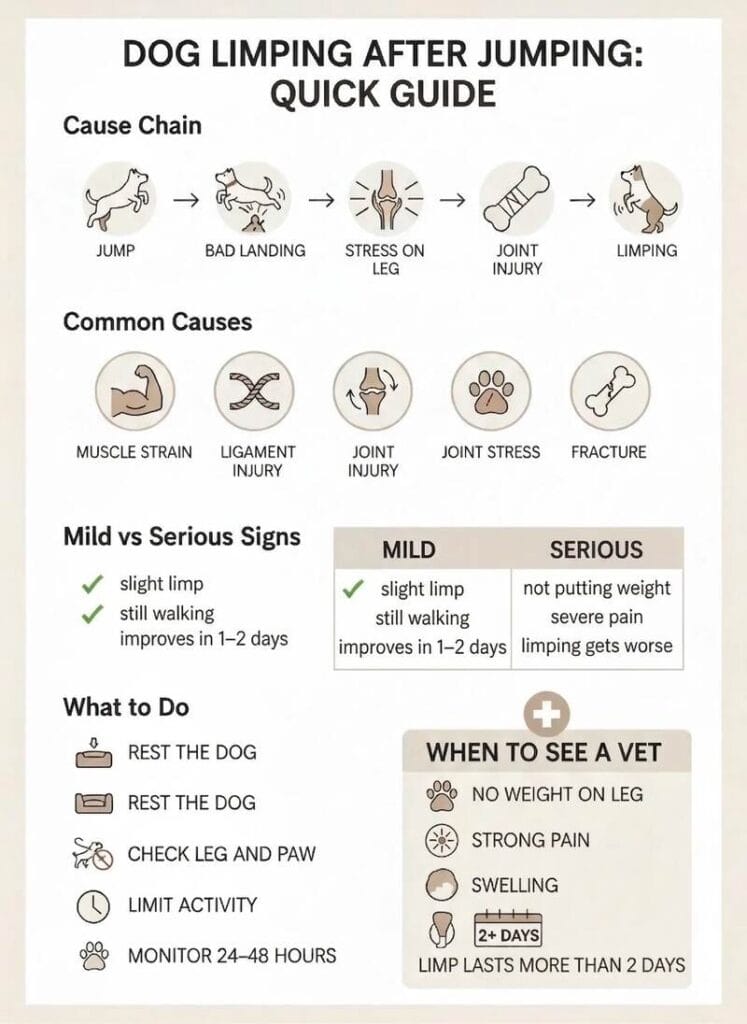
jump → bad landing → stress on leg → inflammation → limping
Mild limping may improve within 24–48 hours with rest
Severe limping or a dog not putting weight on the leg needs veterinary care
If the dog is limping after jumping off bed or couch and shows pain or swelling, it is safer to have a veterinarian check the affected leg.
Table of Contents
Dog Limping After Jumping: Why It Happens
Dog limping after jumping often starts when a dog lands the wrong way or puts too much force on one leg. Even a small jump can stress the body if the landing is uneven.
Cause chain:
jumping → bad landing → stress on leg → tissue damage → limping
When a dog jumps, the legs absorb the impact. A hard landing can strain muscles or put pressure on joints. This can lead to pain and a limp, especially if the dog is active or jumps often.
A twisting motion during landing can also affect ligaments. These structures help keep joints stable. If they stretch or tear, the dog may suddenly limp or avoid putting weight on the leg — learn when to take your dog to the vet for sudden limping.
In many cases, owners notice signs like my dog landed wrong and is limping or dog slipped and is limping. These situations show how quickly a normal jump can turn into an injury.
The force of landing also matters. Jumping from higher places, like beds or couches, increases pressure on bones and joints. This raises the risk of limping, especially in larger or older dogs.
Common Causes of Limping After Jumping
Common Causes
- muscle strain
- ligament injury
- joint trauma
- paw injury
- fracture
Mild vs Serious Limping: How to Tell the Difference
| Symptom | Mild | Serious |
| Weight bearing | Yes | No |
| Pain | Mild | Severe |
| Duration | <48 hrs | Persistent |
| Swelling | None | Visible |
Muscle Strain or Sprain (Most Common)
This happens when muscles or tendons stretch too much during a jump. It is the most common reason for limping.
Dogs may show mild discomfort and still stay active. A dog limping but still jumping, or a dog slightly limping after activity, are both common patterns at this stage. In contrast, limping that happens during active play is often linked to repeated movement and sudden direction changes.
Cause chain:
jump → muscle overstretch → small tissue strain → mild inflammation → limping
Ligament Injury (Serious Risk)
Ligaments help keep joints stable. A bad landing or twist can damage them, especially in the knee.
Cause chain:
twist → ligament damage → joint instability → limping
Dogs may stop using the leg or avoid putting weight on it. Signs include dog not putting weight on back leg or dog won’t put weight on back leg. This needs careful attention from a veterinarian — ligament injuries in the knee are among the most common causes of hind-limb lameness in dogs, according to the American College of Veterinary Surgeons.
Joint Injury or Impact Trauma
Every landing sends a burst of force through the hips, knees, and hocks. A single hard landing, or repeated jumping over time, can irritate the joint surfaces and the soft tissue around them.
Cause chain:
landing impact → joint surface stress → irritation or mild instability → limping
This risk is higher in larger dogs or older dogs, since more body weight moves through the joint with each landing. Dogs with an existing condition such as hip dysplasia or early arthritis often have joints that are already more sensitive, so a jump that wouldn’t affect a healthy dog can be enough to trigger a limp. This is different from the gradual, repeated stress seen in running — jumping delivers that same kind of stress in a single sharp moment rather than building it up over a longer activity.
Paw or Foot Injury
Sometimes the injury is not in the leg but in the paw. Dogs can land on something sharp or damage a nail.
A limp that shows up right after landing, paired with paw licking or visible swelling, points toward dog paw injury limping or dog swollen paw limping rather than a leg or joint problem.
Bone Injury or Fracture (Emergency)
A hard fall or high jump can affect the bones. This is less common but more serious.
Dogs may show strong pain or avoid using the leg completely. Situations like dog fell and is limping or dog hurt leg jumping off bed may need urgent veterinary care, since VCA Animal Hospitals identifies inability to bear weight as one of the clearest signs of a serious orthopedic injury.
Dog Limping After Jumping Off Bed, Couch, or Car
Jumping Off Bed
Jumping off a bed is a common cause of injury at home. The height may seem small, but the landing force can still affect the leg.
A dog limping after jumping off bed — what many owners describe as my dog jumped off the bed and is limping — usually happens because the landing was uneven, or the dog slipped on the floor right after.
Cause chain:
jump from height → uneven landing → pressure on leg → irritation → limping
Jumping Off Couch
Couches are lower than beds, but repeated jumping can still stress the body. Over time, this can affect joints and soft tissues.
Dogs that jump often may develop soreness or mild injury. This can lead to dog limping after jumping off couch, especially after active play.
Cause chain:
Repeated stress → joint strain → inflammation → limping
Jumping Out of Car
Jumping out of a car creates a stronger impact because of the height. The force on landing is much higher than normal jumps.
This increases the risk of injury, especially in larger dogs, and a dog limping after jumping out of car often shows it immediately, right after the jump.
Cause chain:
Higher drop → stronger impact → tissue stress → limping
Front Leg vs Back Leg Limping After Jumping
Front Leg Limping
Front legs take most of the impact when a dog lands. This makes them more likely to feel stress after a jump.
Dog limping front leg after jumping down often fits this pattern — a mild limp from muscle strain or pressure on the paw after landing. For a broader look at front-leg-specific causes beyond jumping — including paw, wrist, elbow, and shoulder sources — see why is my dog limping front leg.
Cause chain:
landing force → front leg absorbs impact → soft tissue stress → limping
Back Leg Limping
Back legs help push and support movement. Injuries here can sometimes be more serious.
Dog limping back leg after jumping, or a dog holding up back leg or favoring back leg, often points to the joint or ligaments being affected.
Cause chain:
bad landing → stress on back leg → joint or ligament strain → limping
If the dog avoids putting weight on the leg or the limp continues, a veterinarian should check the dog to rule out deeper injury.
Signs That the Injury May Be Serious
Weight-bearing, pain, duration, and swelling are the four core signs of a serious limp, covered in the comparison table on this page. A few additional signs are worth watching for beyond those four:
Heat in the affected area alongside swelling, which often signals more active inflammation than swelling alone
Sudden worsening of the limp, rather than a slow, steady change, which tends to point toward a fresh injury rather than a strain settling in
Back-leg limping deserves a specific note. Dog suddenly limping back leg is a pattern many owners search after a jump, and it can point to deeper injury, especially if the dog avoids using the leg. Dog limping back leg but not crying is also common — dogs often hide pain rather than vocalize it, so a quiet limp does not mean the injury is minor.
If any of these additional signs appear alongside the weight-bearing, pain, duration, or swelling signs already covered, a veterinarian should evaluate the dog to understand the cause and prevent further injury.
What to Do When Dog Is Limping After Jumping
Step 1 – Restrict Activity
The first step is to keep the dog calm. Avoid running, jumping, or rough play.
This helps prevent more stress on the injured leg. Rest gives the body time to settle irritation and reduce discomfort.
Cause chain:
continued activity → more stress → worsening injury → more limping
Step 2 – Check the Leg and Paw
Gently look at the leg and paw. Check for swelling, cuts, or anything stuck like a thorn.
Watch how the dog stands and walks. This helps understand which leg is affected and how severe the limp may be.
Step 3 – Use Cold Compress (If Swelling)
If there is swelling, a cold compress can help calm the area. It may reduce inflammation and make the dog more comfortable.
Keep it simple and gentle. Do not apply pressure if the dog shows pain.
Step 4 – Monitor for 24–48 Hours
Watch the dog closely over the next one to two days. Look for improvement in walking and weight bearing.
If the limp gets better, it may be a mild issue. If it stays the same or worsens, a veterinarian should check the dog.
These steps answer common concerns like what to do when dog is limping and how to help dog limping in a safe and simple way.
When to See a Veterinarian
Some limping can be mild, but certain signs mean the dog needs medical attention.
Seek veterinary care if the dog shows:
- Not putting weight on the leg
- Severe pain or crying when moving
- Limping that lasts more than 48 hours
- Visible injury like swelling, bleeding, or deformity
These signs help answer when to worry about a dog limping. They suggest the problem may be more than a simple strain.
Cause chain:
injury → deeper tissue damage → ongoing pain → limited movement → persistent limping
If the dog cannot walk normally or the condition worsens, a veterinarian should evaluate the dog as soon as possible. Early care helps prevent further injury and supports safe recovery.
Can Limping Go Away on Its Own?
Whether a limp resolves on its own comes down to the underlying cause, not how long an owner is willing to wait it out.
Cause chain (mild case):
small strain → minor inflammation → rest → improvement → normal movement
If the limp comes from a mild strain or slight overuse, the dog may start walking better within a day or two of rest and limited activity.
Cause chain (serious case):
injury → deeper tissue damage → ongoing stress → worsening limping
A more serious injury follows this path instead. It tends to persist or worsen rather than quietly fade, since signs like not putting weight on the leg or ongoing pain point to damage that rest alone won’t resolve.
| Situation | Likely Outcome |
| Mild strain | May improve with rest |
| Severe injury | Needs veterinary care |
If the limp does not improve within a couple of days, or seems to be getting worse rather than better, a veterinarian should evaluate the dog to understand the problem safely.
FAQ Section
What if my dog is limping from jumping?
If a dog starts limping after a jump, it is often due to strain or a minor injury. The dog should rest and avoid activity.
If the limp does not improve within 24–48 hours or gets worse, a veterinarian should check the dog.
When should I worry about a dog limping?
Concern is higher if the dog does not put weight on the leg, shows strong pain, has swelling or a visible injury, or keeps limping for more than 48 hours. These signs suggest the dog may need veterinary care.
How does a dog act when he pulls a muscle?
A dog with a muscle strain may limp slightly, move slower than usual, and still try to walk or play. The limp is often mild and may improve with rest.
How do I tell if my dog tore a ligament?
A possible ligament injury may show sudden limping, trouble putting weight on the leg, or holding the leg up. These signs can appear after a bad landing, and a veterinarian should evaluate the dog to understand the issue.
What do I do if my dog is limping but not crying?
Dogs may hide pain. Even without crying, the limp should be taken seriously.
The dog should rest, and the leg should be checked. If the limp continues, a veterinarian visit is recommended.
What is the most common cause of limping in dogs?
The most common cause is a muscle strain or mild sprain. This often happens after activity like running or jumping.
Cause chain:
overuse or stretch → mild tissue strain → inflammation → limping
How long does it take for a strained muscle to heal in a dog?
Mild strains may improve within a few days, though PetMD notes that some cases can take a week or more to fully heal.
Can a dog sprain their leg from jumping?
Yes, a dog can sprain a leg from jumping, especially after a bad landing.
Cause chain:
jump → awkward landing → ligament stretch → inflammation → limping
How do vets diagnose limping?
Veterinarians examine how the dog walks and check the affected leg.
They may look for swelling, pain, or movement limits. In some cases, further tests may be used to better understand the cause.
Sources & References
The information in this article is based on trusted veterinary and research-backed sources.
- American College of Veterinary Surgeons (ACVS) – https://www.acvs.org/small-animal/cranial-cruciate-ligament-disease/
- VCA Animal Hospitals – https://vcahospitals.com/know-your-pet/lameness-in-dogs
- PetMD – https://www.petmd.com/dog/conditions/musculoskeletal/sprains-and-strains-dogs
- Merck Veterinary Manual – https://www.merckvetmanual.com/musculoskeletal-system/lameness-in-dogs/overview-of-lameness-in-dogs
- American Veterinary Medical Association (AVMA) – https://www.avma.org/resources/pet-owners/petcare
- American Kennel Club (AKC) – https://www.akc.org/expert-advice/health/why-is-my-dog-limping/
These sources explain common causes of limping, including muscle strain, ligament injury, joint stress, and trauma after jumping. They also support when it is important to seek veterinary care.
What to Do Next
If a dog is limping after jumping, it is best to stay calm and observe closely. Small changes in movement can help show if the issue is mild or getting worse.
Safe steps like rest and limiting activity can help reduce stress on the leg. Watching the dog’s behavior over time gives a clearer picture of recovery.
If the limping continues, worsens, or shows signs of pain, a veterinarian should evaluate the dog. Early attention helps protect the leg and prevent further injury.
In some cases, limping may not be linked to a single jump. To understand the full picture, see why is my dog limping can help give a clearer picture of the issue.
For broader support, explore the dog joint pain relief guide.
Update Note
This article was reviewed and updated on August 4, 2026 to reduce repeated content around mild-versus-serious signs, expand the explanation of joint and impact-related injuries, add supporting veterinary sources near key claims, and align the guidance on how long a limp should last before seeing a vet. This article is for educational purposes only and is not a substitute for professional veterinary care. If your dog’s limping continues, worsens, or is accompanied by other symptoms, a veterinarian can help confirm the cause and recommend next steps.