
TL;DR
Dog limping on and off usually means a mild or early-stage problem — one that improves with rest but returns once activity picks back up. This pattern is called intermittent limping, or intermittent lameness in dogs, and it often points to a minor injury, joint stress, early arthritis, or ligament strain that hasn’t fully resolved.
Recurring limping can sometimes be one of the early signs of arthritis in dogs, especially if the episodes become more frequent over time. If the limp keeps coming back, a veterinary check is important to find the underlying cause.
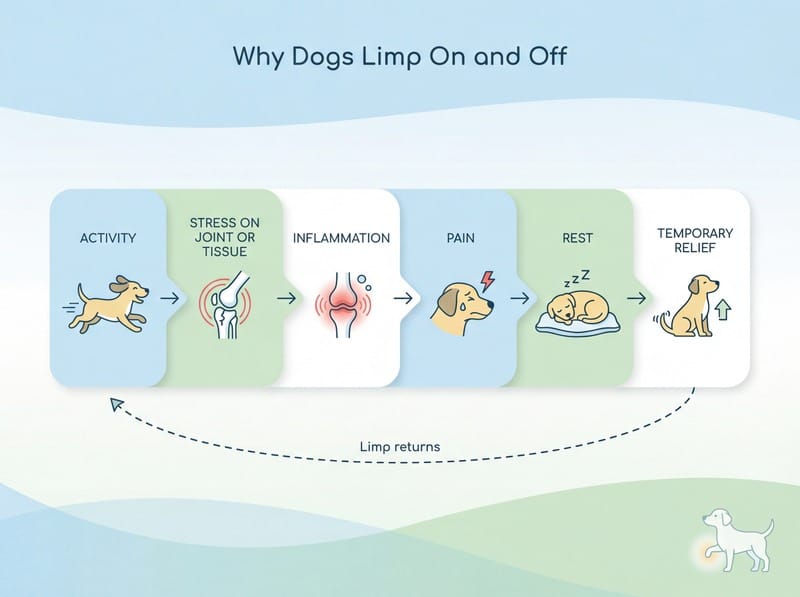
Simple pattern: activity → stress on joint or tissue → mild inflammation → pain → rest → temporary relief → activity → limping returns
Quick Answer Box
Why is my dog limping on and off? A dog limping on and off usually means intermittent pain or joint instability that improves with rest but returns when activity increases. For a complete overview of all possible causes, see why is my dog limping. This pattern is often linked to underlying joint problems — for broader joint support, see the dog joint pain relief guide.
The limp comes and goes because the underlying issue is still present even when symptoms improve, not because it has resolved. How often the limp returns matters just as much as how bad it looks in any single moment — a mild limp that keeps repeating can be more significant than one severe episode that never happens again.
This article focuses specifically on dogs whose limping comes and goes over time. Unlike articles about sudden limping, limping after exercise, this page focuses on recurring or intermittent limping that improves and then returns. That’s a different pattern from limping after rest, which has its own separate causes.
Table of Contents
What Does It Mean When a Dog’s Limp Comes and Goes?
Intermittent Limping Explained
A dog limping on and off is called intermittent lameness in dogs. It means the limp is not constant, even though the underlying problem is still present.
The limp appears during activity, improves with rest, and then returns again later.
This usually happens when the issue is mild or not constant. The dog may look normal at times, but the underlying problem has not fully healed.
Why Limping Does Not Stay Constant
Limping changes because pain is not always the same. It increases with movement and decreases with rest.
Simple pattern:
movement → stress on joint or tissue → pain → limping
rest → reduced pressure → pain decreases → limp improves (but issue remains)
Activity like running or jumping can trigger the limp again. Rest reduces stress, so the limp may temporarily disappear.
This is why a dog limps on and off instead of all the time.
Frequency, Duration & Recovery-Time Tracking (Symptom Log)
A dog limping on and off is easier to understand when the pattern is written down instead of remembered from memory. This holds true whether a dog has been limping for a week or the episodes have stretched into months, since owners often try to recall how many times the limp has shown up, but small details fade quickly, especially when the dog looks completely normal in between episodes.
What to Write Down Each Time
A few simple details make a real difference. Note the date the limp appeared, what the dog was doing right before it started, which leg seemed affected, how bad the limp looked, how long it lasted, and how long it took the dog to look normal again.
Writing these details down builds a timeline. That timeline lets a vet compare one episode to the next, instead of relying on a single visit where the limp may not even be showing. This kind of tracking is about spotting a pattern, not figuring out the exact cause.
Why Frequency, Duration, and Recovery Time Are Separate Signals
It helps to think of a recurring limp as changing in three different ways, not just one. A limp can happen more often without lasting any longer. It can last longer without happening more often. Or it can keep showing up the same amount, but take longer each time for the dog to bounce back.
These three signals do not always move together. A dog’s limp might still only happen once a week, yet each episode now takes a full day to settle instead of an hour. That kind of change is easy to miss unless it is tracked directly, since the limp still looks “the same” on the surface, even when a dog limp getting worse is exactly what’s happening underneath.
Episodes that start happening closer together suggest the underlying issue is becoming less stable, even if each individual episode still looks mild. Episodes that last longer than they used to suggest the dog needs more time to recover, which can point toward something progressing rather than a one-off strain. And when recovery itself slows down each time, that is often one of the more meaningful warning signs, since it means the dog is not bouncing back the way it once did.
Why a Walking Video Helps
A short video can capture something a vet visit often misses. Many dogs stop limping by the time they reach the clinic, simply because the excitement of a car ride or a new environment temporarily overrides the limp.
A useful video shows the dog walking and trotting in a well-lit, flat area, filmed from the side, the front, and the rear if possible. A steady camera and a loose leash make the movement easier to see clearly. Even a short clip can show a vet exactly how the limp looks in real time, rather than relying on a description alone.
When Tracking Points to Monitor vs. Vet Soon vs. Emergency
The details collected in a symptom log can help sort a recurring limp into one of three general categories.
A limp that stays in the mild, monitor category usually shows up as a single brief episode that fully resolves. The dog stays bright, eats normally, and moves normally between episodes, and recovery time stays short and doesn’t seem to be changing.
A limp that fits the needs-vet-soon category tends to keep recurring, showing up more often or after less activity than before. Recovery starts taking longer each time, or the limp has now been present, on and off, for more than a day or two.
Some signs point to something more urgent and fall outside the pattern this article focuses on. A dog that suddenly refuses to bear any weight, shows severe pain, has visible swelling, bleeding, or an odd-looking limb shape, drags a leg, knuckles a paw, or shows whole-body signs like lethargy or fever needs prompt attention rather than continued at-home tracking.
Is a slower recovery each time a meaningful warning sign?
Yes, a recovery time that keeps getting longer is often one of the more meaningful warning signs in a dog limping on and off. It means the dog is not bouncing back the way it once did, which can point toward something progressing rather than a one-off strain.
Recurring-Limp Pattern Classification (What the Pattern Suggests)
A dog limping on and off does not always follow the same pattern. Some dogs limp mostly during activity. Others seem fine all day, then start limping the moment they stand up after resting. And some dogs show something even smaller, a quick hop or skip on one leg that disappears almost as fast as it started. These are three different patterns, and noticing which one fits can help make sense of what the body is doing.
Activity-Triggered vs. Post-Rest vs. Brief Skip-and-Return
An activity-triggered limp usually shows up under load. The dog may seem fine at the start of a walk, then start favoring a leg during play, a longer walk, or a run. This pattern points to discomfort that builds as the leg does more work.
A post-rest limp looks almost the opposite. The dog seems worse right after getting up from a nap or after sleeping through the night, then loosens up as it starts moving around. This is the pattern behind dog limping in the morning or a dog that limps when first getting up, since joints and soft tissue can feel stiffer after time spent still. Some dogs even seem to have a hard time getting up from lying down before easing into a normal stride, a pattern just as common in a labrador limping after lying down as it is in any other breed.
A brief skip-and-return limp is the smallest and easiest to miss. The dog lifts a leg for a step or two, then sets it back down and keeps walking like nothing happened, a pattern that can show up as dog intermittent limping front leg just as easily as in a back leg. It is tempting to write this off completely, since it passes so quickly. But if this same brief skip keeps repeating, that recurring pattern is still worth paying attention to, even though each individual moment looks minor.
None of these three patterns point to one specific diagnosis on their own. They are simply different ways a recurring limp can show up, and noticing which one matches a dog’s behavior is the first step in understanding the bigger picture.
Recurrence Itself Is a Separate Signal From Severity
It helps to separate two different questions: how bad does the limp look in a single moment, and how often does it come back? A limp that clears up fast but keeps returning is not the same as a limp that stays mild and steady without much change. The first pattern shows something that keeps getting triggered again and again. The second shows something that has settled into a stable, low-level state.
This distinction matters because a mild-looking limp can still be worth watching closely if it keeps repeating, while a limp that only ever happened once might not need the same level of attention. Recurrence on its own is a signal, separate from how painful or obvious any single episode looks.
Monitor / Vet Soon / Emergency by Pattern
These recurring patterns can also help sort a limp into a general level of concern.
A pattern that fits the mild, monitor category tends to be rare and brief, fully resolving each time without pain, swelling, or any behavior change. The pattern itself is not becoming more frequent.
A pattern that fits the needs-vet-soon category shows limping that keeps recurring on a more regular basis. The episodes may be getting closer together, starting to show up after less activity than before, or taking longer to settle down than they used to.
Some patterns fall outside what a recurring limp usually looks like and need faster attention instead of continued observation. A dog that suddenly cannot bear weight on the leg, shows severe pain, or has visible swelling, trauma, or systemic signs like fever needs prompt veterinary care rather than more pattern-watching at home.
At what point does “watch and wait” become “call the vet soon”?
Watching and waiting fits a pattern that’s rare, brief, and not changing over time. It’s time to call the vet soon once the limping recurs on a more regular basis, the episodes start happening closer together, or recovery is taking longer to settle down than it used to.
Common Recurring-Limp Causes (Expanded, Pattern-Scoped)
A recurring limp can come from more than one type of problem, and several causes tend to show up specifically as a pattern that comes and goes rather than a limp that stays constant.
Paw or Nail Irritation
A small paw or nail issue can cause a limp that comes and goes because it only becomes noticeably painful under the pressure of walking. The dog may seem fine standing still or resting, then favor the leg again as soon as weight and pressure return to that spot.
Cause chain: paw or nail irritation → pain only under pressure → limp appears during walking → limp eases once weight comes off the paw.
Incompletely Healed Muscle or Tendon Strain
A strain that has not fully healed can flare up again and again with activity, even after it seems to settle down. The tissue may feel better during rest, but it has not finished repairing itself.
Cause chain: incomplete healing → tissue remains fragile → activity re-irritates the area → limp returns → rest allows temporary improvement → cycle repeats until the tissue fully heals.
Brief Kneecap Instability (Skip-and-Return)
Some dogs briefly skip or hop on one leg for a step or two, then return to a normal stride right away. PDSA describes this same skip-and-return pattern as a possible early sign of a luxating patella, though this observation alone does not confirm a diagnosis.
Cause chain: kneecap briefly shifts out of its normal position → dog skips or holds the leg up for a moment → kneecap settles back into place → normal walking resumes.
Compensation From a Primary Issue
When a dog favors one leg for a while, the opposite or nearby limb often takes on extra weight to make up the difference. This can create a second, milder source of discomfort layered on top of the original problem.
Cause chain: primary leg is favored → extra weight shifts to a supporting limb → that limb works harder than usual → mild discomfort can develop in the second leg over time.
Shifting-Leg Discomfort and Broader Inflammatory Processes
In some cases, discomfort that seems to move between legs reflects a broader process affecting more than one area, rather than a single localized injury. This observation stays general here, since pinpointing a specific cause behind shifting-leg discomfort requires veterinary evaluation.
Cause chain: broader inflammatory process affects multiple joints or limbs → discomfort shows up in different legs at different times → the pattern can look like it is “moving around” rather than staying in one place.
Could a small paw or nail issue really cause a limp that comes and goes?
Yes, a paw or nail issue can cause a limp that comes and goes because it only becomes noticeably painful under the pressure of walking. The dog may seem fine standing still or resting, then favor the leg again as soon as weight returns to that spot.
Same Leg Every Time vs. Limping on Different Legs
Where a limp shows up can be just as useful to notice as when it shows up. Some dogs favor the exact same leg every time the limp returns. Others seem to switch sides, favoring one leg one week and a different leg the next. These two patterns often point to different things happening in the body.
| Same Leg Every Time | Limping on Different Legs | |
| What it usually suggests | A localized problem in that one limb | Compensation, or more than one area involved |
| Owner-observable sign | The limp always seems to be in the same leg | The dog seems to switch from one side to the other |
| What to watch for | Stays mild and consistent, no other change | Dog seems stiffer, slower, or less willing to move overall |
| When to take closer notice | If swelling, fever, or low energy appear | If paired with low energy, fever, or behavior change |
What Same-Leg Recurrence Usually Suggests
When the limp always seems to be in the same leg, that usually points to a localized problem in that one limb. The tissue, joint, or paw in that specific leg is likely the source of the discomfort, and it keeps flaring up under the same kind of stress each time. This is often the easier pattern to notice, since the owner can usually point to one consistent leg without much doubt, whether it’s dog limping on and off back leg or the same pattern showing up in a front leg each time.
What Shifting-Leg Recurrence Usually Suggests
A limp that seems to move between legs tells a different story. This can happen when the dog is compensating for one sore leg by putting extra pressure on the opposite one. Over time, that opposite leg starts carrying more weight than it should, and it can begin showing its own soreness or stiffness as a result.
A shifting-leg pattern can also mean more than one area is involved at once, rather than a single sore spot. In these cases, the dog may seem stiff or uneven overall instead of clearly favoring one leg. Some owners describe it as the dog seeming to switch from one side to the other, without a clear single leg to point to.
Why Owners Sometimes Misidentify the Affected Leg
A mild limp can be surprisingly hard to localize. A dog may lick or chew at one leg, which naturally draws attention there, while the actual gait changes suggest a different limb is the real source of discomfort. This happens because a dog that is protecting a sore leg often shifts weight in ways that are not always obvious to watch.
This is also where it helps to remember that the leg a dog seems to be protecting is not always the leg causing the problem. Pain-related favoring, where a dog avoids using a genuinely sore leg, can look very similar to weakness or poor coordination, even though the two come from different mechanisms inside the body. If a dog is dragging a leg or knuckling a paw, see why is my dog dragging his back legs for a closer look at that pattern.
When Shifting-Leg Limping Needs Closer Attention
A limp that stays in one leg, is mild, and comes with no other changes usually fits into the category that can be watched at home. The dog otherwise acts normal, with no swelling, fever, low energy, or loss of appetite.
A limp that seems to move between legs deserves a bit more attention, especially if the dog also seems stiffer, slower, or less willing to move overall. This can be a sign that more than one leg is now carrying extra strain.
Some situations call for quicker action. A shifting-leg limp paired with low energy, fever, or a noticeable change in behavior is worth taking seriously, as is any dragging, knuckling, or sign that points toward a nerve or spinal issue rather than ordinary limping. Recent exposure to a tick-prone area alongside these signs is also worth mentioning to a vet, since it can be useful context even though it does not confirm a specific cause on its own.
If your dog is not putting any weight on the leg at all, see dog not putting weight on back leg for what that specific pattern can mean.
Could my dog actually be protecting a different leg than I think?
Yes, a mild limp can be surprisingly hard to localize. A dog may lick or chew at one leg, which naturally draws attention there, while the actual gait changes suggest a different limb is the real source of discomfort.
Is It Actually Limping, or Stiffness, Weakness, or Poor Traction?
Not every movement change that looks like a limp actually is one. A dog can look off in several different ways, and telling them apart helps point toward the right kind of support.
How These Movement Changes Differ
True limping means the dog is favoring one leg during movement, shifting weight away from it and often shortening its stride on that side. This is different from stiffness, which PDSA notes tends to show up right after resting rather than during general movement, and which usually loosens as the dog keeps walking. A dog that is stiff after lying down may move slowly at first but is not necessarily protecting one specific leg the way a limping dog does. A dog that seems to be walking slow after rest follows a related but separate path worth reading about on its own.
Generalized weakness looks different still. Instead of favoring one leg, a weak dog may seem unsteady on more than one leg, struggle to hold a normal stance, or tire quickly during activity that used to be easy. This spreads across the body rather than pointing to a single sore limb. Sudden hind leg weakness follows its own separate path and is worth a closer look on its own.
Poor traction can look the most like limping at first glance, since a dog that keeps slipping may stumble or catch itself the same way a limping dog stutters its stride. The difference is in the surface. A dog that moves normally on carpet or grass but struggles only on smooth or slick floors is likely dealing with a traction problem, not a limb-specific injury. A dog that keeps slipping on the floor deals with a different underlying issue than this article’s recurring, limb-specific limp.
These four patterns, limb-favoring, post-rest stiffness, generalized weakness, and poor traction, can look similar to an owner watching from across the room. They come from different underlying mechanisms, though, and recognizing which one fits helps guide what to look into next.
Is my dog limping, or just slipping on the floor?
Poor traction can look a lot like limping, since a dog that keeps slipping may stumble the same way a limping dog stutters its stride. The difference is the surface: a dog that moves normally on carpet or grass but struggles only on smooth or slick floors is likely dealing with a traction problem, not a limb-specific injury.
Why Dogs Limp On and Off Without Crying
A dog limping on and off without crying may still be in real discomfort, since dogs often hide pain even when a problem is genuine.
Why This Happens
Pain-hiding is a survival instinct many dogs carry, even when there is no real threat around them — a behavior AAHA notes can make pain difficult for owners to recognize even in attentive households. A dog may still walk, play, or wag its tail normally while quietly favoring a leg, since the discomfort does not always show up as whining or obvious distress.
This is one reason owners sometimes miss a recurring limp until it becomes more noticeable. A dog that hides pain well may only reveal the problem through subtle signs, like a slightly shortened stride or a brief pause before putting weight on one leg, rather than any clear vocal cue.
This pain-hiding pattern is a related but separate topic worth understanding on its own.
Why the Limp Coming and Going Doesn’t Mean It’s Resolved
A dog that seems totally normal for days or weeks at a time can still have an unresolved problem underneath. A quiet stretch is a good sign, but it is not the same as proof that the issue has healed.
Why a Dog May Still Play and Run Between Episodes
Many owners assume that if a dog is limping but shows no sign of pain during play, the leg must be fine. Excitement and activity can change how a dog moves in the moment. A dog caught up in play or running after a ball may push through mild discomfort without slowing down, especially if the underlying issue is not severe enough to stop that behavior outright.
This is why a dog can still want to run and play even though he limps sometimes. Acting normal during a burst of activity does not rule out a problem that shows up again later, once the excitement fades and the dog settles down.
Why Discomfort Isn’t Always Constant
Some joint or soft tissue problems do not cause pain all the time. They may only cause discomfort during certain movements, like a sharp turn, a jump, or getting up after lying down.
This helps explain dog limping but not in pain during normal activity. The dog is not necessarily pain-free. The discomfort may simply not be present at that exact moment, since the issue depends on movement rather than staying constant throughout the day. A dog limping back leg no pain during a calm walk can still show discomfort later, once a specific movement triggers it again.
A “Good Day” Is Not Proof of Resolution
A day or two without limping can feel like reassurance. On its own, though, a good day does not confirm that the underlying issue is gone.
Should I stop worrying if the limp hasn’t shown up in a while? Not necessarily. Some problems ease up for a while and then return once the same trigger happens again. A stretch of dog limping on and off no pain, followed by normal movement, often reflects this same up-and-down pattern rather than true healing. Watching for whether the limp returns over time gives a much clearer picture than judging any single good day on its own.
My dog seems totally normal for weeks at a time — does that mean it’s healed?
Not necessarily. A quiet stretch is a good sign, but on its own it doesn’t prove the underlying issue has resolved, since some problems only cause discomfort during certain movements rather than staying constant.
When Limping Comes and Goes for Weeks or Months
If a dog is limping on and off for weeks or months, it usually means the underlying problem has not healed and keeps getting triggered.
The limp may improve for a short time but returns again, showing the issue is ongoing rather than temporary.
What Long-Term Intermittent Limping Means
This pattern often indicates a deeper problem that is not fully resolving.
The condition may stay mild but continues to affect movement over time.
Possible Long-Term Causes
Recurring limping is often linked to issues that do not heal on their own.
Common causes include:
- degenerative joint disease (slow joint wear over time)
- repeated strain or incomplete healing
- untreated ligament injury (joint instability)
Cause chain:
ongoing issue → repeated stress → inflammation → temporary relief → flare-up → limping returns
Why the Limp Keeps Returning
The limp comes back because the root problem is still present, even if symptoms improve temporarily.
Rest reduces pain, but activity places stress on the same area again.
When to Take It Seriously
If limping continues or keeps coming back, it is important to seek veterinary evaluation.
Early diagnosis helps prevent long-term joint damage and mobility problems.
What “Getting Worse” Looks Like in a Recurring Limp
A limp that keeps coming back is not always staying the same. Sometimes it is quietly getting worse, even if each episode still looks mild. Knowing the signs of progression can help an owner catch a worsening pattern early.
Frequency, Duration, and Trigger-Threshold Changes
One of the clearest signs of progression is a change in how easily the limp starts. If the limp used to show up only after a long walk but now appears after a short one, the dog’s tolerance for activity may be dropping.
Watch for these changes over time:
- The limp shows up after less and less activity.
- The dog stops walking sooner than it used to.
- It takes longer for the dog to look normal again after an episode.
Each of these points to a slightly different shift. More frequent episodes mean less recovery time between flares. Longer episodes mean the dog needs more time to settle. A lower activity threshold means the underlying issue may be more sensitive than before. Together, these three changes are often the earliest clue that a recurring limp is trending in the wrong direction.
Behavioral Compensation Signs
Progression does not only show up as a change in the limp itself. It can also show up in how the dog behaves around the affected leg.
A dog that is quietly getting worse may start to:
- Avoid stairs, jumping, or running that it used to do without hesitation.
- Guard the leg by holding it up or shifting weight away from it, including holding a back leg up occasionally rather than stepping fully on it.
- Lick or chew at the area more than before.
These behavior changes are a separate signal from frequency and duration. A dog can still walk on the leg most of the time and still be showing meaningful compensation through these smaller daily habits. Both types of signs matter, and either one on its own is worth paying attention to.
Why “Still Goes Away Sometimes” Doesn’t Mean “Not Worsening”
It is easy to assume that if the limp still fades after rest, nothing serious is happening. This is not always true. A limp can keep resolving between episodes while the underlying pattern still gets worse over time.
Episode resolution and overall progression are two separate things. One describes what happens during a single flare-up. The other describes the trend across many flare-ups. A recurring limp in an old dog, for example, may still go away completely after each rest period while slowly becoming more frequent or harder to trigger over the following months. Watching the pattern across several episodes, rather than judging each one in isolation, gives a clearer picture of whether the issue is stable or advancing.
Compensation Risk to Other Limbs
When a dog favors one leg for a long stretch of time, the extra strain does not always stay contained to that leg. The opposite or supporting limbs often take on more weight to make up the difference.
This shift in weight-bearing can lead to a chain reaction: favoring one leg for a long time shifts extra load onto another limb, and that overload can bring on secondary soreness or stiffness in a leg that was not part of the original problem. This is one reason a recurring limp that seems isolated to one leg is still worth monitoring closely, even when the dog appears comfortable overall.
Monitor, Vet Soon, or Emergency for a Worsening Pattern
Once an owner is tracking these progression signs, it helps to know what level of response each pattern calls for.
Monitor at home when episodes are rare and are not increasing, recovery looks the same as it always has, and the dog stays active and comfortable between flares.
See a vet soon when the limp is recurring and trending more frequent, longer, or easier to trigger, when the dog starts avoiding normal movement, or when recovery is clearly taking longer than it used to.
Treat it as an emergency or same-day concern if the limp becomes non-weight-bearing, or if there is severe pain, swelling, deformity, dragging, or any sign of systemic illness.
What signs mean the pattern is progressing, not just repeating?
Watch for the limp showing up after less activity than before, the dog stopping sooner on walks, and recovery taking longer each time. Behavioral signs like avoiding stairs or jumping, guarding the leg, or licking the area more than usual can also point to a pattern that’s quietly getting worse.
When to Worry About a Dog Limping
A dog’s limp may be serious if it does not improve, keeps returning, or shows clear warning signs. Early attention helps prevent worsening problems.
Warning Signs
Some signs suggest the limp may need veterinary evaluation.
Watch for:
- not putting weight on the affected leg
- visible swelling or heat
- worsening limp over time
- changes in behavior (less active or reluctant to move)
These signs often indicate more than a mild issue. In these situations, it helps to know when to take your dog to the vet for sudden limping.
Time-Based Rule
The duration and pattern of limping are important.
Pay attention if:
- limping lasts more than 48 hours
- the limp keeps returning
- episodes become more frequent
Simple pattern:
temporary limp → repeated episodes → increasing frequency → possible underlying issue
When to Seek Veterinary Care
If these signs appear, it is best to seek veterinary evaluation.
Early assessment helps protect joint health and prevent long-term damage.
Managing Activity Between Episodes
Knowing what to do when dog is limping does not stop once the limp fades. What an owner does during the good days matters just as much as what they do during a flare-up.
Don’t “Test” the Leg With Full Activity
It is tempting to let a dog run, jump, or take a long walk just to see if the leg is really okay. This is not a reliable way to check. A dog can push through a short burst of activity and seem fine in the moment, only to limp again once the activity ends and the leg has had time to react. Testing the leg this way risks re-triggering the same strain instead of confirming that it has healed.
Controlled, Gradual Activity Resumption
A safer approach is to bring activity back slowly instead of jumping straight from rest to full movement. This gives the leg a chance to show how it responds before it is asked to do more.
A few simple habits support this kind of controlled return:
Keep the dog on a leash rather than letting it run freely right away.
Avoid sharp turns and repeated stair use, since these movements place sudden stress on the joint.
Choose stable, non-slip footing for walks and indoor activity, so the leg is not working to keep balance on top of everything else.
This kind of gradual approach is one of the more practical ways to help a limping dog without guessing whether the leg is ready for more.
Medication Safety
It can be tempting to give a dog something for the pain, especially during a flare-up. Human pain medicine should never be given to a dog, since these medications can be unsafe even in small amounts. Leftover veterinary medicine from a past issue should not be used either unless a vet has directed it for this specific situation. If pain relief is needed, a veterinarian is the right source for guidance on what is safe.
Can I give my dog anything for the pain at home?
Human pain medicine should never be given to a dog, since these medications can be unsafe even
in small amounts, and leftover veterinary medicine shouldn’t be used unless a vet has directed it for this specific situation. If pain relief is needed, a veterinarian is the right source for guidance on what’s safe.
Can a Dog’s Limp Go Away on Its Own? (When It’s Safe)
Some dog limps may improve on their own, but recurring or ongoing limping usually does not resolve without proper care.
When It May Improve
Mild cases can improve with rest, especially when the problem is small and not repeated.
These include:
- mild muscle strain
- minor paw injury
In these cases, the limp may fade as the tissue heals.
When It Will Not Resolve
Some causes do not improve without proper evaluation.
These include:
- joint problems
- ligament injuries
- chronic conditions
Cause chain:
underlying issue → repeated stress → inflammation → ongoing pain → limping returns
If the limp keeps coming back, it is important to seek veterinary evaluation to protect long-term joint health.
FAQ Section
Why does my dog keep limping on and off?
A dog keeps limping on and off when the underlying issue has not fully healed. The limp may improve with rest but returns during activity.
What causes intermittent limping in dogs?
Common causes include mild injury, joint stress, ligament strain, and early joint problems.
Why is my dog limping but showing no sign of pain?
Dogs often hide pain. A dog may look normal but still have mild discomfort that causes limping.
When should I worry about my dog limping?
You should worry about your dog’s limp if it lasts more than 48 hours, keeps returning, or the dog avoids putting weight on the leg.
Will a dog limping heal by itself?
Some mild cases may improve with rest. Recurring limping often needs veterinary evaluation.
How can I tell if a dog’s limp is serious?
A dog’s limp may be serious if it worsens, includes swelling, or affects normal movement.
What should I write down every time my dog limps?
Note the date, what the dog was doing right before the limp started, which leg seemed affected, how bad it looked, how long it lasted, and how long it took the dog to look normal again. This kind of symptom log builds a timeline a vet can use to compare episodes instead of relying on a single visit.
Is it the same leg every time, or does it seem to move around?
This distinction matters because the two patterns often point to different things. When the limp always shows up in the same leg, that usually points to a localized problem in that one limb, while a limp that moves between legs can mean the dog is compensating for one sore leg by putting extra pressure on the other.
Is my dog actually limping, or just stiff after resting?
True limping means the dog is favoring one leg during movement, while stiffness tends to show up right after resting and usually loosens as the dog keeps walking. A stiff dog may move slowly at first but isn’t necessarily protecting one specific leg the way a limping dog does.
Why would a vet want a video if the limp isn’t happening during the appointment?
Many dogs stop limping by the time they reach the clinic, since the excitement of the visit can temporarily override the limp. A short video filmed at home, from the side, front, and rear in a well-lit area, shows a vet exactly how the limp looks in real time rather than relying on a description alone.
Does it matter if episodes are getting closer together, even if each one is mild?
Yes. Episodes happening closer together suggest the underlying issue is becoming less stable, even if each individual episode still looks mild. This is one of three separate trend signals worth tracking, along with how long episodes last and how quickly the dog recovers.
Does it matter whether the limp shows up during activity or after resting?
Yes, these point to different patterns. An activity-triggered limp usually shows up under load, like during play or a longer walk, while a post-rest limp appears right after the dog gets up from lying down and then loosens as it starts moving.
What does it mean if my dog briefly lifts a leg and then walks normally again?
This is called a brief skip-and-return limp, where the dog lifts a leg for a step or two and then keeps walking like nothing happened. It’s easy to dismiss since it passes so quickly, but if this same brief skip keeps repeating, that recurring pattern is still worth paying attention to.
What does it mean if my dog seems to limp on a different leg each time?
A shifting-leg pattern can happen when a dog is compensating for one sore leg, which puts more weight on the opposite leg until it starts showing its own soreness or stiffness. It can also mean more than one area is involved at once, making the dog seem stiff or uneven overall rather than clearly favoring one leg.
Could favoring one leg for a long time cause a problem in another leg?
Yes, when a dog favors one leg for a long stretch, the opposite or supporting limb often takes on extra weight to make up the difference. Over time, that extra load can bring on secondary soreness or stiffness in a leg that wasn’t part of the original problem.
Why does my dog still want to play and run even though he limps sometimes?
Excitement and activity can change how a dog moves in the moment, and a dog caught up in play may push through mild discomfort without slowing down. Acting normal during a burst of activity doesn’t rule out a problem that shows up again later once the dog settles down.
Should I go back to normal walks and play once the limp goes away?
It’s safer to bring activity back slowly rather than jumping straight from rest to full movement. Keeping the dog on a leash, avoiding sharp turns and repeated stairs, and choosing stable footing all give the leg a chance to show how it responds before it’s asked to do more.
Is it safe to “test” whether the leg is better by letting my dog run?
No, this isn’t a reliable way to check. A dog can push through a short burst of activity and seem fine in the moment, only to limp again once the activity ends and the leg has had time to react.
What should I be doing on the good days, not just the bad ones?
On the good days, focus on controlled, gradual activity rather than resuming everything at once. Simple habits like leash control, avoiding sharp turns and stairs, and using stable, non-slip footing help protect the leg while it continues to recover.
What does it mean if my dog briefly skips or hops on one leg?
A brief, self-correcting skip or hop on one leg can point to mild kneecap instability, though this observation alone doesn’t confirm a diagnosis. The kneecap briefly shifts out of position and then settles back into place as normal walking resumes.
Could this be weakness rather than a sore leg?
It’s possible. Generalized weakness looks different from limping because instead of favoring one leg, a weak dog may seem unsteady on more than one leg, struggle to hold a normal stance, or tire quickly during activity that used to be easy.
Why does my dog’s limp come and go?
This usually means the underlying problem is still present but only flares up at certain times, especially with movement or repeated activity.
What are signs of a dog ACL tear?
Signs can include trouble bearing weight, back leg instability, and limping that returns during movement.
Sources & References
- Merck Veterinary Manual
https://www.merckvetmanual.com/dog-owners/bone,-joint,-and-muscle-disorders-of-dogs/lameness-in-dogs - VCA Animal Hospitals
https://vcahospitals.com/know-your-pet/lameness-in-dogs - American Kennel Club
https://www.akc.org/expert-advice/health/why-is-my-dog-limping/ - PetMD
https://www.petmd.com/dog/general-health/why-my-dog-limping - AAHA — What’s Wrong? Common Pet Pain Signs
https://www.aaha.org/resources/whats-wrong-common-pet-pain-signs/ - PDSA — Luxating Patella in Dogs
https://www.pdsa.org.uk/pet-help-and-advice/pet-health-hub/conditions/luxating-patella-in-dogs - PDSA — Limping and Stiffness in Dogs
https://www.pdsa.org.uk/pet-help-and-advice/pet-health-hub/symptoms/limping-and-stiffness-in-dogs - BluePearl Pet Hospital — Dog Limping Guide: When to Seek Emergency Vet Care
https://bluepearlvet.com/pet-blog/dog-limping-guide-when-to-seek-emergency-vet-care/
What to Do Next
If a dog is limping on and off, it often means the underlying issue is still present even when symptoms improve for a while. Watching the pattern closely can help show whether the problem is mild, recurring, or getting worse.
If the limp comes and goes in one back leg without clear pain, see dog limping back leg not in pain.
If the limp continues, returns often, or gets worse, a veterinary check is the safest next step.
Update Note
This article was reviewed and updated on July 31, 2026 with expanded guidance on tracking a recurring limp over time, recognizing when a pattern is getting worse, telling apart same-leg versus shifting-leg limping, and understanding why a limp that comes and goes doesn’t mean it has healed. New sections were also added on managing activity between episodes and distinguishing true limping from stiffness, weakness, or poor traction. This article is for educational purposes only and is not a substitute for professional veterinary care. If your dog’s limping continues, returns often, or is accompanied by other symptoms, a veterinarian can help confirm the cause and recommend next steps.