

TL;DR
Arthritis in dogs often starts with small changes like stiffness, limping, slower walking, trouble climbing stairs, or reluctance to jump. For a complete breakdown of causes, progression, and long-term management, see our Dog Joint Pain Relief Guide. Early signs of arthritis in dogs may also include licking joints, posture changes, reduced playfulness, and mood shifts. These signs often differ from normal aging because they tend to center on the same specific movements, like rising after rest or climbing stairs, rather than a general overall slowdown. If symptoms continue or worsen, a veterinarian should evaluate your dog to confirm the cause and rule out injuries or joint diseases.
Quick Answer Box
Early signs of arthritis in dogs often include stiffness after rest, limping, slower movement, difficulty standing up, reluctance to jump or climb stairs, joint licking, cracking or popping sounds in the joints, and reduced activity. These symptoms usually develop gradually and may worsen over time.
Many owners begin noticing these changes as their dog grows older. These changes often become easier to notice as dogs get older.
Some of the most common early signs of arthritis in dogs include:
- stiffness after rest
- limping or uneven walking
- slower movement
- difficulty standing up
- reluctance to jump or climb stairs
- joint licking
- popping or cracking sounds
- reduced activity
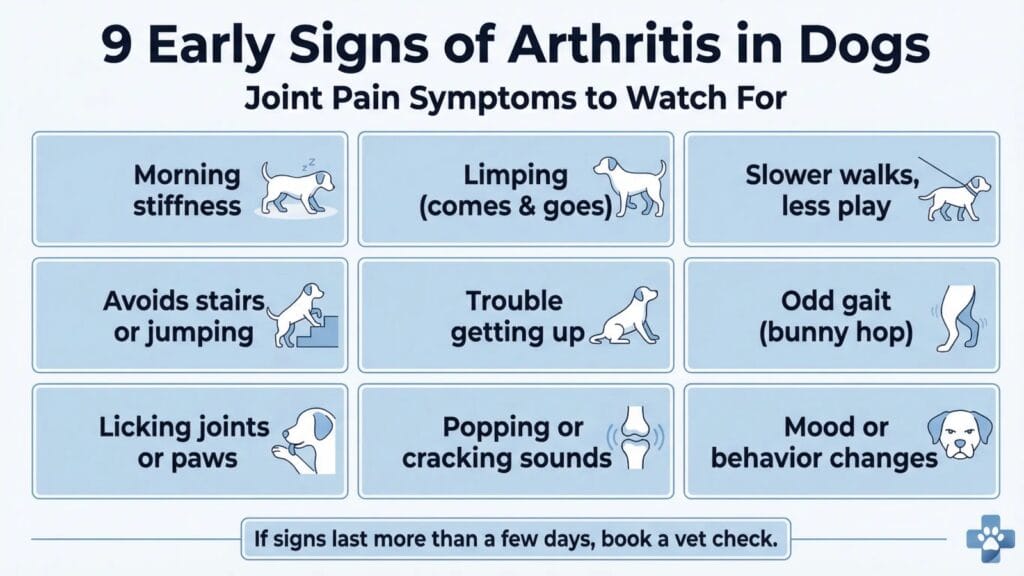
Table of Contents
Do Dogs Get Arthritis?
Yes, dogs can get arthritis. It is one of the most common joint problems in dogs, especially in older dogs, large breeds, overweight dogs, and dogs with past injuries.
Arthritis in dogs happens when the joints become inflamed or worn down over time. This makes movement painful or stiff, and it can slowly reduce mobility. This gradual breakdown of cartilage and joint tissue is well documented by Cornell University’s College of Veterinary Medicine.
Many owners don’t notice it early because arthritis often starts gradually, not suddenly. Joint problems often develop over time, especially when joints face repeated stress, aging, or structural issues.
Can Dogs Have Arthritis?
Yes, dogs can absolutely have arthritis, and it can affect any breed, any size, and even younger dogs in some cases.
Arthritis can develop in:
- Hips
- Elbows
- Knees
- Back/spine
- Shoulders
- Paws and toes
That’s why some dogs show arthritis symptoms in their back legs, while others show pain in the front legs or stiffness in the paws.
Even if your dog still eats normally and seems happy, arthritis may still be present because dogs often hide pain.
Does Age Affect When Signs Appear?
Arthritis usually starts in dogs between 7 to 10 years old, but it can begin much earlier depending on the dog’s breed size, past injuries, or joint conditions such as hip dysplasia. For a full breakdown of typical arthritis onset by age and breed, see what age do dogs get arthritis.
This is why spotting early joint pain symptoms matters.
Early Arthritis Signs Before a Clear Limp Appears
Limping is often the sign owners notice first, but it’s usually not the earliest one. Arthritis tends to affect a dog’s movement and behavior before it produces a clear limp.
The pattern typically follows a simple sequence. Joint discomfort starts small, movement becomes less comfortable, and the dog begins adjusting how it moves or behaves. A visible limp often shows up later, after these smaller changes have already been happening for a while.
Because of this, a dog can have early arthritis without limping at all. Owners may notice the dog moving more carefully instead of favoring a leg outright.
Some of the earliest changes to watch for include:
Slower transitions from lying down to standing up Hesitation before jumping into the car or onto furniture A shorter stride or a stiffer-looking walk Less interest in play or long walks A dog that seems “careful” before any clear limp appears
These changes can be easy to miss because they develop gradually. A dog that pauses before jumping, or takes a moment longer to get up, isn’t always showing an obvious problem. But these small shifts are often the body’s way of protecting a joint before pain becomes visible as a limp.
If these subtle changes stay mild and don’t affect daily activity, they can be monitored at home for now. If they keep happening, get worse, or start interfering with normal routines, it’s a good idea to have a veterinarian take a look.
Can a dog have early arthritis without limping?
Yes. Early arthritis often shows up as stiffness, hesitation, shorter strides, or reduced interest in play well before a dog develops a visible limp. A limp is usually one of the later signs, not the earliest one, so a dog can be dealing with joint discomfort even while walking normally overall.
What changes appear before a dog starts limping?
Dogs often show subtle behavior and movement changes before limping becomes noticeable. This can include slower transitions from lying down to standing, hesitation before jumping into the car or onto furniture, a shorter or stiffer-looking stride, and a dog that generally seems more careful with its movements.
9 Early Signs of Arthritis in Dogs
Arthritis in dogs often starts quietly. Many owners don’t notice it at first because the symptoms can come and go, or look like “normal aging.” But early joint pain signs usually show up in small daily behaviors.
Below are 9 early signs of arthritis in dogs that can help you spot joint discomfort sooner.
1. Stiffness After Rest (Morning Stiffness)
One of the most common early signs of arthritis in dogs is stiffness after resting. Many dogs seem slow or “tight” when they first wake up in the morning or after a nap.
This stiffness may last a few minutes, and then the dog starts walking more normally. That’s why many owners assume it’s nothing serious.
If joint stiffness happens repeatedly, especially after lying down, it may be an early sign of inflammation inside the joint.
Common signs of stiff joints in dogs include:
- Slow rising after sleeping
- Taking small steps at first
- Stiff walking for the first few minutes
- Hesitating before moving normally
This type of stiffness may be more noticeable after rest, especially before the dog starts moving normally again.
2. Limping or Lameness (May Come and Go)
Limping is one of the clearest joint-related discomfort signs, but arthritis limping often comes and goes. In some cases, owners may notice limping without an obvious injury. A dog may limp after a long walk, then appear fine the next day.
This is why many owners delay action. Arthritis-related limping may worsen in cold weather, after heavy activity, or after long rest.
A dog limping from arthritis might not cry or show obvious pain. Instead, they may simply avoid putting full weight on one leg.
Some dogs also show subtle exercise intolerance before more obvious mobility problems develop. They may become sore after walks, stop during walks unexpectedly, or need longer recovery times afterward. Owners who notice these changes may benefit from learning how long to walk a dog with arthritis and how to adjust activity levels safely.
Signs of lameness you may notice:
- A mild limp that appears after exercise
- Uneven steps or “favoring” a leg
- Limping that improves after warming up
- Stopping during walks unexpectedly
3. Slower Walks and Less Interest in Play
Dogs with early arthritis may still want to play, but they often don’t have the same energy or movement confidence. They may walk slower, take shorter walks, or stop more often.
Many owners think their dog is “just getting older,” but a reduced interest in play can be an early sign of joint discomfort.
This may happen because movement feels uncomfortable, especially during fast running, turning, or jumping.
Common changes include:
- Shorter play sessions
- Walking behind instead of leading
- Lying down sooner during play
- Less excitement for walks
4. Reluctance to Jump, Climb Stairs, or Get in the Car
Dogs with arthritis often begin avoiding movements that put pressure on hips, knees, elbows, or spine. Jumping and stairs are common triggers.
A dog may still be able to jump, but they hesitate first. They might stare at the couch or car and wait, as if “thinking about it.”
This hesitation is often one of the earliest signs of arthritis pain in dogs.
Early warning behaviors include:
- Hesitating before stairs
- Jumping off furniture more slowly
- Refusing to jump into the car
- Choosing ramps or alternate paths
5. Trouble Getting Up, Sitting, or Lying Down
Another strong symptom is difficulty during basic movements like standing up or lying down. Dogs with arthritis may look stiff or uncomfortable when changing positions.
Some dogs push up slowly with their front legs first, or shift their body weight awkwardly to avoid pressure on painful joints.
This is especially common in arthritis in senior dogs, but it can also happen in younger dogs with joint disease.
Watch for these signs:
- Struggling to stand up from the floor
- Taking longer to sit down
- Sitting awkwardly (one leg out to the side)
- Stiff movements when lying down
6. “Bunny Hopping” or Odd Gait (Especially Hips)
Some dogs develop an unusual walking or running style. A classic example is “bunny hopping,” where the dog moves both back legs together while running.
This does not automatically mean arthritis, but it can be linked to hip discomfort or joint instability. It may appear more often after exercise.
Odd gait changes can be one of the early signs of arthritis in dogs, especially if they are becoming less flexible or avoiding certain movements.
Common gait changes include:
- Bunny hopping while running
- Swaying hips while walking
- Shorter back-leg steps
- Uneven movement during turns
7. Licking or Chewing a Joint or Paw
Many dogs lick painful areas repeatedly. This is one of the most overlooked arthritis signs because it can look like allergies or skin irritation.
But dogs may lick joints because they feel soreness, inflammation, or stiffness inside the joint. Some dogs focus on their wrists, elbows, hips, or knees. Others lick their paws.
Yes, dogs can get arthritis in their paws, especially in older dogs or dogs with past injuries.
If your dog is constantly licking joints, it may be a sign of arthritis pain in dogs.
Signs to watch for include:
- Excessive licking of one leg or joint
- Chewing at paws or toes
- Licking that happens mostly after walks
- Redness from constant licking
8. Popping/Cracking Sounds + “Joints Cracking” Concerns
Some owners notice sounds like clicking, cracking, or popping when their dog moves. These noises can come from joints, tendons, or ligaments shifting.
Many owners worry when they hear popping or cracking sounds from a dog’s joints, but it’s important to know:
Joint sounds do NOT always mean arthritis.
Sometimes the sound is harmless. Other times, it may be linked to joint wear, cartilage damage, inflammation, or instability.
If popping sounds happen along with stiffness, limping, or pain signs, it becomes more concerning.
When joint sounds may matter more:
- Popping happens frequently
- Your dog seems uncomfortable afterward
- The cracking is paired with limping
- Movement looks stiff or restricted
9. Mood or Behavior Changes (Grumpy, Avoids Touch, Sleeps More)
Arthritis affects more than mobility. Dogs in pain often change emotionally and behaviorally. They may sleep more, seem less social, or avoid being touched in certain areas.
Some dogs become grumpy, especially when someone touches their hips, back legs, shoulders, or paws. Others may avoid being picked up.
These mood shifts can be one of the most important early signs of dog arthritis, because pain can affect quality of life even before severe limping starts.
Behavior changes linked to arthritis may include:
- Irritability or snapping when touched
- Avoiding petting in certain spots
- Sleeping more than usual
- Less excitement around family activities
How to Track Possible Arthritis Signs at Home
Once a sign shows up, keeping a simple record can make a real difference. A dog’s symptoms may only appear now and then, which makes them easy to forget by the time a vet visit rolls around. A few written notes or short videos can help capture the pattern before it fades from memory.
What to Record
A few basic details are usually enough to build a useful picture:
The date and time the sign appeared What seemed to trigger it, such as waking up, using stairs, playing, exercising, or getting into the car Which leg, side, or body area seemed affected How long the stiffness or hesitation lasted Whether the dog improved after a few minutes of walking Whether the episodes are becoming more frequent or more noticeable
This kind of tracking turns a vague memory into something specific. Instead of telling a vet “he seems stiff sometimes,” an owner can say the stiffness shows up most mornings and usually eases within ten minutes.
Useful Video Angles
A short video often shows more than words can describe. It helps to capture the dog:
Walking toward the camera Walking away from the camera From the side Turning Sitting down Lying down Using stairs, only if it’s safe to do so
These angles give a fuller picture of how the dog is moving, especially if the symptom comes and goes.
Comparing Your Dog to Its Own Baseline
The most useful comparison isn’t to other dogs. It’s to how this particular dog normally moves, plays, and rests. A slower walk might look completely different from one dog to the next, so what matters is whether this dog is moving differently than usual.
A Brief Safety Note
Tracking should stay observational. There’s no need to press on a joint, force it to bend, or repeatedly test how the dog moves to see if something hurts. Watching how the dog moves naturally gives plenty of useful information without adding discomfort. For guidance on supporting a dog with arthritis day to day, see how to help a dog with arthritis at home.
What should I track if I notice possible arthritis signs?
Owners can track the date and time a sign appeared, what seemed to trigger it, which leg or body area seemed affected, how long it lasted, and whether the dog improved after a few minutes of walking. Noting whether episodes are becoming more frequent also helps build a clearer picture over time.
What should I record before a vet visit?
Before a vet visit, it helps to note when the sign started, what triggered it, which leg or area seemed involved, and how long it lasted. A short video showing the dog walking, turning, sitting, and standing can also give the vet a clearer picture, especially if the symptom comes and goes.
Is it safe to check my dog’s joints myself?
It’s safer to observe how a dog moves rather than press on the joints or force them to bend. Repeatedly testing a joint to see if it hurts can cause unnecessary discomfort without providing much useful information, so watching movement naturally is the better approach.
Early Signs by Body Area
Arthritis doesn’t always start in the same place. Some dogs favor one leg long before anything shows up elsewhere. Others develop more general stiffness that touches several areas at once. Knowing what to look for in each region can make early signs easier to spot.
| Body Area | Early Changes Owners May Notice |
| Hips / back legs | Slower rising, shorter stride, reluctance to jump, trouble with stairs |
| Knees | Favoring one hind leg, intermittent limp, reluctance to run or turn quickly |
| Elbows / shoulders | Stiffer front-end movement, less enthusiasm for walks, difficulty getting comfortable |
| Spine | Cautious posture, reluctance to lower or rise, reduced mobility overall |
| Paws / toes | Careful stepping, less willingness on rough or slippery surfaces, altered gait |
When only one joint is affected, the dog often compensates by shifting weight elsewhere. This can show up as favoring one leg, an uneven gait, or an asymmetry that’s easy to notice once you know what you’re looking for. When more than one area is involved, the signs tend to be broader. Rising, walking, and using stairs can all become a little harder at once, rather than one specific movement standing out.
It’s worth being clear about what this table can and can’t tell you. Noticing that a sign shows up mostly in the back legs points to a general area, not a confirmed diagnosis. A hip-region sign, for example, doesn’t confirm the hip joint itself is the problem rather than the muscle or tissue around it. Only a veterinarian can pinpoint the actual structure involved.
If a dog shows mild stiffness or a subtle asymmetry in just one area and otherwise seems stable, it’s reasonable to keep watching for now. But if the dog keeps favoring one leg, the stiffness keeps returning, or the pattern starts affecting normal movement, it’s worth having a veterinarian take a look.
Can arthritis affect only one joint or leg first?
Yes. Early arthritis can start in one area, such as one hip or hind leg, before spreading elsewhere or staying limited to that spot. When only one joint is affected, a dog often compensates by shifting weight, which can show up as favoring that leg or an uneven gait.
Why does my dog favor one side?
Favoring one side often means a dog is protecting a joint that feels uncomfortable, most commonly by shifting weight away from it. This kind of one-sided favoring can be an early sign of joint discomfort in that specific area, though only a veterinarian can confirm exactly what’s causing it.
What Does Arthritis in Dogs Look Like? (Real-Life Examples)
Arthritis in dogs usually does not look dramatic in the beginning. It often shows up as small daily changes that are easy to overlook.
Most owners notice behavior shifts before they think about joint disease.
Here are real-life signs dog owners commonly report:
- “My dog walks slower than before.”
- “She seems stiff in the morning.”
- “He doesn’t want to jump on the couch anymore.”
- “She limps after long walks, but it goes away.”
- “He sleeps more and plays less.”
- “She licks her back legs a lot.”
- “He takes longer to get up from the floor.”
- “She avoids stairs now.”
These signs may seem mild at first. But when they happen regularly, they can point to early arthritis symptoms in dogs.
Arthritis often affects the hips, knees, elbows, back, or even paws. Because joints support body weight, discomfort can change how a dog moves, sits, or rests.
Some dogs show symptoms in their back legs first, especially with hip arthritis. Others show stiffness in the front legs or shoulders.
Early Arthritis vs. Normal Aging: How to Tell the Difference
Many owners assume slower movement is simply part of getting older. Sometimes that’s true. But joint pain tends to follow a different pattern than ordinary aging, and knowing the difference can help decide whether a change is worth watching or worth a vet visit.
Normal aging usually looks like a general, gradual decline in energy. The dog does a little less overall, but there’s no clear trigger behind it. Joint pain looks different. It tends to show up around specific movements, again and again, rather than as an overall slowdown.
The table below breaks down how the two patterns usually compare:
| Pattern | More Consistent With Aging | More Concerning For Joint Pain |
| Energy level | Gradual slowing with age | Can seem normal between painful episodes |
| Stairs/jumping | Somewhat less enthusiastic | Hesitation, reluctance, or refusal |
| After rest | No clear repeatable pattern | Stiffness right after waking up or napping |
| Walking | Overall slower pace | Shorter strides, stiff gait, or favoring a leg |
| After warming up | May simply be older | May loosen up temporarily, then show the same pattern again |
Age on its own doesn’t explain why the same movement causes trouble every time. A dog that is simply getting older tends to slow down across the board, without a specific action setting it off. A dog dealing with joint pain, on the other hand, often struggles with the same specific things: getting up after lying down, taking the stairs, or standing up quickly.
This is also why improvement after warming up can be misleading. A dog might seem stiff first thing in the morning, then move more easily once it’s up and walking around. That improvement doesn’t rule out arthritis. It usually means the joint has loosened up temporarily, not that the underlying problem has gone away.
If a dog is simply a little slower or naps more, with no specific movement triggering discomfort, this is often just aging and can be watched for now. But if stiffness keeps showing up after rest, or the dog consistently hesitates with the same movements, it’s worth having a veterinarian take a look.
How can an owner tell early arthritis from normal aging?
The key difference is whether the same specific movements cause trouble again and again. Normal aging usually looks like a general, gradual slowdown with no clear trigger, while joint pain tends to show up around specific actions, such as stiffness after rest or hesitation with stairs and jumping, repeated over time.
Is my dog “just getting older” or in pain?
Repeated stiffness after rest, hesitation with stairs or jumping, or discomfort with the same specific movements points more toward joint pain than simple aging. A dog that is just getting older typically slows down overall without a consistent trigger behind it. If a pattern like this keeps showing up, a veterinarian can help confirm what’s going on.
Can Arthritis in Dogs Come on Suddenly?
In most cases, arthritis develops slowly over time. It is usually linked to joint wear, inflammation, aging, or past injury.
However, symptoms can sometimes appear suddenly.
For example:
- A dog may seem fine one week, then start limping.
- Cold weather may suddenly make stiffness worse.
- Increased activity may trigger noticeable discomfort.
In these cases, arthritis may already have been developing quietly inside the joint. The pain
becomes noticeable when inflammation increases.
That said, sudden joint pain in dogs can also be caused by other conditions, such as:
- Ligament injuries (like ACL/CCL tears)
- Hip dysplasia flare-ups
- Septic arthritis (infection)
- Soft tissue strains
If your dog suddenly refuses to bear weight, cries out, or shows severe limping, that is not typical mild arthritis and should be checked by a veterinarian promptly.
Because symptoms can overlap, a proper veterinary exam is the safest way to confirm whether it is arthritis or another joint problem.
Why Early Signs May Come and Go
Some early arthritis signs don’t show up every day. A dog might seem stiff one morning and move normally the next, which makes it tempting to write the whole thing off. But this back-and-forth pattern has a simple explanation, and it doesn’t mean the joint is fine.
Early joint changes often involve low-level discomfort or inflammation that isn’t constant. It tends to show up after rest or after activity, then ease once the dog gets moving. As the dog walks around, the joint loosens up and the discomfort settles, so the dog can look completely normal again. The same pattern often returns later, especially after another period of rest or exertion.
This shows up in a few familiar ways. A dog might be stiff first thing, then walk just fine ten minutes later. It might seem fine one day and reluctant the next, with no obvious reason why. Many owners notice the signs mostly appear after naps, walks, or play, and disappear once the dog has been up and moving for a while.
It helps to be clear about what this pattern is and isn’t. A dog that looks normal after warming up hasn’t necessarily worked through the problem. The joint has simply loosened enough that the discomfort isn’t obvious anymore, not that it has resolved. This coming-and-going pattern is different from asking whether dog arthritis comes and goes due to weather or activity triggers, which involves a separate set of day-to-day factors covered in arthritis flare-ups in dogs.
If this kind of temporary improvement happens rarely and doesn’t affect the dog’s daily life, it’s reasonable to keep watching for now. But if the cycle keeps repeating, stiffness or limping should still be evaluated by a veterinarian, even if the dog seems perfectly comfortable in between episodes.
Why do arthritis symptoms come and go?
Early joint discomfort often isn’t constant. It tends to show up after rest or activity, then ease once the dog starts moving and the joint loosens up, which can make the dog look completely normal again until the pattern returns.
Does improvement mean the joint is fine?
Not necessarily. A dog that looks normal after warming up has likely just had the joint loosen up enough that the discomfort isn’t obvious anymore, not that the underlying issue has resolved. If the same pattern keeps repeating, it’s still worth having a veterinarian take a look.
Types of Dog Arthritis and Joint Diseases
Not all joint problems in dogs look the same. Some develop slowly over time, while others can cause similar signs more suddenly.
Some conditions develop slowly over time, while others may appear more suddenly during a temporary dog arthritis flare up. This helps explain why joint pain symptoms can look different from one dog to another and why some dogs seem worse on certain days than others.
Osteoarthritis (OA)
Osteoarthritis is the most common type of arthritis in dogs. It develops when cartilage wears down over time, leading to stiffness, slower movement, and discomfort in the joint.
As cartilage becomes thinner, joints lose cushioning. This can lead to inflammation, stiffness, and discomfort.
Common symptoms of osteoarthritis in dogs include:
- Joint stiffness in dogs, especially after rest
- Limping that improves after warming up
- Slower movement
- Trouble rising or climbing stairs
- Arthritis symptoms in dogs hind legs
Osteoarthritis is very common in senior dogs but can also affect younger dogs with joint injuries.
Degenerative Joint Disease (DJD)
Degenerative joint disease is another term often used for long-term joint wear. It usually develops gradually and may cause stiffness, reduced movement, and ongoing joint discomfort.
Hip Dysplasia
Hip dysplasia affects how the hip joint fits together, a pattern outlined by the Orthopedic Foundation for Animals. Over time, this can lead to joint strain, stiffness, and early arthritis, especially in larger dogs.”
Elbow Dysplasia
Elbow dysplasia affects the elbow joint and can lead to irritation, limping, and reduced movement. It may contribute to arthritis as the dog gets older.
Cranial Cruciate Ligament Disease (ACL/CCL)
Damage to the cranial cruciate ligament can make the knee unstable. This may cause limping, difficulty bearing weight, and later joint changes if not addressed.
Luxating Patella
Luxating patella happens when the kneecap slips out of place. It may cause brief limping, skipping steps, or repeated strain in the joint over time.
Septic Arthritis (Serious – Urgent Vet Care Needed)
Septic arthritis is a joint infection that causes severe pain, swelling, and sudden limping. It is not typical age-related arthritis and needs urgent veterinary care.
Immune-Mediated Polyarthritis
This condition affects multiple joints at the same time. Dogs may show stiffness, fever, lethargy, or shifting leg pain, and veterinary testing is important.
Osteochondrosis (OCD)
Osteochondrosis is a developmental joint problem seen more often in growing dogs. It can lead to pain, limping, and early joint changes.
Intervertebral Disc Disease (IVDD)
IVDD affects the spine rather than the joint itself, but it can sometimes look similar to joint pain because it changes how a dog moves. Sudden weakness or severe back-leg problems need urgent veterinary care.
These conditions can cause similar signs, which is why joint pain symptoms may look different from one dog to another. A veterinarian can help confirm the most likely cause through examination and, when needed, imaging.
Symptoms vs Conditions (Quick Table)
Many joint problems in dogs can look similar at first. Stiffness, limping, or slower movement do not always mean classic osteoarthritis.
This table helps you see how different joint problems in dogs compare — and when a veterinary check is more urgent.
| Condition | Common Symptoms You Might See | Why It Can Look Like Arthritis | Vet Check Urgency |
| Osteoarthritis (OA) | Stiffness after rest, limping that improves after warming up, slower walks, difficulty rising | Gradual joint inflammation causes pain and reduced mobility | Routine vet visit recommended if symptoms persist |
| Degenerative Joint Disease (DJD) | Joint stiffness in dogs, reduced range of motion, muscle loss near joint | DJD is often another name for long-term arthritis changes | Routine evaluation to confirm and monitor |
| Hip Dysplasia | Bunny hopping, arthritis in dogs back legs symptoms, swaying hips | Poor hip joint fit leads to early joint wear and pain | Vet check advised, especially in young large breeds |
| Elbow Dysplasia | Front leg limping, stiffness after exercise, reluctance to bear weight | Cartilage damage in elbow can mimic early arthritis | Vet exam recommended to assess joint damage |
| Cranial Cruciate Ligament (ACL/CCL) Injury | Sudden joint pain in dogs, strong limping, avoids weight on one back leg | Knee instability can feel like arthritis pain | Prompt vet visit needed |
| Luxating Patella | Skipping steps, brief limping episodes, dog joints popping | Kneecap slipping causes temporary lameness | Vet check advised if frequent |
| Septic Arthritis | Sudden severe limping, swollen joint, fever, extreme pain | Inflammation inside joint may resemble arthritis at first | Urgent — immediate veterinary care required |
| Immune-Mediated Polyarthritis | Stiffness in multiple legs, fever, lethargy, shifting lameness | Multiple joints inflamed at once can mimic arthritis | Vet evaluation required |
| Osteochondrosis (OCD) | Limping in young dogs, joint swelling, pain after exercise | Cartilage defect may lead to early arthritis signs | Vet assessment recommended |
| Intervertebral Disc Disease (IVDD) | Back pain, weakness in hind legs, stiff posture, reluctance to move | Spinal pain can look like joint pain in dogs | Urgent if sudden weakness or paralysis |
Why This Matters
Many owners ask, “How can I tell if my dog has arthritis?”
The truth is that several conditions can cause similar dog joint pain symptoms. Some are mild and develop slowly. Others can progress quickly and need urgent care.
If symptoms are:
- Gradual and mild → schedule a routine vet visit
- Sudden and severe → seek veterinary care immediately
A proper physical exam and imaging help confirm whether it is arthritis or another joint disease.
How to Tell if a Dog Has Arthritis (What Vets Look For)
Many owners ask, “How can I tell if my dog has arthritis?”
While early signs of arthritis in dogs can be spotted at home, only a veterinarian can confirm the diagnosis.
Vets look at patterns, movement, and joint changes — not just one symptom.
Here’s what usually happens during an evaluation.
History + Physical Exam
The first step is a detailed history. Your veterinarian will ask questions like:
- When did the stiffness or limping begin?
- Is it worse in the morning or after exercise?
- Has activity level changed?
- Has there been any past injury?
These details help identify whether symptoms are gradual (more typical of arthritis) or sudden (which may suggest injury).
During the physical exam, the vet will:
- Gently move each joint
- Check for swelling or thickening
- Test range of motion
- Feel for muscle loss
- Watch for pain responses
Dogs with arthritis symptoms in their hind legs may show reduced flexibility in hips or knees. Some may resist certain movements.
This hands-on exam helps narrow down whether joint inflammation is likely.
Gait Check
A gait check means observing how your dog walks and moves.
The vet may ask your dog to:
- Walk in a straight line
- Turn in circles
- Trot slowly
- Sit and stand
They look for:
- Limping or lameness
- Shortened stride
- Weight shifting
- Stiff joints in dogs
- Uneven movement
Some dogs show subtle changes, like slower turns or hesitation before stepping. Others may show clearer dog limping from arthritis patterns.
Video recordings from home can also help, especially if symptoms come and go.
Imaging (X-Rays) – High-Level Overview
If arthritis is suspected, X-rays may be recommended.
X-rays do not show pain, but they show structural joint changes such as:
- Narrowed joint space
- Bone spurs
- Joint thickening
- Signs of degenerative joint disease in dogs
Imaging helps confirm osteoarthritis and rule out other causes like fractures, tumors, or severe hip dysplasia.
In some cases, additional tests may be needed if infection or immune-related joint disease is suspected.
Why Diagnosis Matters
Several joint problems in dogs can look similar. What appears to be simple arthritis could also be:
- Cranial cruciate ligament injury
- Luxating patella
- Septic arthritis
- Intervertebral disc disease
Because symptoms overlap, professional evaluation is the safest way to know what is truly happening inside the joint.
If you notice ongoing joint stiffness in dogs, limping, or mobility changes, scheduling a veterinary exam is the responsible next step.
When Mild, Recurring Signs Need a Routine Vet Visit
Not every mild sign needs an immediate trip to the vet, but the ones that keep coming back are worth paying attention to. There’s a real difference between a single stiff morning that never happens again and a pattern that keeps showing up week after week.
A routine vet visit is a good idea when:
Stiffness keeps returning after rest A limp comes and goes over several days The dog is less willing to climb stairs or jump Normal walks feel harder, even if the dog finishes them The painful area feels sensitive when touched Two or more subtle signs show up together, even if each one seems minor on its own
Symptoms that fluctuate can be easy to dismiss, since a dog might seem fine one day and stiff the next. But these good days and bad days don’t mean the problem has gone away. Recurring episodes usually point to joint disease continuing in the background, not a one-time issue that resolved itself.
The same pattern applies to mobility over time. Repeated mild stiffness that keeps returning, even briefly, can add up to a slow decline. Walks, stairs, and getting up may all become a little harder, and that gradual shift is exactly the kind of change worth having a veterinarian look at.
This is different from an emergency. A single brief episode that fully resolves and doesn’t come back can usually be watched without concern. But recurring signs, symptoms that last several days, or a slow decline in mobility call for a routine appointment rather than continued waiting. This is separate from more serious warning signs like sudden collapse or an inability to bear weight, which need faster attention and are covered later in this article.
Whether arthritis can come on suddenly or build up slowly, the pattern of recurrence matters more than how it started. A veterinarian who understands how vets diagnose arthritis in dogs can help confirm what’s actually going on and rule out other causes.
Should a dog see a vet if stiffness goes away after walking?
Yes, if the stiffness keeps coming back. Temporary improvement after walking doesn’t rule out joint disease, since the joint may simply be loosening up rather than the underlying problem resolving. A pattern that keeps returning is worth having a veterinarian evaluate, even if the dog seems fine in between.
How long should I monitor mild signs before calling the vet?
A single brief episode that fully resolves and doesn’t come back can usually be watched for now. But if stiffness or limping keeps returning, lasts several days, or slowly gets worse, it’s a good idea to schedule a routine veterinary appointment rather than continuing to wait.
Do recurring mild symptoms matter if the dog seems normal between episodes?
Yes. Recurring episodes often mean joint disease is still present in the background, even when the dog looks completely normal between them. A pattern of “good days and bad days” usually points to an ongoing issue rather than something that resolved on its own.
When to See a Vet Immediately (Red Flags)
Most early signs of arthritis in dogs develop slowly. Stiffness, slower walks, or mild limping may appear gradually over weeks or months.
However, some joint or mobility changes are not typical mild arthritis and should be checked right away. Some older dogs may also begin slipping on the floor more often as balance, traction, or joint stability becomes less reliable.
If you notice any of the signs below, contact a veterinarian as soon as possible.
Sudden Inability to Bear Weight
If your dog suddenly refuses to put weight on one leg, this is not usually simple age-related arthritis.
It may be linked to:
- Cranial cruciate ligament (ACL/CCL) injury
- Fracture
- Severe joint inflammation
- Septic arthritis
Sudden joint pain in dogs that causes complete weight avoidance needs prompt evaluation.
Severe or Rapidly Worsening Limping
Mild dog limping from arthritis may come and go.
But if limping:
- Gets worse quickly
- Does not improve after rest
- Is paired with obvious discomfort
It should be examined.
Rapid changes are not typical of slow degenerative joint disease in dogs.
Swollen, Warm, or Painful Joint
If a joint looks enlarged, feels warm, or is extremely sensitive to touch, this could signal infection or acute inflammation.
Signs of septic arthritis in dogs may include:
- Swelling in one joint
- Fever
- Lethargy
- Refusal to move
These symptoms require urgent veterinary care.
Sudden Weakness in Back Legs
If your dog suddenly struggles to stand, drags their back legs, or shows loss of coordination, this may not be standard arthritis.
It could indicate:
- Intervertebral disc disease (IVDD)
- Neurological issues
- Severe spinal pain
These situations should be treated as urgent.
Crying Out or Extreme Sensitivity
Most dogs with arthritis show subtle signs of pain.
If your dog:
- Cries out suddenly
- Snaps when touched
- Shows intense discomfort
This may signal an acute injury rather than gradual arthritis symptoms.
Trust Your Instinct
If something feels very different or severe compared to your dog’s normal arthritis signs, it’s safer to have a professional check.
Mild arthritis symptoms in dogs usually develop slowly.
Sudden, intense, or rapidly worsening symptoms should never be ignored.
A timely veterinary exam can help identify the cause and guide the safest next steps.
FAQs
How Do I Know If My Dog Has Arthritis?
Many owners notice small changes first. Your dog may move slower, hesitate before jumping, or seem stiff after rest. Common dog arthritis signs include joint stiffness in dogs, limping that comes and goes, trouble getting up, less interest in play, and licking joints. If these symptoms last more than a few days or slowly get worse, a veterinary exam is the safest way to confirm whether it is arthritis or another joint problem. Only a veterinarian can officially diagnose arthritis using a physical exam and, in some cases, X-rays.
Is Arthritis in Dogs Painful?
Yes, arthritis in dogs can be painful. The pain is usually linked to joint inflammation and cartilage wear, consistent with pain management guidelines published by the American Animal Hospital Association. However, dogs often hide discomfort. Instead of crying, they may show subtle changes such as sleeping more, avoiding stairs, moving more carefully, or becoming irritable when touched. So if you’re asking, “Is arthritis painful for dogs?” — the answer is yes, but it often appears as behavior changes rather than obvious distress.
What Are the First Signs of Arthritis in Dogs?
The early signs of arthritis in dogs are usually mild and gradual. The first symptoms often include stiffness after resting, slower walking, reluctance to jump, mild limping, and reduced activity. These changes are often mistaken for normal aging, especially in senior dogs. Spotting early joint pain symptoms in dogs helps owners seek guidance before mobility declines further.
What Age Can Dogs Get Arthritis?
Arthritis is most common in older dogs, but it can begin earlier in dogs with joint injuries, abnormal joint structure, or excess body weight.
What Are the Signs of Septic Arthritis in Dogs?
Septic arthritis is different from age-related arthritis and is considered urgent. It may develop quickly and is usually caused by infection inside the joint. Signs of septic arthritis in dogs may include sudden severe limping, a swollen or warm joint, fever, lethargy, and refusal to bear weight. If these symptoms appear suddenly, seek veterinary care immediately. Unlike gradual osteoarthritis, septic arthritis requires prompt medical treatment.
Sources & References
The information in this guide is based on established veterinary knowledge and educational resources from recognized institutions and professional organizations.
Below are authoritative sources that explain arthritis, joint disease, and related mobility conditions in dogs:
- Cornell University College of Veterinary Medicine – Osteoarthritis in Dogs
https://www.vet.cornell.edu/departments-centers-and-institutes/riney-canine-health-center/canine-health-topics/osteoarthritis - American College of Veterinary Surgeons (ACVS) – Osteoarthritis in Dogs
https://www.acvs.org/small-animal/osteoarthritis-in-dogs/ - Merck Veterinary Manual – Osteochondrosis in Dogs
https://www.merckvetmanual.com/musculoskeletal-system/arthropathies-and-related-disorders-in-
small-animals/osteochondrosis-in-dogs - VCA Animal Hospitals – Lameness in Dogs
https://vcahospitals.com/know-your-pet/lameness-in-dogs - American Animal Hospital Association (AAHA) – Pain Management Guidelines for Dogs and Cats
https://www.aaha.org/globalassets/02-guidelines/pain-management/2015_aaha_aafp_pain_management_guidelines_for_dogs_and_cats.pdf - Orthopedic Foundation for Animals (OFA) – Hip Dysplasia in Dogs
https://ofa.org/diseases/hip-dysplasia - Blue Cross – Arthritis in Dogs
https://www.bluecross.org.uk/advice/dog/health-and-injuries/arthritis-in-dogs
These sources provide science-based, veterinary-reviewed explanations of arthritis symptoms, joint degeneration, lameness evaluation, and related orthopedic conditions in dogs.
For diagnosis and treatment decisions, always consult a licensed veterinarian.
What to Do Next
If your dog is showing early signs like stiffness, limping, or reduced activity, the most important step is to monitor how these changes develop over time.
Small signs can gradually become more noticeable, especially as joint stress increases.
To understand the bigger picture of movement changes and possible causes, see why is my dog limping.
Update Note
This article was updated on July 26, 2026 to add new sections on recognizing arthritis before a clear limp appears, telling early arthritis apart from normal aging, tracking possible signs at home, understanding why symptoms can come and go, spotting signs by body area, and knowing when mild, recurring signs are worth a routine vet visit. This article is for educational purposes only and is not a substitute for professional veterinary care. If you notice ongoing or worsening signs of joint pain, a veterinarian can help confirm the cause and recommend next steps.