
Quick Summary
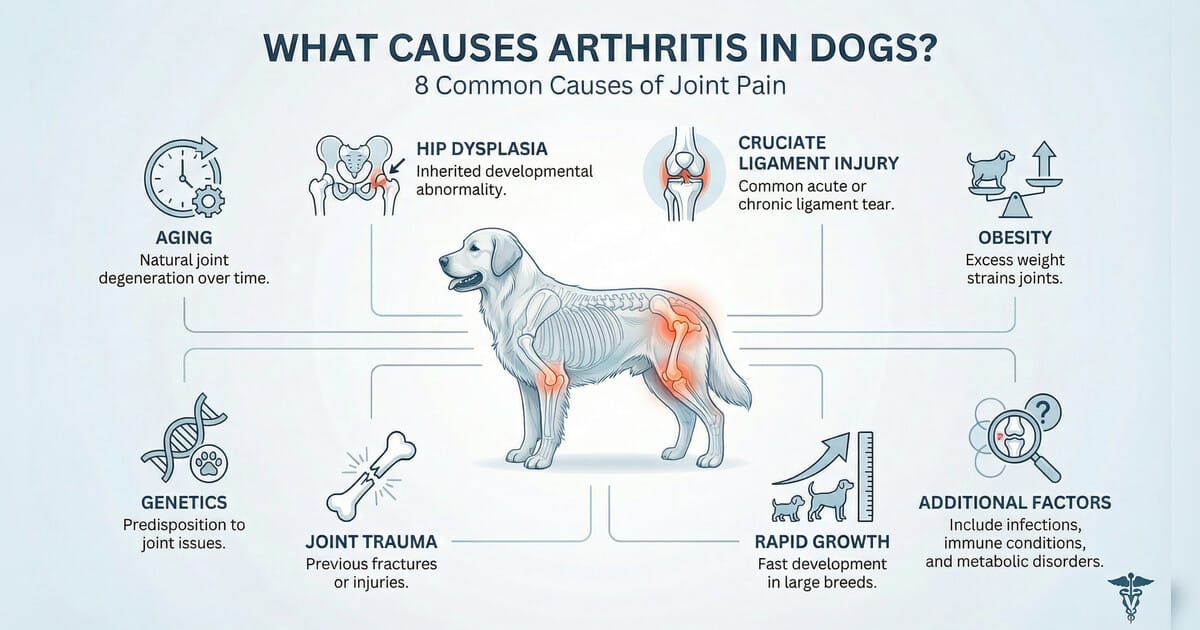
Many dog owners ask what causes arthritis in dogs when they notice stiffness or limping. In most cases, arthritis develops when joint cartilage slowly breaks down due to aging, joint instability, injury, obesity, or inherited joint problems like hip dysplasia or elbow dysplasia.
The usual chain looks like this:
joint instability or extra pressure → cartilage damage → inflammation → osteoarthritis over time
Some risks, such as age and genetics, cannot be changed. Others, like excess weight and repeated joint strain, can increase stress on a dog’s joints and speed up degeneration.
Understanding the underlying cause helps explain why arthritis is more common in older dogs but can also affect younger dogs with joint problems or past injuries.
Table of Contents
Quick Answer Box
What causes arthritis in dogs?
Arthritis in dogs develops when a joint becomes unstable, overloaded, or damaged. Over time, this leads to cartilage breakdown and inflammation inside the joint.
The most common causes of arthritis in dogs include:
- Hip dysplasia (loose hip joint)
- Elbow dysplasia (abnormal elbow development)
- Cruciate ligament injury (unstable knee joint)
- Obesity (extra pressure and inflammatory effects)
- Aging (slower cartilage repair)
- Previous joint injuries or trauma
- Genetic predisposition
In most dogs, arthritis does not happen from one single cause. It develops gradually as joint stress builds over time.
Understanding Arthritis in Dogs
Arthritis is a joint disease that affects one or more joints. It causes pain, stiffness, and reduced movement. In dogs, the most common type is osteoarthritis, also called degenerative joint disease.
The Merck Veterinary Manual describes osteoarthritis as one of the most common chronic joint diseases in dogs.
Inside a healthy joint, smooth cartilage covers the ends of the bones. This cartilage works like a cushion. It helps the joint move easily and reduces friction.
When arthritis develops, this cartilage begins to wear down. The joint becomes less stable. Inflammation increases inside the joint capsule. Over time, the bones may rub more than they should. This leads to pain and stiffness.
In simple terms:
cartilage damage → inflammation → joint wear → arthritis
Arthritis usually develops slowly. However, it can progress faster if a dog has hip dysplasia, elbow dysplasia, a cruciate ligament injury, or excess body weight.
Understanding how the joint changes helps explain why arthritis is considered a progressive condition rather than a sudden problem.
What Causes Arthritis in Dogs?
After understanding how arthritis affects a joint, the next question is why it starts in the first place.
In most dogs, arthritis develops when a joint experiences long-term stress or instability. This stress may come from structural problems, injuries, excess weight, or inherited joint conditions.
Some dogs are born with joints that do not fit together perfectly. Conditions such as hip dysplasia or elbow dysplasia change how weight is distributed inside the joint. Over time, uneven pressure increases wear.
Other dogs develop arthritis after a cruciate ligament injury or joint trauma. When the knee becomes unstable, abnormal movement places strain on the joint surfaces.
Body weight also plays a major role. Extra weight increases mechanical load on hips, knees, and elbows. In addition, fat tissue can contribute to low-level inflammation that may worsen joint damage.
Age adds another layer. As dogs grow older, their ability to repair joint tissues slows. Small problems that once healed may gradually build up.
In short, arthritis usually develops from ongoing joint stress rather than a single cause. The condition worsens over time as joint damage increases. The next sections explain each pathway clearly using simple cause chains.
8 Common Causes of Arthritis in Dogs
Arthritis usually develops over time due to one or more underlying factors. In most cases, one or more joint problems slowly lead to cartilage damage and inflammation. Below are the most common causes of arthritis in dogs. Each one affects the joint in a different way.
Aging and Slower Joint Repair
As dogs age, joint cartilage becomes thinner and less resilient. The body also repairs tissue more slowly. Small amounts of wear that once healed may gradually build up.
Over time:
aging → slower cartilage repair → cumulative damage → osteoarthritis
This is why arthritis in older dogs is common. However, age usually works together with other factors, not alone.
Hip Dysplasia
Hip dysplasia happens when the hip joint is loose or does not fit properly. This instability creates uneven pressure inside the joint.
hip dysplasia → unstable hip → abnormal rubbing → cartilage loss → arthritis in the hips
This condition is a common pathway to osteoarthritis, especially in larger breeds.
Elbow Dysplasia and Other Joint Malformations
When a joint does not form correctly, the surfaces do not move smoothly. Abnormal contact increases early wear.
elbow dysplasia → uneven joint contact → cartilage injury → chronic inflammation → arthritis
Dogs with developmental joint disease may develop arthritis earlier than expected.
Cruciate Ligament Disease (ACL/CCL Injury)
According to the American College of Veterinary Surgeons (ACVS), cranial cruciate ligament disease is a common cause of secondary arthritis in dogs.
The cruciate ligament stabilizes the knee joint. When it degenerates or tears, the knee becomes unstable.
cruciate ligament damage → unstable knee → abnormal motion → rapid cartilage damage → osteoarthritis
Even if the injury happens suddenly, joint instability can lead to long-term arthritis.
Previous Injuries or Joint Trauma
Fractures, severe sprains, or joint dislocations can permanently affect joint surfaces.
joint trauma → cartilage damage → persistent inflammation → post-traumatic arthritis
Some dogs develop arthritis years after an old injury.
Obesity and Excess Body Weight
Excess weight affects joints in two ways.
First, extra body weight increases mechanical pressure:
extra weight → higher joint load → faster cartilage wear
Second, fat tissue can contribute to inflammatory signals:
increased body fat → inflammatory mediators → worsened joint damage
Because weight is modifiable, it is one of the most important risk factors.
Genetics and Breed Predisposition
Some dogs inherit joint structures that increase instability or abnormal loading.
genetic predisposition → joint imbalance → early cartilage breakdown → arthritis
Some breeds, especially larger dogs, may have a higher risk due to inherited joint structure.
Rapid Growth and Early Joint Stress
In puppies with genetic risk, rapid growth may increase joint strain. Overfeeding during growth can amplify underlying instability.
genetic predisposition + rapid growth → increased joint stress → earlier cartilage damage → higher arthritis risk.
This does not mean growth alone causes arthritis. It may worsen existing structural vulnerabilities.
These causes often overlap. For example, a large breed dog with hip dysplasia and excess weight may experience faster joint degeneration than a dog with only one risk factor.
The next section will explain how primary and secondary arthritis differ.
Primary vs Secondary Arthritis in Dogs
After understanding the common causes, it helps to know that arthritis in dogs can be grouped into two main types: primary and secondary. This distinction explains why some dogs develop arthritis slowly with age, while others develop it after another joint problem.
Primary Arthritis
Primary arthritis develops mainly due to age-related joint wear. Over time, cartilage naturally loses resilience. Repair processes slow down. Small amounts of joint stress gradually accumulate.
age-related cartilage wear → gradual joint deterioration → osteoarthritis
This form is more common in senior dogs. It usually affects multiple joints and progresses slowly.
Secondary Arthritis
Secondary arthritis happens when another joint problem leads to instability or abnormal pressure. In dogs, this is very common.
Examples include:
- hip dysplasia
- elbow dysplasia
- cruciate ligament disease
- patellar luxation
- joint trauma or fractures
In these cases, the underlying condition changes how the joint moves or bears weight.
underlying joint disease → instability or uneven loading → cartilage damage → inflammation → osteoarthritis
Secondary arthritis can develop earlier in life if the original joint problem appears in puppyhood or young adulthood.
In practice, many dogs show a mix of both types. A dog with hip dysplasia may also experience age-related changes later. This overlap explains why arthritis is considered a progressive and multifactorial joint disease.
Understanding whether arthritis is primary or secondary helps explain why identifying the underlying cause is important during veterinary evaluation.
Risk Factors That Increase Arthritis in Dogs
Some dogs have a higher chance of developing arthritis because of certain risk factors. A risk factor does not directly cause arthritis on its own. Instead, it increases stress on the joint or raises the chance of joint instability over time.
Age
Age is one of the strongest risk factors for arthritis in dogs. Understanding what age dogs get arthritis can help explain why joint problems often appear later in life. As dogs grow older, cartilage repair slows down, and small joint stresses that once healed may gradually accumulate.
Older dogs are therefore more likely to show signs of osteoarthritis, especially if other joint problems are present.
Obesity and Excess Body Weight
Excess weight places extra pressure on hips, knees, elbows, and the spine. This mechanical load increases strain on cartilage.
Body fat can also release inflammatory signals. These inflammatory mediators may worsen joint damage over time.
Because weight management is controllable, maintaining a healthy body weight is one of the most important protective steps.
Breed and Genetics
Certain breeds are predisposed to orthopedic conditions such as hip dysplasia or elbow dysplasia. Large breed dogs often carry higher joint loads.
Genetic structure → abnormal joint alignment or instability → increased cartilage stress → higher arthritis risk
This does not mean every dog of a breed will develop arthritis. It means some dogs start with higher structural risk.
Previous Joint Injury
Dogs that have had a cruciate ligament tear, fracture, or severe joint trauma have an increased chance of secondary arthritis.
Injury → altered joint mechanics → uneven pressure → cartilage breakdown
Even after healing, the joint may never move exactly the same way.
Rapid Growth in Large Breed Puppies
Rapid growth during early development can increase stress on joints that are already genetically vulnerable.
In large breeds, excessive weight gain during growth may amplify underlying joint laxity. This increases long-term arthritis risk.
Activity Patterns and Repeated Strain
Repetitive high-impact activities over long periods may increase joint stress. Dogs that jump frequently or exercise intensely on hard surfaces may place additional strain on their joints.
Balanced exercise supports joint health, but uneven or excessive strain may contribute to earlier degeneration.
Most dogs with arthritis have more than one risk factor. For example, a large breed dog with excess weight and a past cruciate ligament injury faces compounded joint stress.
Understanding these risk factors helps explain why arthritis develops in some dogs earlier than others.
Can Young Dogs or Puppies Get Arthritis?
Yes, young dogs and even puppies can develop arthritis. Although arthritis is more common in older dogs, age is not the only factor.
When people ask what causes arthritis in young dogs, the answer often relates to joint structure or injury rather than simple aging.
In most cases, arthritis in younger dogs develops due to underlying structural problems or ligament injuries.
Developmental Joint Problems
Some puppies are born with joint conditions such as hip dysplasia or elbow dysplasia. These problems affect how the joint fits and moves.
joint malformation → uneven pressure → early cartilage damage → osteoarthritis
Because the joint is unstable from the start, damage can begin at a young age. Signs may not appear immediately, but the process can start early.
Cruciate Ligament Disease in Young Dogs
Young, active dogs can experience cruciate ligament injuries. When the knee becomes unstable, joint stress increases quickly.
cruciate ligament damage → knee instability → rapid cartilage wear → arthritis
In these cases, arthritis develops as a secondary condition after joint instability.
Rapid Growth in Large Breed Puppies
Large breed puppies grow quickly. If a puppy has genetic predisposition to joint laxity, rapid growth may increase stress on the joints.
genetic risk + rapid growth → increased joint strain → higher arthritis risk
Growth alone does not cause arthritis. It may worsen an underlying structural issue.
Injury or Trauma
Fractures, severe sprains, or joint trauma during puppyhood can damage cartilage. Even if the dog appears to recover, long-term joint changes may occur.
cartilage injury → persistent inflammation → early osteoarthritis
Arthritis in young dogs is usually linked to developmental joint disease, injury, or inherited factors. It is less commonly caused by natural wear alone.
Understanding this difference helps explain why arthritis can affect dogs of any age, even though it is more common in senior dogs.
When Arthritis Appears Suddenly in Dogs
Many owners feel confused when their dog seems fine one week and then starts limping the next. Learning how to recognize early joint pain signs can help identify these early warning signs. They often ask if arthritis can come on suddenly.
In most cases, arthritis does not appear overnight. The joint damage usually builds slowly over time.
What changes suddenly is the symptom, not the disease.
Flare-Ups of Existing Arthritis
A dog may already have early osteoarthritis without obvious signs. Then a small trigger makes the pain more noticeable.
Common triggers include:
- increased activity such as intense play or running
- jumping or rough play
- slippery flooring
- cold weather
- minor strain on an already weak joint
existing joint damage → extra stress → increased inflammation → visible limping
This is often called an arthritis flare-up. The underlying joint disease was already present.
Sudden Injury That Leads to Secondary Arthritis
Sometimes the problem truly starts with an injury, such as a cruciate ligament tear.
cruciate ligament rupture → knee instability → rapid cartilage damage → secondary arthritis
In this case, the injury happens suddenly, but arthritis develops as a result of joint instability. The instability is what drives the progression.
Infection or Inflammatory Conditions (Less Common)
In rare cases, septic arthritis or immune-related joint disease can cause rapid swelling and pain.
infection or immune reaction → intense joint inflammation → joint damage
These situations require prompt veterinary evaluation because they differ from typical degenerative joint disease.
Why It Feels Sudden
Dogs often hide pain well. Subtle stiffness may go unnoticed until inflammation increases enough to change movement.
early cartilage damage → mild discomfort → gradual compensation → noticeable limping later
So when arthritis seems to appear suddenly, it is often the first visible sign of a problem that has been developing quietly.
If a dog shows sudden lameness, swelling, or severe pain, a veterinarian should assess the joint to determine the underlying cause.
Early Signs That Arthritis May Be Developing
Arthritis usually develops slowly. The early signs can be subtle and easy to miss. Many dogs adjust their movement before owners notice a clear problem.
The most common early signs relate to stiffness and mild changes in mobility.
Mild Stiffness After Rest
One of the first changes is stiffness after lying down or sleeping. A dog may rise slowly, stretch longer than usual, or hesitate before walking.
early cartilage wear → mild inflammation → temporary stiffness after rest
The stiffness may improve after a few minutes of movement.
Slight Limping or Favoring a Leg
Some dogs begin to shift weight away from an uncomfortable joint. Limping may appear after exercise or long walks.
joint discomfort → uneven weight bearing → subtle limp
In early stages, the limp may come and go.
Reluctance to Jump or Climb Stairs
Dogs with developing arthritis may hesitate before jumping onto furniture or climbing stairs.
joint pain → reduced range of motion → hesitation with elevation changes.
Owners may notice the dog taking stairs more slowly or avoiding them altogether.
Reduced Activity or Playfulness
A normally active dog may seem less eager to run or play. This change is often gradual.
mild joint discomfort → decreased activity → lower exercise tolerance
This is sometimes mistaken for simple aging, especially in middle-aged dogs.
Behavioral Changes
Chronic discomfort can affect behavior. Some dogs become irritable, restless, or less tolerant of touch around affected joints.
persistent low-level pain → behavior changes.
These early signs do not confirm arthritis on their own. However, when several changes appear together, it may suggest developing joint disease.
Because early signs can be subtle, noticing small changes in movement is important. Persistent limping, stiffness, or reduced mobility should be evaluated by a veterinarian to determine the underlying cause.
Can Arthritis in Dogs Be Prevented?
Arthritis cannot always be completely prevented. Some risk factors, such as age and genetics, cannot be changed. However, certain steps may help reduce joint stress and lower the risk of developing severe osteoarthritis.
Prevention focuses on protecting joint structure and reducing long-term strain.
Maintain a Healthy Body Weight
Excess body weight increases pressure on hips, knees, elbows, and the spine.
extra weight → increased joint load → faster cartilage wear → higher arthritis risk
Keeping a dog at a healthy weight is one of the most important protective measures. Weight management reduces mechanical strain and may help limit inflammation linked to excess fat tissue.
Support Healthy Growth in Puppies
Large breed puppies should grow at a steady, controlled rate. Rapid growth combined with genetic predisposition can increase joint stress.
genetic vulnerability + rapid growth → joint strain → higher long-term risk
Balanced nutrition and proper portion control during growth may reduce excessive strain on developing joints.
Prevent Repeat Joint Injuries
Joint trauma increases the likelihood of secondary arthritis later in life.
injury → altered joint mechanics → uneven pressure → cartilage deterioration
Preventing slips on smooth flooring, avoiding repetitive high-impact activity, and supervising rough play may help protect joint stability.
Provide Balanced Exercise
Regular exercise supports muscle strength and joint stability. Strong muscles help support the joint and distribute weight more evenly.
healthy muscle support → improved joint stability → reduced stress on cartilage
However, excessive strain or repetitive impact over long periods may increase wear.
Early Veterinary Evaluation
If a dog shows persistent stiffness, limping, or reduced mobility, early veterinary examination can help identify underlying joint problems.
Identifying conditions such as hip dysplasia or cruciate ligament disease early may allow better long-term joint management.
While arthritis cannot always be avoided, reducing mechanical stress and managing controllable risk factors may help delay onset and slow progression.
FAQ Section
What causes arthritis in dogs?
Arthritis in dogs usually develops when a joint becomes unstable, overloaded, or damaged over time. Common causes include hip dysplasia, elbow dysplasia, cruciate ligament injury, obesity, genetics, and aging. These factors increase stress on the joint and lead to cartilage breakdown and inflammation.
What causes arthritis in young dogs?
In younger dogs, arthritis is usually linked to developmental joint problems or injury rather than aging. Conditions such as hip dysplasia or cruciate ligament damage can cause joint instability, which leads to cartilage damage and early osteoarthritis. Rapid growth in large breed puppies may increase stress on genetically vulnerable joints.
How do dogs get arthritis?
Dogs develop arthritis when repeated joint stress, injury, or structural joint problems cause cartilage to break down over time. As cartilage deteriorates, inflammation increases and the joint gradually develops degenerative joint disease.
Can arthritis in dogs come on suddenly?
Arthritis in dogs develops gradually over time. However, symptoms can seem to appear suddenly during a flare-up or after a joint injury. In these cases, existing joint damage becomes more painful or inflamed, leading to noticeable limping. Sudden lameness should be evaluated by a veterinarian to rule out other causes.
Can obesity directly cause or worsen arthritis in dogs?
Yes. Excess body weight increases mechanical pressure on a dog’s joints, especially the hips, knees, and elbows. Fat tissue can also release inflammatory signals that may worsen joint damage over time. Together, increased joint load and inflammation can speed up cartilage wear and arthritis progression. Maintaining a healthy body weight supports long-term joint health.
Can dogs get arthritis at any age?
Yes. Although arthritis is more common in senior dogs, it can affect dogs of any age. Puppies with inherited joint conditions and active young dogs with ligament injuries may also develop arthritis.
What age do dogs usually get arthritis?
There is no exact age. Many dogs show signs in middle age or later, especially larger breeds. However, dogs with hip dysplasia, elbow dysplasia, or cruciate ligament disease may develop arthritis earlier.
Is arthritis common in dogs?
Yes. Osteoarthritis is one of the most common joint diseases in dogs. Studies suggest a significant percentage of adult dogs show signs of degenerative joint disease, especially as they age.
Can previous injuries cause arthritis later?
Yes. Joint trauma, fractures, or ligament injuries can damage cartilage permanently.
joint injury → altered joint mechanics → post-traumatic arthritis
Arthritis may appear months or even years after the original injury.
Sources & References
The information in this article is based on established veterinary research and educational resources related to canine osteoarthritis and joint disease.
Peer-Reviewed Veterinary Research
Anderson KL, O’Neill DG, Brodbelt DC, et al. Prevalence, duration and risk factors for osteoarthritis in dogs under primary veterinary care in the UK. Available at: https://pmc.ncbi.nlm.nih.gov/articles/PMC7198754/
Goldring MB, Goldring SR. Osteoarthritis pathogenesis and cartilage degeneration mechanisms. Available at: https://pmc.ncbi.nlm.nih.gov/articles/PMC1003936/
These studies support the understanding that osteoarthritis in dogs is commonly linked to developmental joint disease, ligament instability, obesity, age-related degeneration, and chronic inflammation.
Veterinary Educational Resources
Eascor Animal Hospital. Why Is Arthritis in Dogs So Common?
https://eascoranimalhospital.com/pet-pain-management-in-flint-mi/why-is-arthritis-in-dogs-so-common/
Merck Veterinary Manual. Osteoarthritis in Dogs.
Cornell University College of Veterinary Medicine. Canine Osteoarthritis Overview.
American College of Veterinary Surgeons (ACVS). Cranial Cruciate Ligament Disease and Joint Disorders in Dogs.
VCA Animal Hospitals. Arthritis and Degenerative Joint Disease in Dogs.
These resources provide clinically reviewed explanations of:
- hip dysplasia and elbow dysplasia
- cruciate ligament disease
- degenerative joint disease
- risk factors such as obesity and age
- mechanisms of cartilage deterioration and joint inflammation
All explanations in this article are educational in nature and reflect current veterinary understanding of canine arthritis and joint health.
What to Do Next
Understanding what causes arthritis in dogs helps explain how joint problems develop over time.
If your dog is showing stiffness, limping, or reduced activity, the next step is to understand how these symptoms appear and progress.
To recognize early warning signs, see early signs of arthritis in dogs.
If symptoms continue or worsen, a veterinary check is the safest next step.
Update Note
This article was updated in April 2026 to improve clarity, accuracy, and alignment with current veterinary guidance on arthritis causes and joint health.