
TL;DR
The stages of arthritis in dogs describe how joint damage slowly worsens over time. Veterinary medicine commonly describes four stages, starting with mild cartilage changes and progressing to severe joint degeneration.
In the early stages, the joint may show subtle inflammation and minor cartilage wear. Dogs may appear slightly stiff after rest. As the disease progresses, cartilage continues to break down and the joint becomes less stable.
The typical progression looks like this:
cartilage damage → joint inflammation → reduced cushioning → bone changes → severe degenerative joint disease
In the final stages, cartilage may wear away almost completely. This can lead to bone-on-bone contact, significant pain, and reduced mobility. Understanding these stages helps pet owners recognize changes in movement and know when to consult a veterinarian.
Quick Answer Box
What are the 4 stages of arthritis in dogs?
Veterinary medicine commonly describes four stages of arthritis in dogs based on how much damage has developed inside the joint. Arthritis is a progressive joint disease, meaning it usually worsens gradually over time.
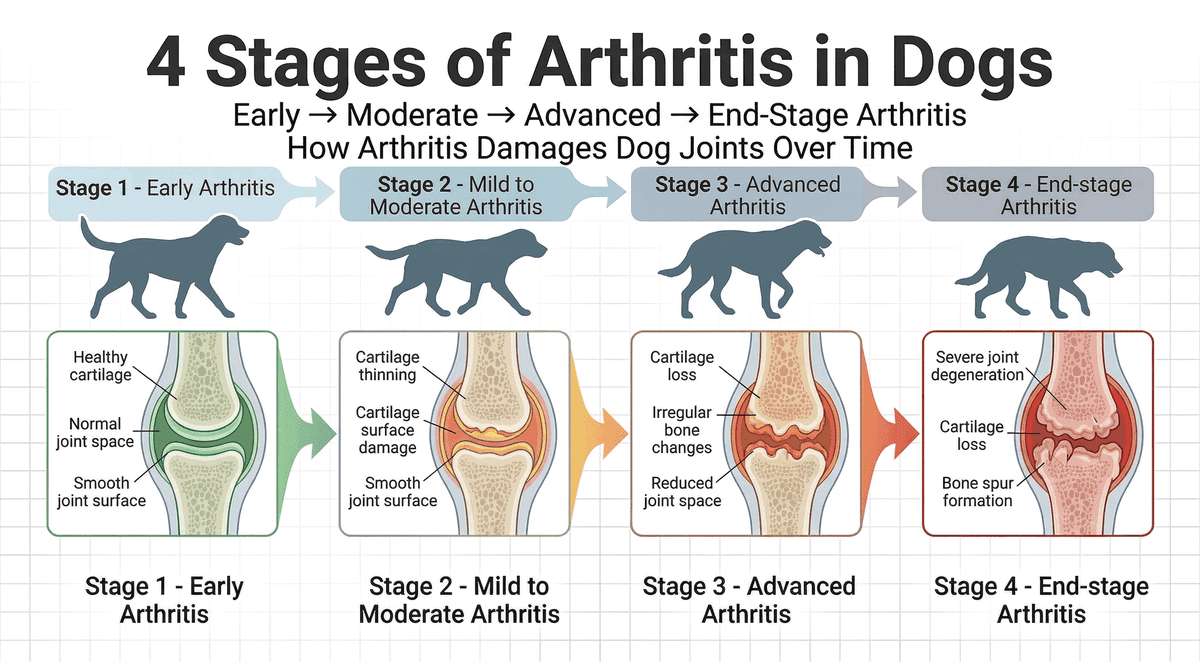
The four stages of arthritis in dogs are:
- Stage 1 – Early arthritis
- Stage 2 – Mild to moderate arthritis
- Stage 3 – Advanced arthritis
- Stage 4 – End-stage arthritis
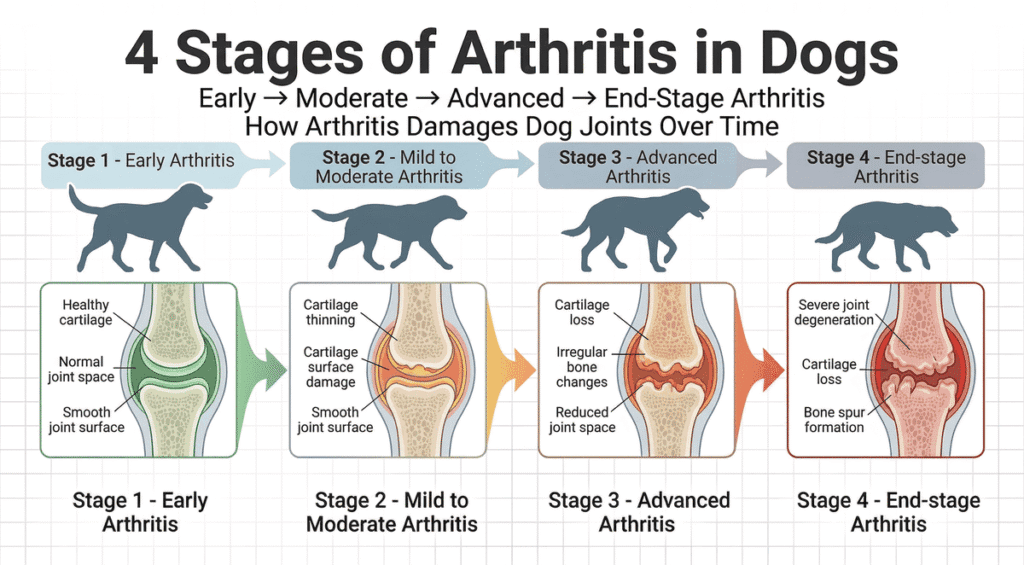
The diagram below shows how joint damage progresses through the four stages.
In This Guide (Table of Contents)
The four stages of arthritis in dogs include:
- Stage 1 — Early arthritis (mild cartilage damage and subtle stiffness)
- Stage 2 — Mild to moderate arthritis (cartilage wear increases and limping may appear)
- Stage 3 — Advanced arthritis (significant cartilage loss and reduced mobility)
- Stage 4 — End-stage arthritis (severe joint degeneration and major mobility problems)
| Stage | What Happens in the Joint | What Owners May Notice |
| Stage 1 – Early arthritis | Mild cartilage damage begins. Early joint inflammation may develop. | Subtle stiffness after rest, slight change in movement |
| Stage 2 – Mild to moderate arthritis | Cartilage wear increases and joint inflammation becomes more noticeable | Occasional limping, slower movement, hesitation to jump or climb stairs |
| Stage 3 – Advanced arthritis | Significant cartilage loss and new bone formation may occur. Joint movement becomes limited | Frequent limping, difficulty standing up, reduced activity and exercise tolerance |
| Stage 4 – End-stage arthritis | Severe degenerative joint disease with possible bone-on-bone contact | Major mobility problems, chronic pain, difficulty walking or climbing stairs |
In many dogs, arthritis develops through this chain:
joint stress → cartilage damage → inflammation → joint degeneration → severe osteoarthritis
The speed of progression can vary. Factors such as age, joint structure, body weight, and previous joint injury may influence how quickly arthritis advances.
Understanding the Stages of Arthritis in Dogs
Arthritis in dogs is usually a progressive joint disease. This means the condition tends to develop slowly over time rather than appearing all at once. The stages of arthritis in dogs describe how joint damage gradually increases as the disease advances.
In healthy joints, smooth cartilage covers the ends of bones. This cartilage acts like a cushion. It allows the bones to move smoothly without friction.
When arthritis develops, the cartilage begins to break down. As a result, the joint becomes inflamed and movement may become less comfortable.
The typical progression often follows this pattern:
cartilage damage → joint inflammation → reduced cushioning → joint degeneration
At first, these changes may be very mild. Many dogs continue to move normally during the early stages. Over time, however, the joint may lose stability and flexibility.
Several factors can influence how arthritis develops in dogs. These include age, joint structure, body weight, and previous joint injuries. Certain orthopedic conditions, such as hip dysplasia, may also increase stress on the joint.
Because arthritis progresses gradually, the stages help veterinarians describe how far the disease has advanced. Many dog owners begin researching the condition when they notice early changes in their dog’s movement. Understanding these stages helps explain why some dogs show only subtle stiffness, while others develop more noticeable mobility problems as the condition progresses.
What Happens Inside an Arthritic Joint
Arthritis develops when cartilage inside the joint gradually breaks down, causing inflammation, reduced cushioning, and structural changes in the bone.
To understand the stages of arthritis in dogs, it helps to know what happens inside the joint as the disease develops. Arthritis, often called canine osteoarthritis or degenerative joint disease, affects the structures that help a joint move smoothly.
A healthy joint contains several important parts. The ends of the bones are covered with smooth cartilage, and the joint is surrounded by fluid that helps reduce friction during movement. These structures protect the joint and support normal mobility.
When arthritis begins, the first changes usually involve cartilage damage. Cartilage may become softer and thinner. Small cracks can appear in the protective surface of the joint.
This early process often follows a chain like this:
joint stress → cartilage damage → joint inflammation
As the body responds to cartilage injury, the joint may become inflamed. Inflammation can affect the joint capsule, surrounding tissues, and synovial fluid. This reduces the smooth gliding movement that normally occurs between bones.
Over time, continued joint stress can cause additional structural changes. The body may produce new bone along the joint edges, a response sometimes seen in degenerative joint disease. At the same time, the joint may lose some of its cushioning.
This progression may look like:
cartilage thinning → inflammation → reduced cushioning → bone remodeling
As arthritis advances, the joint may become stiffer and movement can become more difficult. In later stages, cartilage may wear down significantly. In severe cases, bone-on-bone contact can occur, which is associated with more noticeable mobility problems.
These internal changes explain why arthritis is considered a progressive disease. The joint gradually loses its ability to move smoothly as the condition advances through different stages.
The 4 Stages of Arthritis in Dogs
The stages of arthritis in dogs describe how joint damage gradually worsens over time. Arthritis in dogs, often called canine osteoarthritis or degenerative joint disease, is considered a progressive disease. This means the condition typically develops slowly as joint structures change.
In many cases, the process follows a pattern like this:
joint stress → cartilage damage → joint inflammation → joint degeneration
Veterinary medicine commonly describes four stages to explain how the disease progresses inside a dog’s joints.
Stage 1 — Early Joint Changes
Stage 1 is the earliest stage of arthritis. At this point, the joint still functions relatively well, but small changes may already be developing.
Cartilage may begin to soften or develop tiny areas of damage. Mild joint inflammation may also appear inside the joint.
Dogs in this stage may show only subtle changes, which are often early signs of arthritis, such as:
- mild stiffness after rest
- slightly slower movement during long walks
- small changes in gait
Because these signs can be mild, many dogs continue normal activities during this stage.
Stage 2 — Mild to Moderate Arthritis
In the second stage, cartilage damage becomes more noticeable. The joint may begin losing some of its protective cushioning.
This stage develops as cartilage damage increases over time due to ongoing joint stress.
cartilage thinning → reduced cushioning → increased joint stress
Dogs may begin showing clearer dog arthritis signs, including:
- occasional limping
- hesitation when climbing stairs
- reduced enthusiasm for exercise
Movement may still appear normal at times, but stiffness can become easier to notice.
Stage 3 — Advanced Joint Degeneration
Stage 3 represents advanced arthritis. At this point, significant cartilage loss may occur and the body may begin forming new bone around the joint.
These bone changes are part of the body’s response to chronic joint stress.
Common changes in dogs may include:
- frequent limping
- difficulty rising from rest
- reduced range of motion
- decreased activity levels
Dogs may also begin losing muscle mass around the affected joint because movement becomes uncomfortable.
Stage 4 — End-Stage Arthritis
Stage 4 is considered end-stage arthritis. In this stage, cartilage may be almost completely worn away.
Without cartilage, the bones inside the joint may move directly against each other. This is often described as bone-on-bone contact.
Dogs in this stage may show more noticeable mobility problems such as:
- difficulty walking or climbing stairs
- reluctance to stand after lying down
- reduced daily activity
This stage represents severe degenerative joint disease, which can affect a dog’s mobility and overall comfort.
Not every dog progresses through these stages at the same speed. Factors such as age, joint structure, body weight, and underlying orthopedic conditions can influence how arthritis develops.
How the Stages Affect Movement
As arthritis progresses, the stages of arthritis in dogs begin to affect how a dog moves and uses its joints. Because arthritis is progressive, mobility changes usually appear gradually rather than all at once.
In the early stages, movement changes may be very mild. As the disease advances, joint stiffness and discomfort can make everyday activities more difficult.
The progression often follows this pattern:
joint inflammation → reduced joint flexibility → altered movement → decreased mobility
Changes in Walking and Gait
One of the first things many pet owners notice is a change in the dog’s gait. The dog may walk more slowly or move more carefully.
Some dogs may show:
- a stiff gait, especially after resting
- shorter steps while walking
- occasional limping
These changes often happen because the dog is trying to reduce pressure on painful joints.
Difficulty With Everyday Activities
As arthritis advances, certain movements may become harder for the dog.
- Common changes can include:
- hesitation when climbing stairs
- difficulty jumping onto furniture
- reluctance to go on long walks
Dogs may also move more cautiously on slippery floors, where joints must work harder to maintain balance.
Reduced Range of Motion
Joint inflammation and cartilage loss can reduce the joint’s ability to move normally. Over time, this may lead to a decreased range of motion in affected joints.
For example, a dog with arthritis in the back legs may have difficulty extending or bending the joint fully. This can make standing up, turning, or climbing stairs more challenging.
Muscle Loss Around the Joint
When a joint becomes painful, many dogs naturally move less. Reduced activity can lead to muscle atrophy, which means the muscles around the joint gradually lose strength.
muscle loss → weaker joint support → increased joint stress
This can further affect mobility, especially in senior dogs or dogs with advanced arthritis.
Because arthritis affects each dog differently, mobility changes may vary. Observing gradual changes in movement can help pet owners recognize how arthritis stages influence a dog’s comfort and daily activity.
How Veterinarians Identify Arthritis Stages
Veterinarians use several methods to understand how far arthritis in dogs has progressed. Because the stages of arthritis in dogs describe changes inside the joint, identifying the stage usually involves evaluating both joint structure and movement.
In many cases, the process includes a physical examination, mobility assessment, and diagnostic imaging.
Physical Examination
The first step often takes place during a visit to a veterinary clinic. A veterinarian gently examines the dog’s joints to look for signs of stiffness, swelling, or discomfort.
During this examination, the veterinary team may check:
- joint flexibility
- swelling around the joint
- decreased range of motion
- areas where the dog reacts to pressure
These observations can provide clues about how much the joint may be affected.
Observing Movement and Gait
Veterinarians also watch how the dog moves. This helps identify mobility changes that may occur as arthritis progresses.
They may look for signs such as:
- limping while walking
- a stiff gait after rest
- shifting weight away from a painful joint
- difficulty rising or turning
Changes in dog behavior or movement patterns can help indicate how the condition is affecting daily activity. Early stages may show as stiffness after lying down before more obvious limping develops.
Diagnostic Imaging
In many cases, veterinarians use imaging tools such as X-rays to examine the joint more closely. Imaging can help reveal structural changes that occur during degenerative joint disease.
These changes may include:
- cartilage loss
- new bone formation around the joint
- narrowing of the joint space
Such findings help veterinarians better understand the severity of joint degeneration.
Combining Multiple Observations
Arthritis stages are usually identified by combining several types of information:
joint examination → movement assessment → imaging findings
Together, these observations help the veterinary team understand how the joint has changed and how arthritis may be affecting the dog’s mobility and comfort.
How Quickly Arthritis Progresses
Arthritis in dogs usually develops gradually over time. The speed of progression can vary depending on the dog’s age, joint condition, genetics, and overall health.
In many cases, arthritis follows a gradual pattern:
cartilage damage → joint inflammation → joint degeneration → reduced mobility
This process may take months or even years, especially in the early stages.
Why Progression Is Different in Every Dog
The stages of arthritis in dogs do not progress at the same speed for every dog. Some dogs may stay in early stages for a long time, while others develop more noticeable joint problems more quickly.
Several factors can influence progression, including:
- advancing age
- existing joint problems such as hip dysplasia
- repeated joint stress from activity or injury
- excess body weight placing pressure on the dog’s joints
Large and giant breeds may sometimes show faster joint degeneration because their joints carry greater mechanical load.
Early Stages May Be Difficult to Notice
During the early stages, changes inside the joint can develop before clear symptoms appear. Cartilage may slowly wear down while the dog still moves normally.
Because of this, many pet owners first notice arthritis when subtle signs begin to appear, such as:
- stiffness after rest
- reduced willingness for long walks
- slower movement when climbing stairs
These changes often reflect gradual joint inflammation and cartilage damage.
Progression in Later Stages
As arthritis advances, the joint may experience more structural change. In later stages, cartilage loss can lead to bone-on-bone contact, which may increase joint irritation and discomfort.
At this point, movement changes may become more visible, such as:
- persistent limping
- difficulty rising from lying down
- decreased activity or play
These mobility changes occur because the joint’s ability to move smoothly becomes more limited.
Why Monitoring Joint Changes Matters
Because arthritis is a progressive disease, observing gradual changes in mobility can help identify when joint health may be worsening.
If noticeable changes in movement or comfort appear, a veterinarian can evaluate the dog’s joints and determine what may be affecting mobility.
Early recognition helps owners notice joint pain before symptoms become severe.
Why Early Recognition Matters
Recognizing arthritis early can make a meaningful difference in a dog’s long-term joint health and comfort. Because arthritis is a progressive disease, changes inside the joint often begin before obvious symptoms appear.
Early recognition allows pet owners and veterinarians to better understand what may be affecting the dog’s joints and mobility.
In many cases, the progression follows a pattern such as:
joint stress → cartilage damage → joint inflammation → degenerative joint disease
Identifying arthritis earlier in this process can help protect the dog’s quality of life over time.
Early Changes Are Often Subtle
During the early stages of arthritis, signs may be mild and easy to overlook. A dog may still appear active but show small changes in movement or behavior.
- Common subtle signs may include:
- stiffness after resting
- slower movement when standing up
- reluctance to jump or climb stairs
- reduced interest in long walks
These small changes can sometimes indicate that joint inflammation or cartilage wear is beginning.
Preventing Further Joint Stress
When arthritis is recognized earlier, it becomes easier to reduce factors that may increase joint stress.
For example, veterinarians may suggest approaches that support joint health, such as:
- weight management to reduce pressure on the joints
- controlled gentle exercise to maintain mobility
- monitoring activity to avoid excessive joint strain
These steps may help maintain muscle strength and joint support, which are important for long-term mobility.
Supporting Long-Term Comfort
As arthritis progresses, joint degeneration can gradually affect how a dog moves and behaves. Early awareness helps pet owners observe changes in movement, gait, and comfort before they become more severe.
Because arthritis develops slowly in most dogs, recognizing early changes allows the veterinary team to evaluate the condition and discuss options that support the dog’s overall well-being.
Protecting mobility early can help maintain a dog’s daily activity, independence, and quality of life as the condition develops over time.
FAQ Section
What are the four stages of arthritis in dogs?
Arthritis in dogs is commonly described in four stages based on the amount of joint damage. Stage 1 involves mild cartilage changes and early inflammation. Stage 2 includes increased cartilage wear and occasional stiffness or limping. Stage 3 involves significant cartilage loss and reduced joint mobility. Stage 4 is end-stage arthritis, where severe joint degeneration and bone-on-bone contact may occur.
How quickly does osteoarthritis progress in dogs?
The progression of osteoarthritis in dogs varies depending on age, genetics, joint structure, body weight, and previous injuries. In many dogs, arthritis develops slowly over months or years as cartilage gradually breaks down and joint inflammation increases. Some dogs may remain in early stages for a long time, while others may develop more noticeable mobility changes more quickly.
How can someone tell if a dog’s arthritis is getting worse?
Worsening arthritis in dogs often leads to noticeable mobility changes. Signs may include more frequent limping, stiffness after resting, difficulty standing up, reduced willingness to walk or play, and decreased activity levels. As joint damage progresses, dogs may also show discomfort during movement or hesitation when climbing stairs or jumping.
How do veterinarians diagnose arthritis in dogs?
Veterinarians diagnose arthritis in dogs through a combination of physical examination, mobility assessment, and diagnostic imaging. During the exam, the veterinarian checks joint flexibility, swelling, and pain responses. Imaging tests such as X-rays may be used to identify cartilage loss, joint space narrowing, or bone changes associated with degenerative joint disease.
Should dogs with arthritis still go for walks?
In many cases, regular gentle exercise can help maintain mobility in dogs with arthritis. Short, controlled walks may support muscle strength and joint flexibility.
However, activity levels may vary depending on the dog’s condition. A veterinarian can help determine what type of exercise is appropriate for a dog experiencing joint discomfort.
Can arthritis symptoms appear suddenly in dogs?
Arthritis itself usually develops gradually. However, symptoms may sometimes appear suddenly during a flare-up or after increased joint stress.
For example:
existing joint damage → increased inflammation → sudden limping or stiffness.
A sudden change in movement may also be caused by injuries or other joint conditions. A veterinarian can evaluate the cause of sudden mobility changes.
How long can a dog live with advanced arthritis?
Many dogs live for years with arthritis when the condition is properly managed. While arthritis can affect mobility and comfort, it does not usually shorten a dog’s lifespan by itself.
The goal of arthritis care typically focuses on maintaining the dog’s quality of life, comfort, and mobility as the disease progresses.
Sources & References
The information in this article is based on veterinary medical references and educational materials related to canine osteoarthritis, degenerative joint disease, and joint health in dogs.
Key sources include:
Merck Veterinary Manual — Osteoarthritis in Dogs
https://www.merckvetmanual.com/musculoskeletal-system/lameness-in-dogs/osteoarthritis-in-dogs
American College of Veterinary Surgeons — Osteoarthritis in Dogs
https://www.acvs.org/small-animal/osteoarthritis
Cornell University College of Veterinary Medicine — Arthritis in Dogs
https://www.vet.cornell.edu/departments-centers-and-institutes/cornell-feline-health-center/health-information/arthritis
VCA Animal Hospitals — Arthritis and Degenerative Joint Disease in Dogs
https://vcahospitals.com/know-your-pet/arthritis-in-dogs
American Veterinary Medical Association — Osteoarthritis and Joint Disease in Pets
https://www.avma.org/resources-tools/pet-owners/petcare/osteoarthritis-pets
These sources explain how arthritis develops, progresses through stages, and affects joint structure and mobility in dogs.
Veterinary understanding of arthritis continues to evolve through ongoing research on joint degeneration, cartilage damage, and canine mobility disorders.
Soft CTA
Understanding the stages of arthritis in dogs helps pet owners recognize how joint problems develop and how mobility can gradually change over time.
Arthritis usually progresses slowly. Subtle movement changes, stiffness, or reduced activity may appear before more noticeable joint problems develop.
Learning how arthritis affects the dog’s joints, cartilage, and mobility can help owners recognize early signs and understand how the condition progresses.
If a dog begins showing stiffness, limping, or difficulty moving, a veterinarian can evaluate the joints and determine what may be affecting the dog’s mobility.
Readers who want to learn more can explore our guides on early signs of arthritis in dogs and what causes arthritis in dogs, which explain how joint problems begin and what changes may appear as arthritis develops.
For a broader explanation of arthritis causes, symptoms, and joint health in dogs, readers can explore the complete Dog Joint Pain Relief Guide, which explains how joint problems develop and how arthritis develops over time.
Update Note
This article was updated in March 2026 to improve clarity and help dog owners understand the stages of arthritis in dogs and how joint disease can gradually affect mobility and comfort.
Content on Dog Joint Relief Guide is reviewed periodically to ensure it reflects current veterinary knowledge about canine osteoarthritis, degenerative joint disease, and joint health in dogs.
As new veterinary research and clinical guidance become available, this article may be updated to improve clarity and accuracy for pet owners seeking reliable information.
Readers who notice persistent mobility changes, stiffness, or limping in their dog should consult a licensed veterinarian for proper evaluation and guidance.