
TL;DR
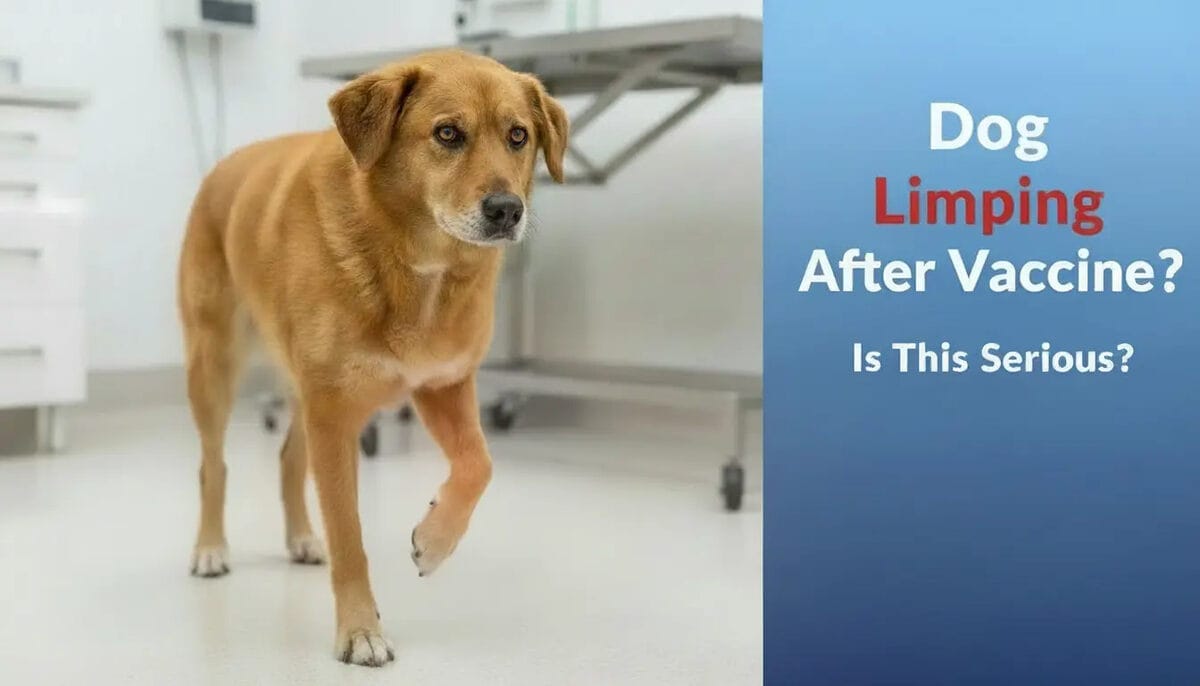
Dog limping after vaccine is usually caused by soreness at the injection site. This happens as the body reacts to the vaccine and creates mild inflammation.
- Most mild reactions improve within 24–48 hours
- Some dogs may show pain, swelling, or trouble walking after shots
- Limping can affect the front leg after vaccine where the shot was given
- Puppies may also show mild limping after shots due to sensitivity
Serious reactions are rare but need attention.
If limping gets worse, lasts more than 2 days, or the dog is not putting weight on the leg, a veterinarian should check the dog.
Quick Answer Box
Most cases of dog limping after vaccine resolve without any lasting issue, but knowing the difference between a normal reaction and a warning sign is what actually matters in the first day or two.
Common pattern:
vaccination → local immune response → mild inflammation at the injection site → temporary soreness → limping
What this means for owners:
- Limping that starts within a day of a shot and eases within 24–48 hours usually reflects a normal, mild reaction
- Limping that worsens, spreads beyond the injection-site leg, or comes with facial swelling or breathing trouble is not a normal reaction and needs prompt veterinary care
- Limping unrelated to a recent vaccine, or that doesn’t fit this pattern, may have a different cause — see why is my dog limping for the full picture
Even a normal reaction is worth watching closely for the first day or two, since it is the pattern over that window — not the limp itself — that tells you whether everything is on track.
Table of Contents
Dog Limping After Vaccine: Why It Happens
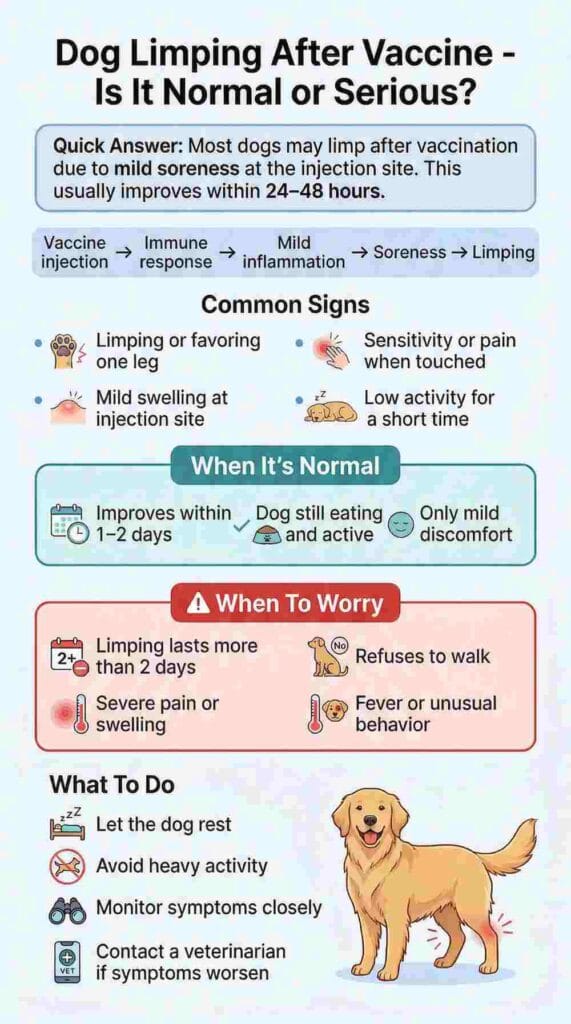
Here’s a quick way to tell if your dog’s symptoms are mild or serious:
| Symptom | Mild (Normal) | Serious (Warning) |
| Limping | Short-term | Persistent |
| Pain | Mild | Severe |
| Swelling | Small | Large |
| Activity | Slightly reduced | Cannot walk |
If your dog shows any serious symptoms, a veterinarian should evaluate them
Dog limping after vaccine happens because the body reacts to the shot. This reaction can cause soreness and discomfort in the leg.
Cause chain:
vaccination → immune response → inflammation at injection site → soreness → limping
Injection Site Soreness (Most Common)
The most common reason is soreness where the vaccine was given. The injection area can feel tender for a short time, which VCA Animal Hospitals lists as one of the most frequent normal reactions after vaccination.
This may lead to:
- dog leg sore after vaccines
- dog limping front leg after vaccine
The dog may avoid putting full weight on that leg due to discomfort.
Immune System Response
Vaccines activate the dog’s immune system. This helps protect against disease but can cause mild side effects.
Some dogs may show:
- mild fever
- low energy
- general discomfort
This temporary response can make movement uncomfortable, leading to limping.
Muscle Irritation From Injection
The vaccine is often given into muscle. This can irritate the muscle tissue for a short time.
This may cause:
- dog limping after intramuscular injection
- temporary stiffness
The stiffness usually improves as the muscle settles.
Puppy Limping After Multiple Vaccines (Combo Visits)
Puppies usually need more than one vaccine visit before they turn four months old. Vets space these visits two to four weeks apart, and each one often includes several vaccines at the same time, not just one — a schedule the American Animal Hospital Association outlines as standard practice, not a sign that anything is being rushed. Puppies are born with some protection from their mother, and that protection fades on its own schedule. Vets time the shots to fill the gap before it opens, and combining vaccines into fewer visits means less stress and fewer trips for both the puppy and the owner.
Because puppies often get more than one vaccine at once, their bodies sometimes respond more strongly than an adult dog’s would after a single annual booster. A puppy’s immune system hasn’t encountered these antigens before, so it can react more forcefully the first time. Adding several vaccines to one visit means more of that reaction happening at once, in a smaller body. Smaller and neutered puppies tend to show this more, since they carry a higher chance of a stronger response in the first place.
This helps explain something many owners notice but don’t expect: a puppy limping more, or seeming more worn out, than an adult dog did after its own shots. The pattern looks like this: a puppy’s immune system reacts to several new vaccines at once, that reaction is stronger than what one shot alone would cause, and the result is more noticeable soreness, limping, or tiredness than owners remember seeing in an older dog. It isn’t that something went wrong. It’s that more immune activity is happening in one visit, in a puppy whose body hasn’t built up any prior response to soften it.
A puppy recovering from a combo-vaccine visit usually looks a little different than usual for the rest of that day. Many puppies seem sleepier or less interested in playing. Some eat less than normal for a few hours, sometimes into the next day. Limping or a reluctance to run and jump can be more obvious than what an owner might expect from an adult dog’s post-vaccine soreness. A puppy may also cry out or flinch if the leg near the injection site is touched or picked up, since that spot is naturally more tender right after the shot.
Most of this settles on its own. Sleepiness, a smaller appetite, and mild soreness or limping that stay steady and don’t get worse over the first 24 to 48 hours usually just need time and a quiet day at home. If a puppy’s appetite loss or low energy carries on past 48 hours, or the limping still isn’t improving by the second or third day, that’s worth a call to the vet rather than more waiting. Some signs point to something beyond normal recovery and need same-day attention: facial swelling, hives, vomiting, diarrhea, sudden weakness, or trouble breathing. Puppies can go downhill faster than adult dogs in these situations, since they have less reserve to draw on and can become dehydrated more quickly, so these signs are never something to sit on and watch.
Common Vaccine Reactions in Dogs
Dogs can show different reactions after vaccination. Most are mild and short-lived, but some need closer attention.
Mild and Normal Reactions
These reactions are common and usually improve within 1–2 days. They happen as the body builds protection.
Common signs include:
- soreness at the injection site
- mild swelling
- low energy or tiredness
- puppy limping after shots
Cause chain:
vaccine → immune response → mild inflammation → soreness → temporary limping
Moderate Reactions to Watch
Some dogs may show stronger discomfort. These signs should be monitored closely.
They may include:
- dog having trouble walking after shots
- visible discomfort when moving
- dog whining or crying
If these signs do not improve, a veterinarian should check the dog.
Rare but Serious Reactions
Serious reactions are uncommon but important to recognize early. They can develop quickly after
- vaccination.
- Warning signs include:
- severe allergic reaction
- facial swelling
- difficulty breathing
These symptoms need immediate veterinary care to keep the dog safe — the American Veterinary Medical Association identifies facial swelling and breathing difficulty as signs of a serious vaccine reaction requiring urgent attention. This kind of sudden, serious reaction is the same category covered in dog suddenly limping: when to take your dog to the vet.
Immediate vs Delayed Vaccine Reactions (Timeline)
Not every vaccine reaction follows the same timeline. Understanding when a reaction shows up can help tell a normal recovery from something that needs a closer look.
Most soreness starts within hours of the shot, not days later. Injection-site inflammation itself usually shows up about a day after vaccination and can last up to a week on its own. A true allergic-type reaction, if one is going to happen, typically starts within minutes to a few hours, though some owners don’t notice signs until up to eight hours afterward. That early window can stretch a little further too, with some allergic responses lingering for up to two days before settling.
A smaller number of dogs develop a different kind of reaction that doesn’t follow this early pattern at all. Rather than showing up within hours, it can take several days to appear, and in some documented cases has shown up anywhere from a few days to as long as six weeks after the shot, with most falling somewhere around the two-week mark, according to veterinary immunologist Dr. Jean Dodds. This type of delayed reaction has been linked to joint and blood-related immune responses rather than simple injection-site soreness. A case series published in the veterinary literature found that several dogs diagnosed with immune-mediated joint inflammation had been vaccinated somewhere between three and fifteen days earlier, averaging around eleven days before symptoms began.
These two patterns work through different mechanisms, not just different points on the same clock. An immediate reaction happens because the immune system activates right away at the injection site, causing quick, local inflammation that settles within a day or two if it’s a normal response. A delayed reaction works differently. It comes from a slower, cell-mediated immune process in a small number of dogs, one that doesn’t fully show itself until days or even weeks later. By the time it appears, the vaccine visit can feel like old news, which is exactly why owners often don’t connect the two.
This distinction matters for deciding what to do next. Soreness or mild limping that starts the same day and eases within 24 to 48 hours fits the expected pattern and usually just needs monitoring. A firm, painless bump that shows up within a day and isn’t growing also fits this normal window. New limping, joint stiffness, or lethargy that shows up several days after the visit is different. Because a delayed onset is itself part of what makes this pattern unusual, it’s worth having a veterinarian take a look even if the symptoms themselves seem mild, rather than waiting to see if it resolves on its own the way same-day soreness typically does. Facial swelling, hives, vomiting, or trouble breathing within minutes to hours of the shot still call for same-day veterinary care, regardless of which timeline pattern the rest of the reaction seems to be following.
Types of Vaccines That May Cause Limping
Some vaccines are more likely to cause temporary soreness in the leg. This can lead to short-term limping after the shot.
Dog Limping After Rabies Shot
The rabies vaccine is often given in the leg muscle. This can cause soreness at the injection site.
Some dogs may show:
- stiffness in the leg
- mild pain when walking
- short-term limping
This usually improves within a day or two.
Dog Limping After Lepto Vaccine
The leptospirosis vaccine can sometimes cause stronger reactions than other vaccines, a pattern also noted by the American Animal Hospital Association. Some dogs may feel more discomfort after this shot.
Owners may notice:
- my dog is limping after lepto shot
- increased sensitivity in the leg
- mild swelling or soreness
Monitoring is important, especially in smaller or sensitive dogs.
Dog Limping After Lyme Vaccine
The Lyme vaccine may also cause temporary soreness. This can affect movement for a short time.
Common signs include:
- stiffness after the vaccine shot
- mild limping when walking
- reduced activity
Cause chain:
vaccine shot → local irritation → inflammation → soreness → limping
Front Leg vs Back Leg Limping After Vaccine
Limping can affect different legs depending on where the vaccine was given.
The location of the injection often explains the type of limping.
Front Leg Limping (Injection Site)
Front leg limping is common after vaccination. Many vaccines are given in the front leg muscle.
This may lead to:
- soreness at the injection site
- dog limping front leg after vaccine
- mild stiffness when walking
Cause chain:
injection → local soreness → inflammation → discomfort → limping
This type of limping is usually temporary and improves quickly. For a broader look at front-leg limping in general, not just after a vaccine, see why is my dog limping front leg.
Back Leg Limping (Less Common)
Back leg limping is less common after vaccines. It may happen due to body position or sensitivity.
Possible reasons include:
- posture changes after the shot
- temporary muscle discomfort
- sensitivity in the hind leg
If a dog shows strong back leg limping or avoids using the leg, a veterinarian should check the dog. A dog that won’t put weight on the leg at all fits the pattern covered in dog not putting weight on back leg.
What to Do If Dog Is Limping After Vaccine
If a dog shows limping after vaccination, simple steps can help keep the dog safe and comfortable.
The goal is to reduce stress on the leg and watch for any changes.
Step 1 – Limit Activity
The dog should avoid running, jumping, or rough play. Rest helps reduce strain on the sore leg.
This allows the body to recover from the vaccine reaction.
Step 2 – Monitor Symptoms Closely
The dog should be observed over the next 24–48 hours. Look for changes in movement, pain, or behavior.
Mild limping should improve during this time.
Step 3 – Check Injection Area
The injection site should be checked gently. Look for swelling, redness, or sensitivity.
A small lump or soreness can be normal after a shot.
Caring for Swelling at the Injection Site
A small lump at the injection site is one of the most common things owners notice after a vaccine, and in most cases it is a normal part of the body’s response rather than a problem on its own.
This kind of lump, sometimes called a vaccinal granuloma, forms because immune cells gather at the injection site as the body reacts to the shot. It usually shows up within 24 hours and feels firm, not soft or squishy. Most owners describe it as somewhere between the size of a coin and a golf ball. It can feel a little tender for the first day or two, but that tenderness should fade rather than get worse. Left alone, it typically shrinks on its own over one to three weeks.
Simple home care can help while it heals. Keep the area clean and dry, and stop the dog from licking or chewing at it, since a cone or e-collar can help if needed. It also helps to check the lump once a day, comparing its size to something familiar like a coin so any change is easier to notice. Veterinarian-reviewed guidance from PetMD notes that a warm compress for 10 to 15 minutes every 8 to 12 hours may help the swelling go down faster, but this should only be done if a vet has actually suggested it for your dog, not as something to try on your own first.
Not every lump follows the same path, and the difference matters. A normal vaccinal granuloma stays firm, doesn’t hurt much, and slowly shrinks over time. A lump caused by infection or a different kind of reaction behaves the opposite way. It tends to grow instead of shrink, feels warm or hot to the touch, turns red, and can become increasingly painful. These are two different outcomes from the same starting point, not two stages of the same thing, so a lump that’s getting bigger or more painful is not just “further along” in healing. It’s a sign that something else may be going on.
A lump that keeps growing, becomes more painful or warm, or is still there after about three weeks is worth a veterinary recheck. Some signs call for care the same day rather than waiting: swelling paired with facial puffiness, hives, vomiting, diarrhea, sudden weakness, or trouble breathing, or a lump that starts draining pus or blood. These go beyond typical post-vaccine swelling and need a vet’s attention right away.
Step 4 – Contact a Veterinarian If Needed
If limping does not improve or gets worse, a veterinarian should evaluate the dog. This is important if the dog has trouble walking after shots or avoids using the leg — see when to take your dog to the vet for limping for a fuller breakdown of these warning signs.
What Not to Do After a Dog’s Vaccine
Knowing what to avoid is just as helpful as knowing what to do. A few common mistakes can slow down recovery or, in some cases, cause a bigger problem than the vaccine reaction itself.
Activity is one of the easiest things to get wrong. A short, gentle walk to the bathroom is fine right after a vaccine visit. Running, jumping, rough play, or a trip to the dog park is not, and should wait about 24 to 48 hours. It’s easy to assume a dog that seems fine can go back to normal right away, only to notice the soreness get worse a little later once the activity has already happened. Pushing a sore leg and an already-active immune system too soon can add more stress on top of what the body is already dealing with, which can make limping or discomfort more noticeable than it would have been with a quieter day. Bathing is best held off for about a week to ten days too, since it can irritate the injection site while it’s still healing.
Medication is where mistakes can matter the most. Reaching for something from the medicine cabinet feels like the natural response when a dog seems uncomfortable, but human pain relievers like Tylenol, aspirin, and ibuprofen are not safe for dogs and can cause serious harm. The same goes for antihistamines or anti-inflammatory medication left over from a past prescription. These should only be given if a vet has specifically said to use them for this situation, at the dose the vet recommends. If a dog is ever given one of these by mistake, that’s worth a call to the vet or animal poison control right away, even if the dog seems okay in the moment.
A few other precautions round out the list. New puppies especially should avoid unvaccinated or unfamiliar dogs for about 10 to 14 days after a shot, since it takes time for full protection to build up. It’s an easy detail to forget in the excitement of a new puppy, but skipping a dog park visit or a meetup with an unknown dog for those two weeks is a simple way to avoid adding risk on top of a system that’s still catching up.
Can Limping After Vaccine Go Away on Its Own?
Dog limping after vaccine can go away on its own in many cases, and how long it takes usually depends on how mild or severe the reaction is.
Cause chain:
vaccine → mild inflammation → soreness → limping → recovery
A mild reaction typically improves within 24–48 hours, sometimes stretching to a few days, and the dog usually stays able to walk throughout. This is the most common pattern and needs nothing more than rest and monitoring.
A stronger reaction follows a different path. If the limping does not improve, the pain increases over time, or the dog starts avoiding the leg entirely rather than gradually walking better, VCA Animal Hospitals notes this points to something beyond ordinary post-vaccine soreness, and a veterinarian should evaluate the dog to ensure proper care.
If the limping continues beyond a few days without any real sign of improvement, that duration on its own is worth having the dog checked, even if nothing else seems dramatically wrong.
FAQ Section
Can a vaccine cause a dog to limp?
Yes, a vaccine can cause a dog to limp. This usually happens due to soreness at the injection site.
Cause chain:
vaccine → immune response → mild inflammation → soreness → limping
This is often temporary and improves within a short time.
Is it normal for my dog to limp after vaccines?
Yes, mild limping can be normal after vaccination. It usually improves as the soreness goes away. Ongoing or worsening limping needs veterinary attention.
How long does a puppy limp after shots?
A puppy may limp for 24–48 hours after shots. This is usually due to temporary soreness. If the limp lasts longer or worsens, a veterinarian should evaluate the puppy.
Why is my dog’s leg swollen after vaccination?
A normal lump, sometimes called a vaccinal granuloma, feels firm rather than soft, stays about the size of a coin to a golf ball, and slowly shrinks over one to three weeks. A lump that needs a vet check does the opposite: it grows instead of shrinking, feels warm, turns red, or becomes more painful over time.
Dog having trouble walking after shots — what does it mean?
This may mean the dog is feeling discomfort or soreness. It can also be a stronger reaction to the vaccine. If the dog struggles to walk or avoids movement, a veterinarian should assess the dog.
Dog limping after rabies vaccine — is it normal?
Mild limping after a rabies shot can be normal. It is often due to muscle soreness where the vaccine was given. If the limping lasts more than 1–2 days or gets worse, a veterinarian should check the dog.
How to treat dog leg pain after vaccination?
The dog should rest and avoid activity. The injection area can be monitored for changes. If pain continues or gets worse, a veterinarian should guide further care.
Why does my puppy seem worse after shots than my adult dog did?
Puppies often get several vaccines in one visit, while adult dogs usually get just one annual booster, so puppies deal with more immune activity all at once. Their immune systems also haven’t encountered these vaccines before, so the first reaction can be more noticeable than what an adult dog shows. This is expected and not a sign that anything went wrong, though a vet visit is worth it if the limping or tiredness carries on past a couple of days.
Is it normal for a puppy to get several vaccines at the same visit?
Yes, puppies typically get more than one vaccine in the same visit, spaced two to four weeks apart across multiple appointments before they turn four months old. This is standard practice that helps protect them before the immunity they got from their mother fades, and it also means fewer total trips to the vet.
Should I be more worried about a puppy limping than an adult dog limping after vaccination?
A puppy limping more visibly than an adult dog usually just reflects a stronger immune response to multiple vaccines at once, not a bigger problem. Puppies can decline faster than adult dogs if a reaction turns serious, though, since they have less reserve and can become dehydrated more quickly, so signs like facial swelling, vomiting, or trouble breathing call for same-day veterinary care regardless of age.
What are the symptoms of a delayed vaccine reaction in dogs?
A delayed vaccine reaction can show up as new limping, joint stiffness, or lethargy that appears several days after the shot rather than right away. In documented cases this has ranged from a few days up to six weeks later, though it most often shows up around the two-week mark. Because the timing itself is unusual, a veterinarian should evaluate any new symptoms that start this long after a vaccine, even if they seem mild.
How soon after a vaccine should limping start if it’s going to happen?
Normal, mild limping usually starts within hours of the shot, not days later, and typically eases within 24 to 48 hours. A true allergic-type reaction, if one happens, tends to start within minutes to a few hours, though some owners don’t notice it until up to eight hours afterward.
If my dog starts limping three or four days after a shot, is that still from the vaccine?
It’s possible. A smaller number of dogs develop a delayed reaction that doesn’t show up right away and can appear several days to weeks after the vaccine instead. Because a delayed onset like this is itself unusual, it’s worth having a vet take a look rather than assuming it will resolve the way same-day soreness typically does.
How do I bring down swelling in my dog’s leg after a shot?
For a normal, small, firm lump, keep the area clean and dry, stop the dog from licking or chewing it, and check its size once a day against something familiar like a coin. A warm compress for 10 to 15 minutes every 8 to 12 hours may help, but only if a vet has actually recommended it for your dog’s situation.
How long can I expect the swelling to last?
A normal post-vaccine lump typically shrinks on its own over one to three weeks. If it’s still present after about three weeks, or if it starts growing, becoming more painful, or feeling warm instead of shrinking, a veterinary recheck is worth scheduling.
What should I avoid doing after my dog gets a vaccine?
Avoid letting your dog do anything strenuous, like running, jumping, or visiting the dog park, for about 24 to 48 hours after the shot, and hold off on bathing for about a week to ten days. It’s also important to avoid giving human pain relievers like Tylenol, aspirin, or ibuprofen, since these can be toxic to dogs, and to skip antihistamines or leftover medication unless a vet has specifically approved them for this situation.
Is it okay to walk my dog after vaccines, and if so how soon?
A short, gentle walk to the bathroom is fine right after a vaccine visit. Running, jumping, rough play, or anything more strenuous should wait about 24 to 48 hours, since pushing a sore leg too soon can make the soreness more noticeable than it would be with a quieter day.
Can I give my dog anything for pain without asking the vet first?
No, human pain relievers like Tylenol, aspirin, and ibuprofen are not safe for dogs and can cause serious harm. Any antihistamine or anti-inflammatory medication should only be given if a vet has specifically approved it for this situation, and if a dog is ever given the wrong medication by mistake, that’s worth an immediate call to the vet or animal poison control.
Sources & References
- VCA Animal Hospitals – Care for Your Pet After Vaccination
https://vcahospitals.com/know-your-pet/care-for-your-pet-after-vaccination - American Veterinary Medical Association (AVMA) – Vaccinations for Pets
https://www.avma.org/resources-tools/pet-owners/petcare/vaccinations - Merck Veterinary Manual – Vaccine Adverse Events in Animals
https://www.msdvetmanual.com/pharmacology/vaccines-and-immunotherapy/vaccine-failure-and-other-adverse-events-in-animals - PDSA – Vaccination Reactions in Pets
https://www.pdsa.org.uk/pet-help-and-advice/pet-health-hub/symptoms/vaccination-reactions-in-pets - University of Minnesota – What to Expect After Your Pet’s Vaccines (PDF)
https://sirvs.umn.edu/sites/sirvs.umn.edu/files/2021-02/What%20to%20expect%20after%20your%20pet%27s%20vaccines.pdf - AAHA – Vaccine Reactions in Pets
https://www.aaha.org/your-pet/pet-owner-education/ask-aaha/vaccine-reactions/ - AAHA – Recommendations for Core and Noncore Canine Vaccines
https://www.aaha.org/resources/2022-aaha-canine-vaccination-guidelines/recommendations-for-core-and-noncore-canine-vaccines/ - WSAVA – Core Vaccines for Pet Dogs (PDF)
https://wsava.org/wp-content/uploads/2025/06/Dogs-Vaccination-Table.pdf - PMC / National Institutes of Health – Adverse Consequences of Vaccination
https://pmc.ncbi.nlm.nih.gov/articles/PMC7348619/ - PubMed – Changes in Blastogenic Responses and Delayed-Type Hypersensitivity After Vaccination in Dogs
https://pubmed.ncbi.nlm.nih.gov/1420577/ - Denver Animal Protection – What to Expect After Vaccination (PDF)
https://denvergov.org/content/dam/denvergov/Portals/682/documents/Vaccinations.pdf - PMC / National Institutes of Health – More Bumps on the Vaccine Road
https://pmc.ncbi.nlm.nih.gov/articles/PMC7149318/ - Hemopet / Dr. Jean Dodds – Adverse Vaccine Reactions (PDF)
https://www.runamokfarm.com/uploads/1/5/1/7/15176454/adversevaccreactionsdodds.pdf - PetMD – Treating Your Pet’s Vaccine-Associated Skin Swellings, Lumps, and Bumps
https://www.petmd.com/blogs/thedailyvet/patrick-mahaney/2014/april/treating-your-pets-vaccine-associated-skin-swellings-lu
What to Do Next
If a dog is limping after vaccination, it is often due to temporary soreness, but it should still be monitored closely to ensure it improves.
If the limp continues, gets worse, or the dog has trouble walking after shots, a veterinary check is the safest next step. For broader guidance on joint health and mobility support, see the dog joint pain relief guide.
Update Note
This article was reviewed and updated on August 15, 2026 to add new sections on puppy vaccine reactions, the difference between immediate and delayed vaccine reactions, home care for swelling at the injection site, and common mistakes to avoid after a vaccine visit. Several new questions were also added to the FAQ section to cover these topics in more detail. This article is for educational purposes only and is not a substitute for professional veterinary care. If your dog’s limping continues, worsens, or is accompanied by other symptoms, a veterinarian can help confirm the cause and recommend next steps.